


Mahogany Revolving Wine Table
A mahogany revolving wine table is a clever piece of Georgian or Victorian engineering designed to keep the bottle within easy reach.
Mahogany Revolving Wine Table
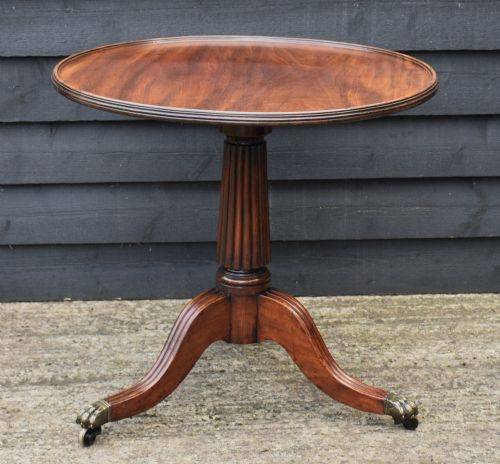
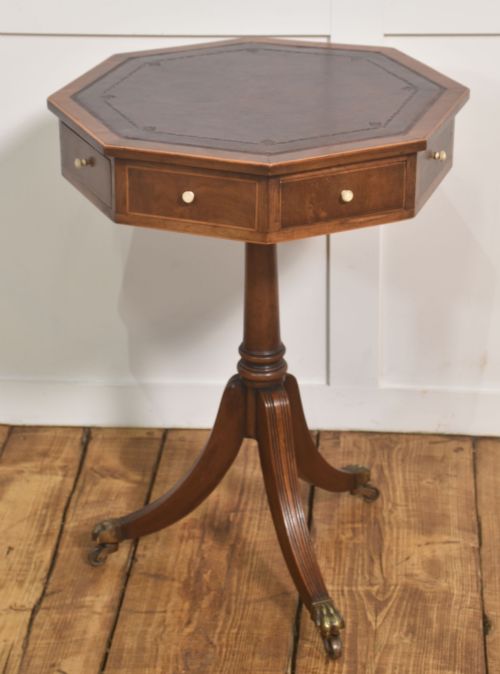
A mahogany revolving wine table brings together nimble domestic furniture and mechanical turning mechanisms, often taking the form of a tripod tea table or a drum table. When buyers search for a mahogany revolving wine table, they encounter items built across several centuries, from the mid-eighteenth century through the Victorian era and into later revivals.
The core utility lies in the revolving top or swivel action, which allows diners or guests to access bottles and glasses without standing up or passing heavy decanters across the board. The pieces on this page appear as occasional tables, tea tables, and dumbwaiters, maintaining a portable stature suited to sitting rooms and dining parlours.
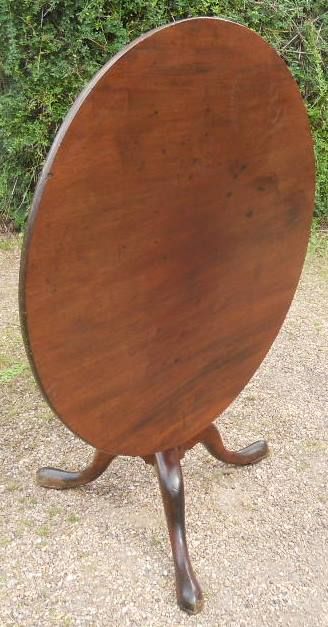
Victorian and Regency examples dominate the current selection, alongside older eighteenth-century Georgian specimens that show the evolution of the form. One often finds variations such as birdcage actions or drop-leaf surfaces that add versatility to the rotating mechanism.
How they were made
Makers relied on dense timber, principally mahogany supplemented by burr walnut, shaped into circular tops supported by robust central pillars and tripod legs. The wood is frequently polished to a deep lustre that highlights the natural grain of the timber.
Mechanical ingenuity defined the construction, incorporating brass fittings and pivoting joints that allowed the upper surface to turn smoothly on its base. Tripod bases provided stable footing on uneven floorboards, while clever hinging permitted folding or tilting tops in certain forms.
The listings span from the mid-eighteenth century to the late Victorian period, featuring mahogany, brass, leather, and burr walnut.
What varies in quality
The sophistication of the turning mechanism dictates much of the distinction between ordinary utility items and finer parlour furniture. A well-fitted pivot moves without excessive wobble, maintaining balance even when loaded with heavy glassware.
Proportion and timber selection set the better examples apart, as seen in the choice of figured mahogany or burr walnut veneers. Subtle details in the carving of the tripod legs and the crispness of the mouldings indicate the care invested by the original maker.
The Mahogany Revolving Wine Table Glossary
- Revolving top
- A surface mounted on a central pivot that allows the entire tabletop to spin horizontally. This feature made serving drinks easier in domestic settings.
- Tripod base
- A support structure comprising three legs radiating from a central pillar. It prevents rocking on uneven historical floors.
- Drum table
- A circular library or occasional table with a deep rim resembling a drum, frequently fitted with drawers or compartments. These often incorporate a rotating mechanism.
- Bird cage
- A timber framework beneath a tilt-top table that allows the surface both to rotate and to pivot vertically for storage. It represents a refined piece of eighteenth-century joinery.
- Dumbwaiter
- A tiered serving table, sometimes revolving, designed to hold dishes and wine bottles without the need for constant attendance by servants.
Mahogany Revolving Wine Table: Frequently Asked Questions
What is a revolving wine table?
A revolving wine table is a small occasional table featuring a rotating top designed to hold bottles and glasses within easy reach during social gatherings.
These pieces typically stand on a central tripod base and allow diners to spin the surface to access drinks without standing up.
How do I date a mahogany table?
Dating involves examining the construction methods, timber choice, and decorative styles characteristic of periods like the Georgian era or Victorian times.
Earlier eighteenth-century pieces often show hand-cut joinery and simpler timber preparation, whereas later nineteenth-century examples may display revival styling and different secondary woods.
Where were these tables placed?
Historically, these tables sat beside seating areas in drawing rooms, libraries, or dining parlours where guests gathered for tea or wine.
Their compact tripod footprint made them easy to move around the room as the company shifted position.
What is the difference between a tea table and a wine table?
Tea tables were generally designed to hold porcelain service for social gatherings, while wine tables often incorporated specific mechanisms or lower profiles suited to holding bottles.
Over time, the terms frequently overlapped as makers adapted circular pivoting tops for multiple domestic uses.