

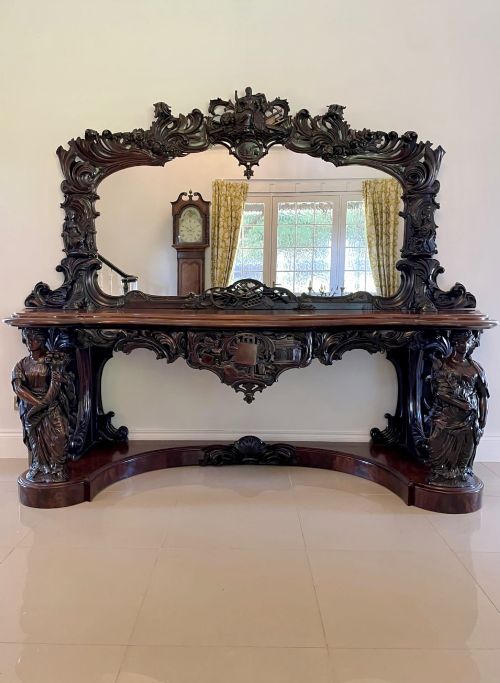
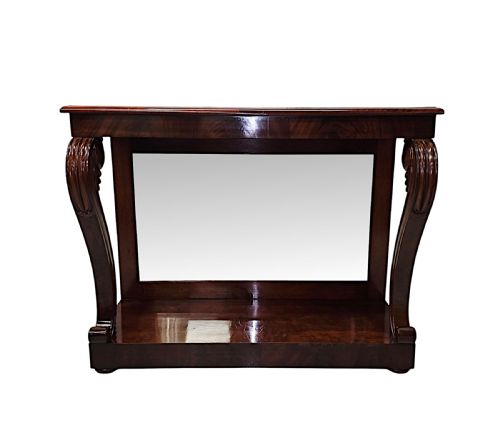
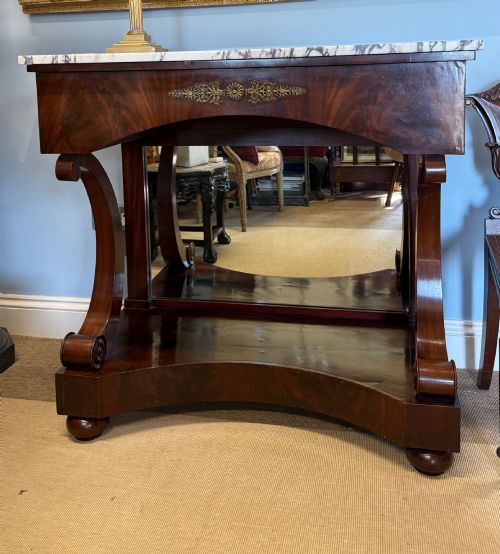


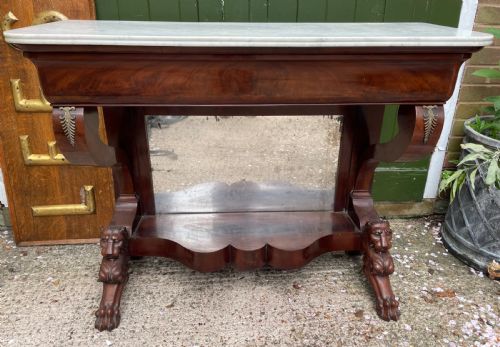


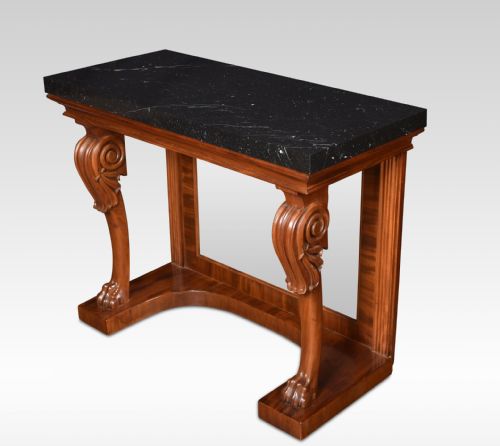
Mahogany Mirror Back Console
A mahogany mirror back console brings light and architectural weight to a room through deep wood grains and reflective glass.
Mahogany Mirror Back Console
A mahogany mirror back console combines a console table with an integrated mirror, appearing across the nineteenth century in Regency, Victorian, and French Empire styles. These pieces function primarily as statement furniture designed to sit against a wall in a hall or reception room, reflecting both natural light and the interior space.
The versions most commonly met on this page date from the nineteenth century, including specific regional variations such as Irish and French examples. Makers utilised figured timbers, notably flame mahogany, alongside marble and gilt bronze mounts to create striking visual focal points.
What varies in quality
Quality in a mahogany mirror back console rests largely on the selection of the timber veneers and the crispness of any carved ornamentation. Pieces displaying symmetrical flame mahogany figures and substantial marble slabs demonstrate superior craftsmanship compared to simpler utilitarian variants.
The integration of the mirror frame to the table base distinguishes finer cabinet work from more basic construction. Proportions that balance a heavy top with sturdy console legs or columns indicate superior design originating from established workshops.
Dolphin pedestals carved into nineteenth-century mahogany bring unexpected marine life straight into the formal parlour.
Gillingtons of Dublin
The Mahogany Mirror Back Console Glossary
- Console table
- A table designed to stand against a wall, frequently supported by brackets or front legs rather than four conventional posts. They often feature elaborate under-tiers or plinths.
- Flame mahogany
- A veneer cut from the fork of a mahogany tree where the branch meets the trunk, producing a distinctive flickering flame pattern. It was highly prized by nineteenth-century cabinet makers.
- Mirror back
- An upright looking glass panel attached to the rear of a piece of furniture, designed to reflect light and interior objects. In console tables, this glass visually extends the depth of the room.
- Carrara marble
- A type of white or blue-grey marble from Italy, commonly used for the tabletops of nineteenth-century French and continental consoles. It provides a cool, smooth working surface.
- Gilt bronze
- Copper alloy cast and treated with gold leaf or mercury gilding, also known as ormolu. It appears as decorative mounts and accents on Empire and Victorian furniture.
Mahogany Mirror Back Console: Frequently Asked Questions
How do I identify a Regency console?
Regency pieces often display classical architectural motifs, clean lines, and dark mahogany timbers sometimes contrasted with ebony stringing or brass inlay. The influence of Greek and Roman design guides the leg shape and mount styles.
These tables tend to feel more restrained than later Victorian or French Empire variants, focusing on balanced proportions and timber grain rather than heavy carving.
What is flame mahogany?
Flame mahogany is a decorative wood veneer derived from the junction where a branch joins the main trunk of the tree. The cutting process reveals a rippling, three-dimensional pattern resembling flickering flames.
Cabinet makers arranged these veneers symmetrically across drawer fronts and table bodies to catch the light and create striking visual movement.
Are marble tops original?
Marble tops on nineteenth-century console tables were standard practice, particularly on French Empire, Louis Philippe, and continental models. They provided a heavy, cool surface that anchored the wooden base.
When examining a marble top, look for consistent thickness, bevelled edges, and signs of age-appropriate wear that match the timber carcase beneath.