


French Mahogany Credenza
A french mahogany credenza brings grand continental presence to a room, offering rich timber and refined mounts for storing dining silver or books.
French Mahogany Credenza
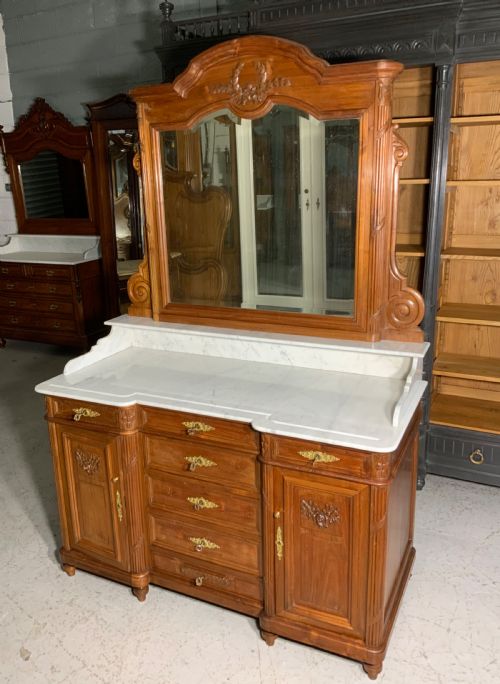
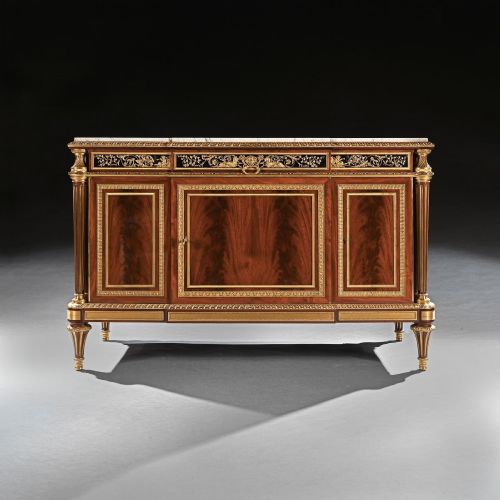
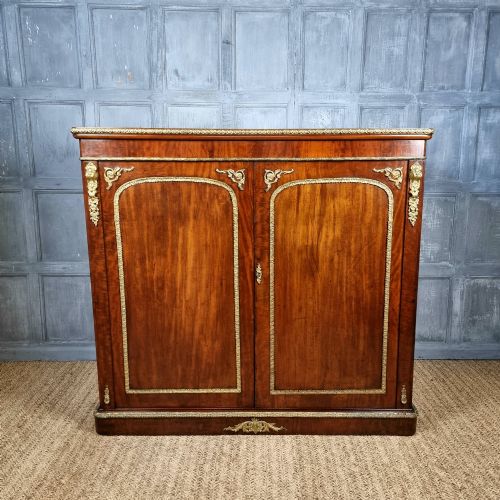
A french mahogany credenza is a substantial storage piece originating from continental workshops, typically combining rich cabinet timbers with decorative stone and metalwork. Buyers searching for a french mahogany credenza encounter side cabinets, chiffoniers, and commodes spanning the nineteenth and early twentieth centuries.
The material palette draws heavily on rich mahogany, often paired with contrasting walnut, maple, and marble tops. Pieces frequently reference historical design vocabularies including French Empire, Louis XVI, and Louis Philippe styles.
Forms vary from tall chiffonier sideboards to low display cabinets and commodes fitted with doors. Side cabinets and commodes dominate the selection, providing practical surface space alongside enclosed shelving.
Materials and construction
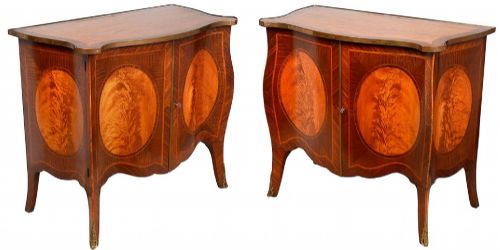
Cabinetmakers utilised solid mahogany and flame mahogany veneers over secondary timbers, building carcases designed to withstand heavy use while displaying figured grain patterns. Marquetry and parquetry techniques introduced geometric or floral patterns using contrasting woods such as walnut and maple.
Marble tops, ranging from white to coloured varieties, were shaped to follow the contours of the timber carcase above enclosed cupboards. Cast bronze and ormolu mounts were applied to corners, friezes, and feet to accentuate structural lines.
Some nineteenth century music cabinets were built to hide secret sheet music compartments behind dummy book spines.
Assessing quality and execution
The refinement of the cast bronze and ormolu mounts separates standard production from exceptional cabinetwork. Crisp chasing and heavy gilding indicate a higher tier of workshop output.
Veneer selection dictates visual impact, with matched flame mahogany and intricate marquetry panels demonstrating superior artisan skill. The integration of thick marble tops with precise edge moulding further distinguishes finer examples.
Henry Dasson·Weisweiler·Gillows·Jean-Henri Riesener
The French Mahogany Credenza Glossary
- Commode
- A low cabinet or chest of drawers designed for domestic storage. French examples often feature marble tops and shaped fronts.
- Chiffonier
- A tall sideboard or cabinet featuring enclosed shelving and cupboard doors. Nineteenth century versions frequently incorporate a raised back tier.
- Marquetry
- Inlaid wood veneers forming pictorial or geometric designs. Artisans cut various timber species to fit flush within a background veneer.
- Parquetry
- Geometric patterns formed by small wood veneers fitted together. This technique commonly appears on tabletops and cabinet door panels.
French Mahogany Credenza: Frequently Asked Questions
How do I clean a marble top?
Use a soft cloth dampened with warm water and mild, pH-neutral soap to wipe the surface clean. Avoid acidic cleaners, vinegar, or harsh scouring powders that can etch or dull the stone polish.
Dry the marble thoroughly with a clean towel to prevent water spots. Periodic application of a neutral stone sealer helps protect against stains from accidental spills.
Where should I place a credenza?
Position the piece along a primary wall in a dining room, hallway, or living space where its depth will not obstruct thoroughfares. Ensure the location remains away from direct sunlight and heat sources to protect the mahogany finish and wood movement.
Allow adequate clearance for opening cabinet doors and drawers fully without striking adjacent furniture. Heavy marble tops require stable, level flooring to maintain door alignment.
Can I store heavy items inside?
Internal wooden shelving supports standard dining ware, books, and household linens with ease. Distribute weight evenly across the shelves to prevent sagging over time.
Very heavy objects should rest on the lower base rather than upper shelves. Check the shelf supports and fixings periodically if storing dense collections.