
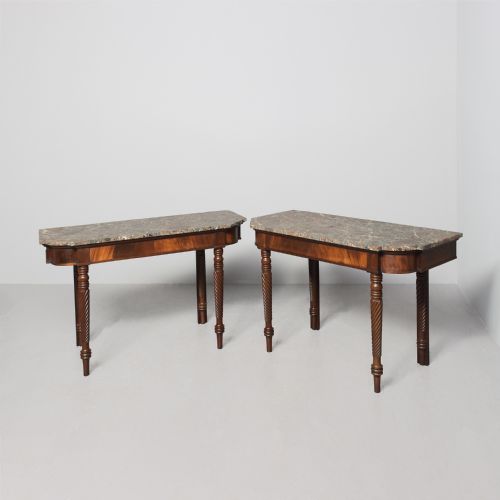
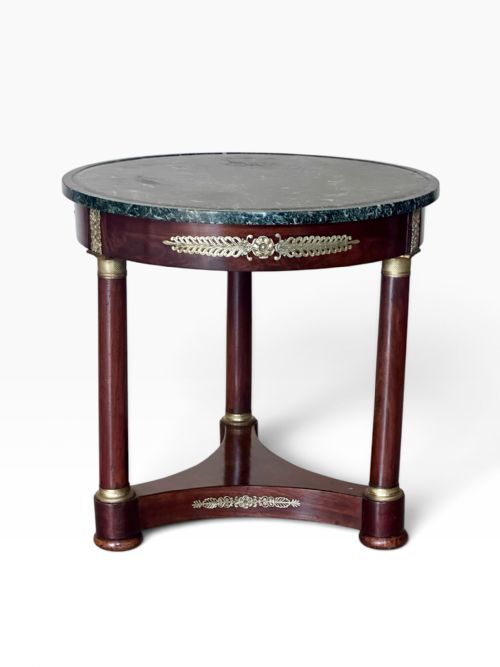
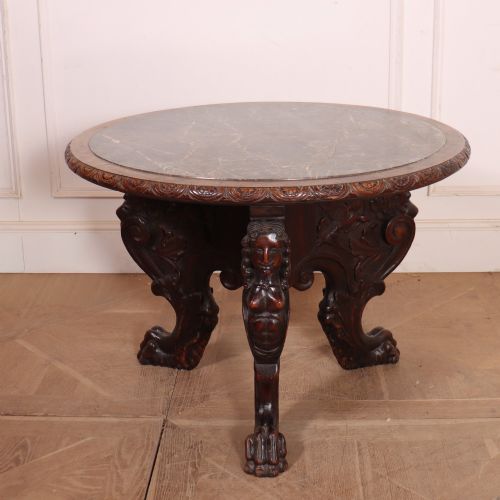

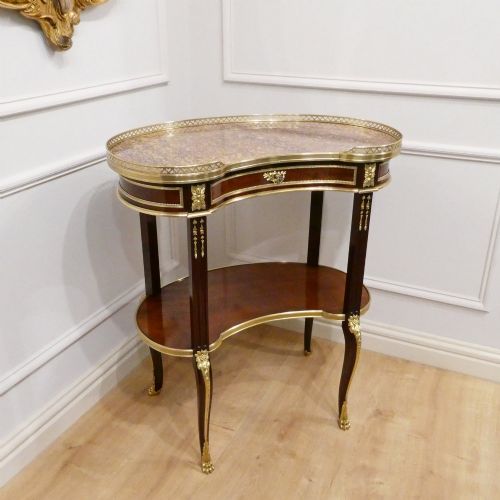
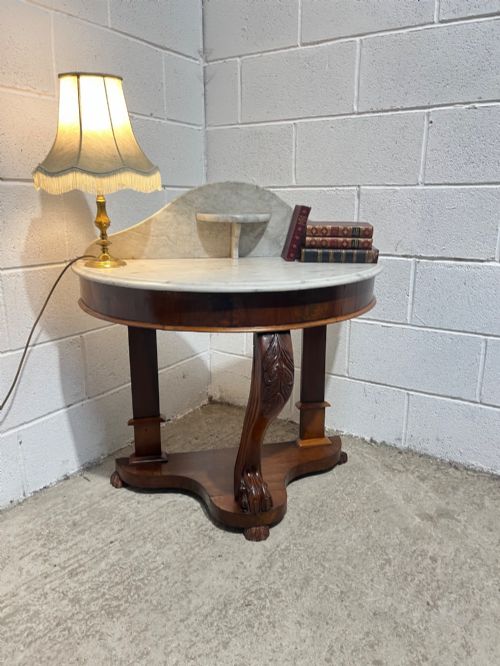
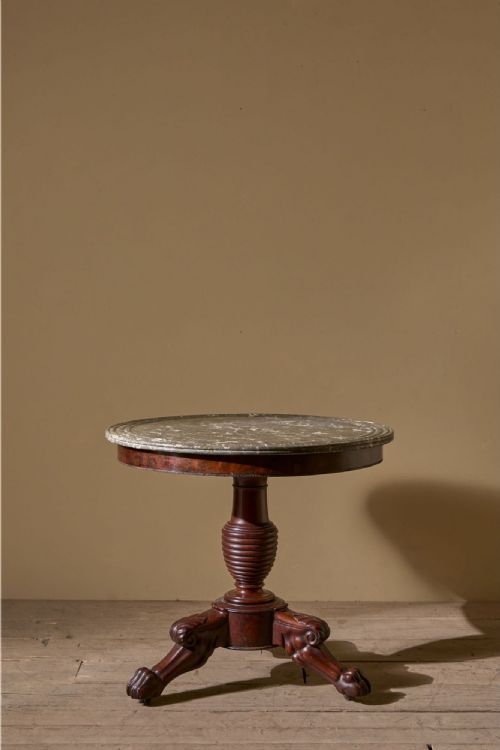
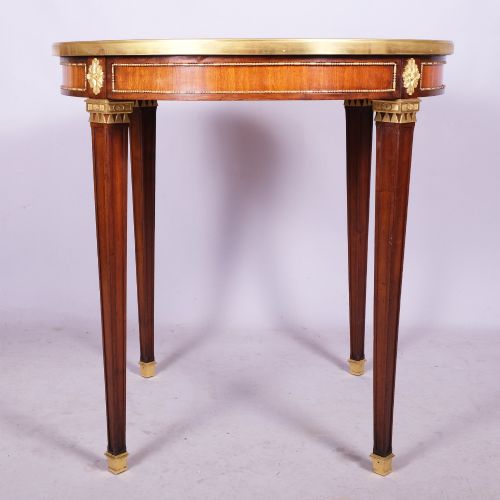
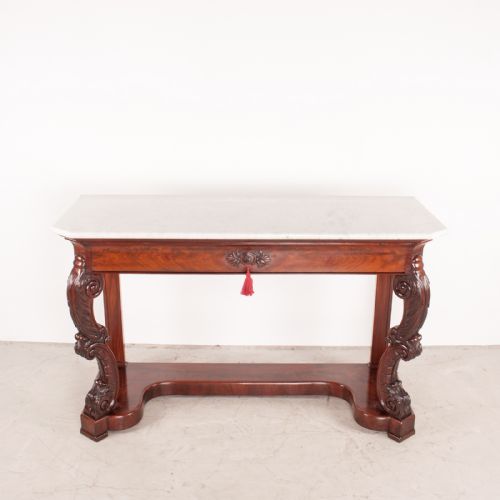
Mahogany Marble Side Table
A mahogany marble side table brings cool stone and deep wood together, offering a solid surface for lamps, books and daily use.
Forms and periods
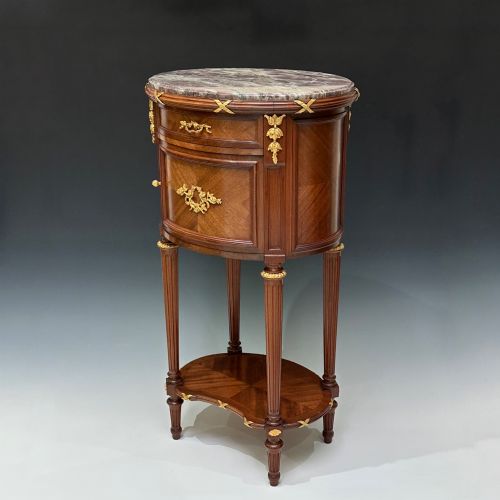
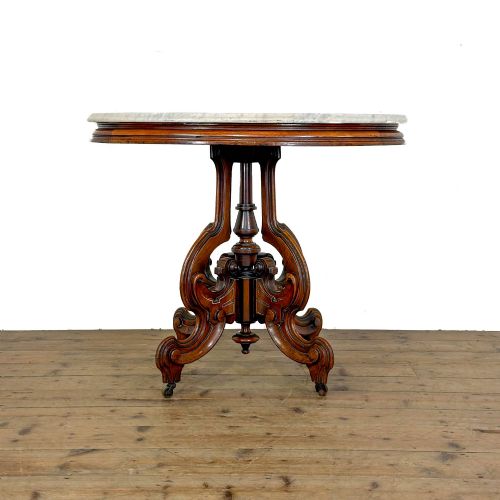
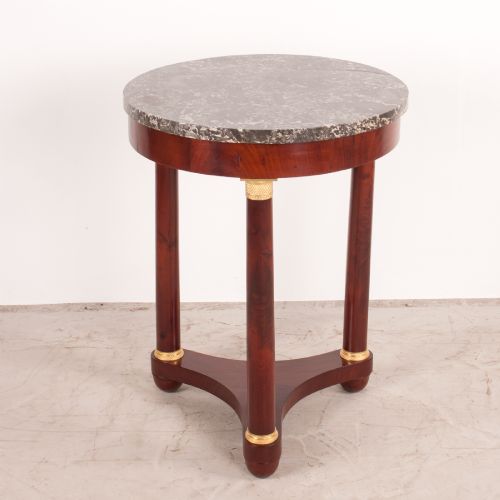
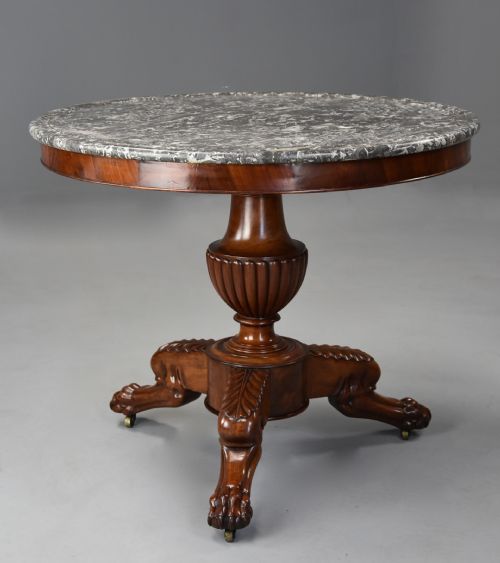
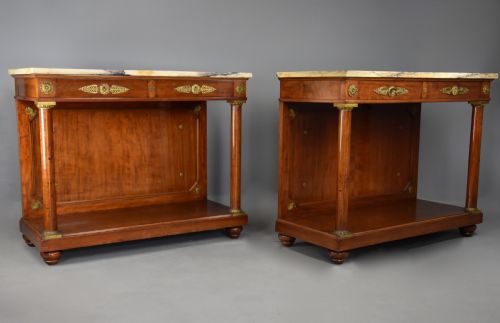
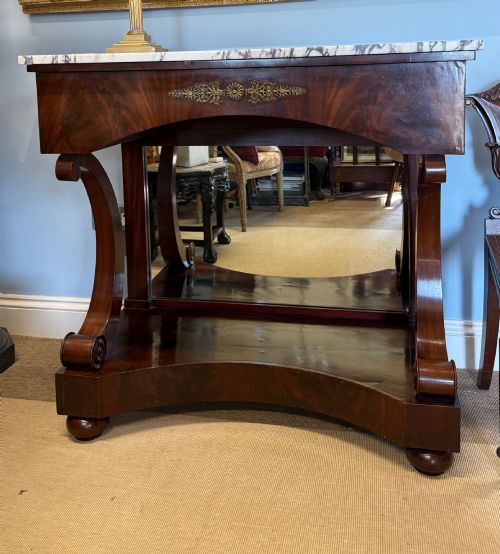
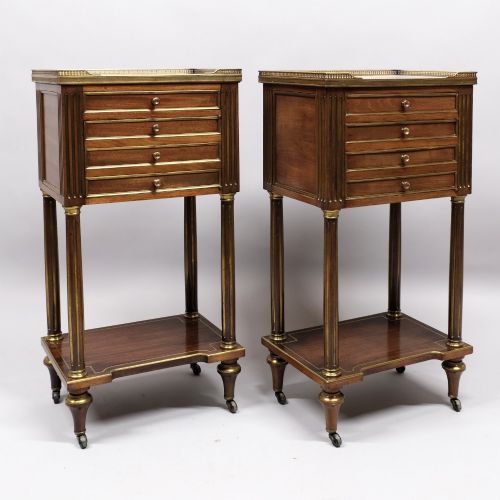
A mahogany marble side table combines timber frames with heavy stone slabs, appearing across nineteenth century English and French designs. You meet taller console tables, round gueridon tables, and compact bedside variants.
The materials span standard mahogany alongside flame and figured veneers, paired with white Carrara, grey, pink, and specialised specimen marbles. Brass mounts, ormolu accents, and mirror backs frequently accompany these forms.
English iterations lean toward Georgian, Victorian, and William IV proportions, whilst French examples embrace Empire and Charles X aesthetics. Many pieces function equally well as washstands, servers, or central display surfaces.
Assessing the pieces
Superior examples rely on finely figured flame mahogany and thick, unblemished marble slabs with rich natural veining. Lesser pieces feature plain timber boards and thinner, secondary stones with minor repairs.
The crispness of the brass mounts and the joinery of the sub-frame dictate the tier of craftsmanship. Finer workshops delivered tighter mitres, heavier cast hardware, and more ambitious neo-classical or French Empire proportions.
Retail Price Guide 2026
Typical UK retail prices for mahogany marble side table, calculated from the Sellingantiques database of over a million retail prices indexed since 2003. This retail price guide relies exclusively on Sellingantiques data; no external sources or auction records are used, so the figures do not describe the wider market.
Listings feature both English regional workshops and Parisian makers, spanning the early Georgian era through the late Victorian period.
Maples·Johnstone and Jeanes·Gillows
The Mahogany Marble Side Table Glossary
- Gueridon
- A small circular table supported by a central pillar or multiple columns. This French form frequently pairs mahogany woodwork with an inset marble top.
- Console table
- A wall-mounted or freestanding table designed to sit flat against a room divider. They often feature elaborate front legs and marble tops suited for display.
- Ormolu
- Gilded bronze mounted onto furniture frames. French makers utilised this material to highlight corners, aprons, and structural columns.
- Carrara marble
- A white or blue-grey stone quarried in Italy. It appears frequently as the primary top surface on nineteenth century tables.
- Pietra dura
- An artistic technique using cut and fitted polished coloured stones to create geometric or pictorial designs. Certain high-end pieces incorporate this stonework into the marble surface.
Frequently Asked Questions
What is a mahogany marble side table used for?
These tables served various practical functions in nineteenth century interiors, acting as washstands, serving surfaces, bedside units, and hall consoles.
The heat-resistant marble top made them suitable for holding pitchers, washbasins, and heavy decorative objects without damaging the polished timber underneath.
How do I clean the marble top?
Wipe the stone surface using a soft cloth dampened with warm water and a mild, pH-neutral soap.
Avoid acidic cleaners, vinegar, and abrasive scouring pads, which will etch and dull the polished finish of the marble.
Are these tables heavy?
Yes, the combination of dense mahogany timber and thick stone slabs creates substantial overall weight. The marble top is typically heavy enough to stay in place by its own gravity without permanent fixings.
When moving the furniture, lift the stone slab off first to reduce strain on the wooden frame and joints.
How do I tell English and French pieces apart?
English examples often show restraint through Georgian or Victorian proportions, straightforward column supports, and classical mahogany framing.
French pieces from the Empire and Charles X periods generally display bolder ormolu mounts, architectural gilt details, and distinctively shaped gueridon or console silhouettes.