
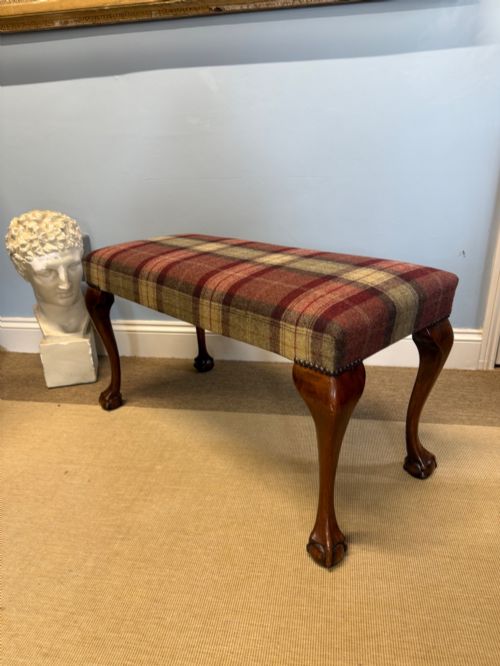


Mahogany Long Stool
A mahogany long stool brings generous seating and deep timber warmth to a window recess or fireside, pairing sturdy framing with varied period upholstery.
Mahogany Long Stool
A mahogany long stool provides an elongated seating form designed for parlours, bedrooms, and window bays across the eighteenth, nineteenth, and early twentieth centuries. These versatile furnishings appear as upholstered window seats, piano benches, hearth rests, and long footstools built on solid timber frames.
The pieces on this page span Georgian, Regency, Victorian, and Edwardian eras, encompassing both formal revival styles and simpler domestic forms. Buyers frequently encounter examples featuring buttoned leather, patterned velvet, ticking, or tapestry upholstery supported by turned, fluted, or cabriole legs.
How they were made
Carpenters constructed the structural frames of these pieces using solid mahogany and imported tropical hardwoods, often shaping the timber into cabriole legs, fluted columns, or bracketed rails. Selected examples incorporate carved detailing such as ball and claw feet, parcel-gilding, or intricate mouldings along the frieze.
Upholstery techniques varied widely according to function, employing traditional stuffing materials beneath outer coverings of leather, wool, cotton, or printed velvet. Brass-studded trim, needlepoint, kilim fragments, and designer textiles like Liberty velvet frequently secure the edges of the padded seat.
Listings feature mahogany long stools spanning the eighteenth, nineteenth, and early twentieth centuries, including Georgian, Victorian, and Edwardian examples.
What varies in quality
The refinement of the timber framework and the harmony of its proportions distinguish superior examples from ordinary production. Finely drawn legs, crisp carving, and substantial mahogany scantlings separate bespoke seating from standard utilitarian workshop output.
Integrity of construction and the quality of the upholstery materials also dictate worth, as deeply sprung webbing, traditional stuffing, and premium coverings like hide or stamped velvet reflect higher original manufacture and careful later maintenance.
Gillows·Morris and Co
The Mahogany Long Stool Glossary
- Cabriole leg
- A furniture leg that curves outward at the knee and inward at the ankle, finishing in a pad, claw, or scroll foot. This classical form appears frequently on eighteenth- and nineteenth-century seating.
- Window seat
- An upholstered bench designed specifically to fit within a recessed window bay. These pieces often feature arms at one or both ends and long rectangular proportions.
- Fender stool
- A low, elongated footstool designed to sit immediately in front of a hearth fender. They keep feet elevated away from cold stone or brick floors.
- Duet stool
- A wide piano bench built to accommodate two players side by side. Many incorporate a hinged seat lid revealing internal storage for sheet music.
- Buttoned
- An upholstery technique where twine pulls the fabric deep into the stuffing at regular intervals to create a padded, diamond-patterned surface.
Mahogany Long Stool: Frequently Asked Questions
Where should I place a long stool?
These pieces fit naturally at the foot of a bed, beneath a bay window, or alongside a hearth where an extended seat is useful.
Their narrow profile also suits entrance halls and long corridors as a place to sit while removing shoes.
How do I identify a Georgian frame?
Georgian frames display dense, dark mahogany timber with hand-cut joinery and restrained, elegant proportions.
Look for well-drawn legs and understated carving rather than heavy Victorian ornamentation.
Are piano stools different from window seats?
Piano stools generally feature hinged tops that open to reveal internal storage compartments for musical scores.
Window seats lack this internal compartment and focus purely on stationary upholstered comfort.
Can I use modern fabric for reupholstery?
Many buyers choose contemporary designer textiles, such as printed velvets or heavy wools, to refresh antique frames.
Retaining traditional webbing and stuffing methods during the process preserves the structural integrity of the piece.