


Mahogany King Bedstead
A mahogany king bedstead anchors a room with solid timbers, deep grain and enduring proportions that adapt easily to modern interiors.
Mahogany King Bedstead
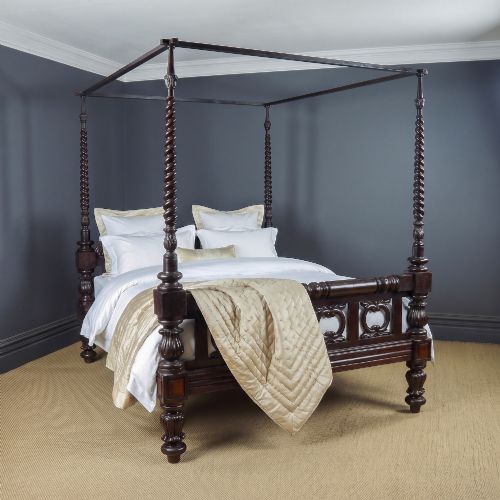
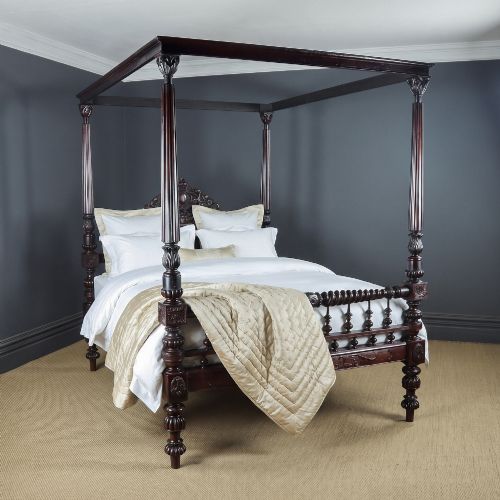
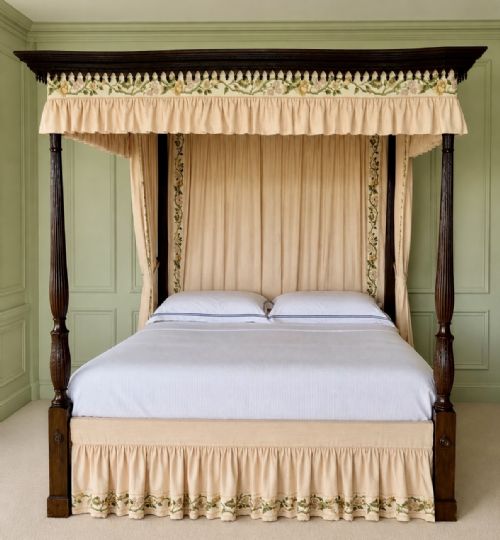
A mahogany king bedstead brings substantial presence to a bedroom, combining historical cabinet-making with generous proportions suited to contemporary mattresses. The examples seen here range from four-poster tester frames to French and Anglo-Indian colonial designs.
Most pieces date from the nineteenth century, including Victorian and Edwardian periods, alongside earlier eighteenth-century Chippendale models and Grand Regency examples. These larger bedframes often originate from French workshops or colonial commissions, utilising rich timbers and grand scale.
How they were made
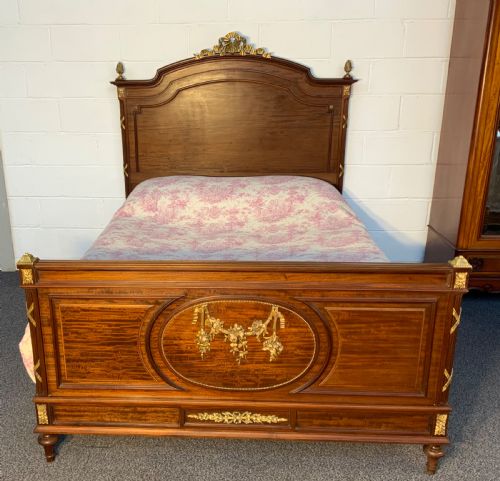
Construction relies heavily on solid mahogany and flame mahogany veneers, frequently accented with fruitwood parquetry, burr walnut, and contrasting brass or ormolu detailing. Frame stability is achieved through heavy timber posts, carved headboards, and robust side rails.
Many of the four-poster and tester models feature elaborate hand-carved pillars and cornices, while continental frames employ geometric parquetry and metal mounts to delineate the stylistic periods from Louis XVI to French Empire.
Listings span from the eighteenth century through the Edwardian era, incorporating solid mahogany, flame veneers, brass mounts, and fruitwood parquetry.
What varies in quality
The standard of a mahogany king bedstead depends upon the depth of the timber's grain, the crispness of hand-carved ornamentation, and the integrity of the original construction joints. Superior pieces display carefully matched veneers and robust structural timbers without excessive replacement parts.
Refinement in design distinguishes finer examples, such as the balanced proportions found in Anglo-Indian colonial testers or French neoclassical frames, compared to plainer utilitarian bedframes from the turn of the twentieth century.
Staples & Co
The Mahogany King Bedstead Glossary
- Parquetry
- A geometric mosaic of wood pieces used for decorative inlay on furniture surfaces. Fruitwoods and contrasting veneers are often arranged in patterns on French beds.
- Ormolu
- Gilded bronze mounts applied to furniture for decorative enrichment. This technique appears on nineteenth-century continental pieces to accent the mahogany framework.
- Flame mahogany
- A veneer cut from the fork of the mahogany tree, producing a distinctive fire-like ripple pattern. It provides striking visual movement across large headboards and footboards.
Mahogany King Bedstead: Frequently Asked Questions
Will a standard modern king mattress fit?
Many antique bedsteads were built to nineteenth-century dimensions rather than modern standardised mattress sizes. Some adaptation or custom base building may be necessary to accommodate contemporary mattresses securely within the antique frame.
Checking the internal rail lengths and widths against your specific mattress measurements before purchase ensures proper alignment and support.
How do I care for polished mahogany?
Maintenance involves dusting with a soft, dry cloth and applying natural beeswax periodically to nourish the timber grain. Avoid placing antique wood in direct sunlight or near heat sources to prevent timber shrinkage and veneer splitting.
Keeping room humidity stable protects the structural integrity of joints and prevents the polished surface from drying out over time.
Can these beds be dismantled easily?
Most antique wooden bedframes utilise traditional knockdown bolts, bed screws, or slot-in rail fittings designed for straightforward dismantling and transport. However, larger four-poster tester frames require careful handling and two people to manage the heavy posts and canopy components.
Professional assembly is often recommended for complex colonial or four-poster structures to ensure the frame remains square and stable.
How do I identify a Victorian piece?
Victorian mahogany furniture typically exhibits heavier proportions, darker reddish-brown finishes, and robust machine-assisted or hand-carved detailing. Stylistic influences often draw from earlier Gothic, Elizabethan, or classical revivals.
Examining the construction fasteners, secondary interior timbers, and screw types helps confirm the nineteenth-century manufacturing period.