
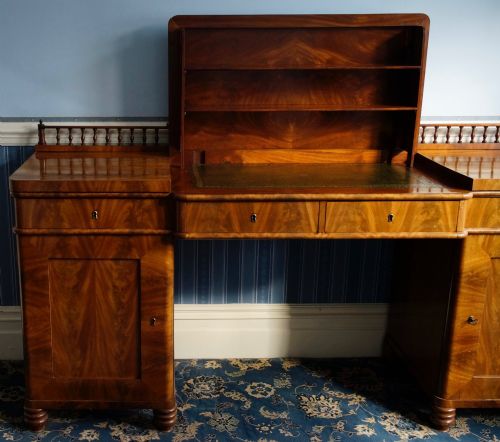
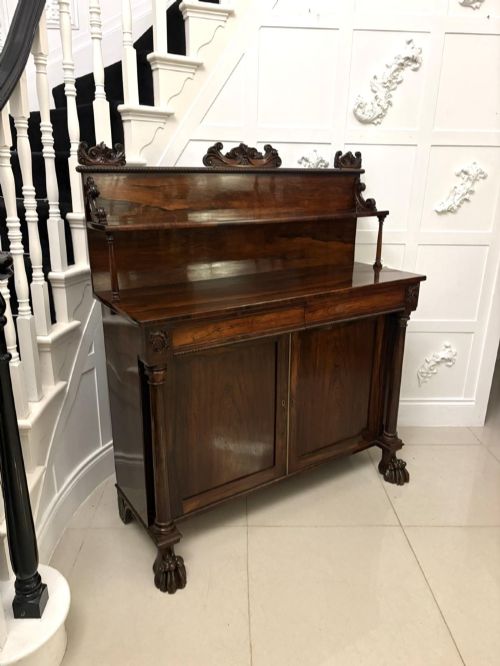

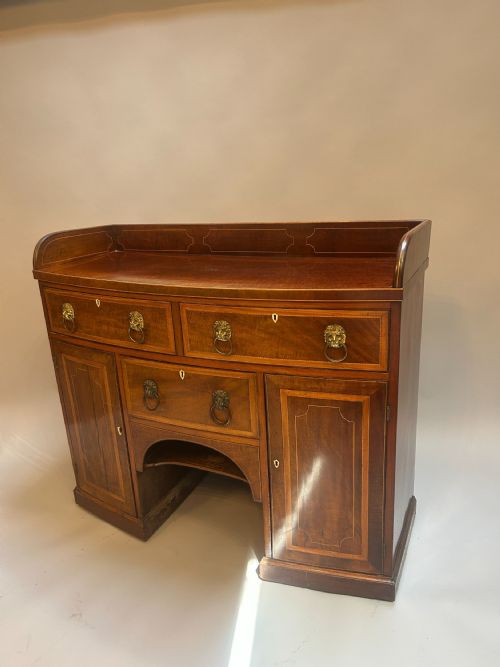


Mahogany Gallery Credenza
Mahogany gallery credenza pieces are substantial serving furniture carrying raised upper tiers, chosen for rich timber figure and formal dining storage.
Mahogany Gallery Credenza
A mahogany gallery credenza brings together formal dining furniture and serving cabinetry from the Georgian, Regency, and Victorian periods. Buyers investigating a mahogany gallery credenza encounter pieces spanning sideboard, chiffonier, and cabinet forms equipped with upper brass rails or integrated shelf backs.
The selections on this page draw predominantly from nineteenth century workshops, encompassing George III, Regency, William IV, and Edwardian revivals. These variants range from compact side cabinets with two shelf backs to monumental pedestals fitted with extensive drawer sets.
Materials and construction
Cabinet makers utilised solid mahogany and flame mahogany veneer laid over secondary timbers, often accentuating the primary wood with boxwood and satinwood inlay. Structural integrity relies on heavy carcase construction, frequently supported by turned feet or substantial pedestals.
Metalwork played a functional and decorative role, incorporating cast brass galleries, handles, and grilles alongside glass door panels. Interior configurations included adjustable shelving, deep cellarette drawers, and occasional writing surfaces.
Listings feature mahogany, satinwood, and Gonçalo-Alvez timbers across Georgian, Regency, and Victorian periods.
Judging the work
Quality rests upon the selection of timber figure, where richly grained flame mahogany veneer elevates a piece above plain stock. The crispness of inlaid stringing, boxwood detail, and carved ornamentation demonstrates the underlying skill of the workshop.
Proportion and the integration of upper galleries or tiers dictate overall success. Examples retaining original brass galleries and harmonious hardware show greater integrity than those altered over time.
Edwards and Roberts·Howard And Sons·H Mower And Stephenson
The Mahogany Gallery Credenza Glossary
- Gallery
- A raised rail or low superstructure placed along the top of a sideboard or cabinet to secure serving items.
- Chiffonier
- A compact sideboard featuring a lower enclosed cupboard beneath one or more upper display shelves.
- Flame mahogany
- A highly figured veneer cut from where a branch joins the main trunk, creating a distinctive flame-like pattern.
- Pedestal sideboard
- A heavy dining room form with two substantial side cupboards flanking a central drawer section.
- Stringing
- Narrow inlay lines of contrasting timber used to outline drawers, doors, and borders.
Mahogany Gallery Credenza: Frequently Asked Questions
What is a gallery credenza?
A gallery credenza is a low dining room storage piece featuring a raised rail or shelf structure along its upper surface. These additions were designed to display silver or retain glassware safely during service.
Such furniture combines the enclosed storage of a sideboard with upper display space. The form spans various nineteenth century revivals and regional interpretations.
How do I date a mahogany piece?
Dating relies on observing structural characteristics, timber preparation, and decorative motifs associated with specific reigns. Georgian and Regency pieces display restrained classical lines, whereas Victorian examples often incorporate heavier carving and architectural proportion.
Examining secondary timbers and drawer construction reveals manufacturing methods characteristic of a period. Hardware and brass galleries also provide reliable chronological indicators.
Where were these cabinets used?
These cabinets served primarily within the formal dining room or parlour of substantial homes. They functioned as serving stations for meals and storage spaces for linens, cutlery, and wine.
Smaller variants also appeared in libraries and drawing rooms to house books and writing materials. Their adaptable proportions suit contemporary living spaces as focal storage units.
How do I care for mahogany?
Mahogany requires stable room temperatures away from direct sunlight and heat sources to prevent timber movement. Regular dusting with a soft, dry cloth preserves the polished surface without damaging the grain.
Periodic application of appropriate wax maintains the lustre of the timber. Avoid abrasive cleaners and excess moisture during routine maintenance.