
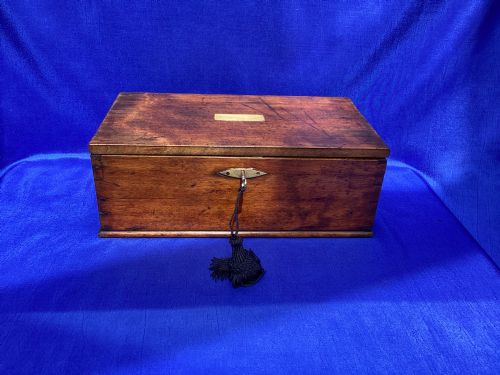


Mahogany Fitted Instrument Case
A mahogany fitted instrument case houses precision tools and delicate apparatus in a robust timber shell designed to protect contents from the hazards of travel and time.
Mahogany Fitted Instrument Case
A mahogany fitted instrument case provides secure housing for scientific, medical, nautical, and musical equipment across the Georgian, Victorian, and Edwardian eras. These boxes organise diverse tools such as microscopes, drainage levels, hydrometers, and drawing sets into tailored compartments lined with velvet or leather.
The pieces on this page span several distinct collecting fields, including scientific instruments, medical collectables, and musical instrument cases. Buyers encounter various forms ranging from small desk tidies and marine instruments to large cello cases and specialised surveying equipment.
Origins reflect British and European craftsmanship, with prominent retail and manufacturing centres represented by London makers and continental firms. The overarching style connects utilitarian precision with cabinet-making traditions, resulting in functional objects that double as handsome desk or display pieces.
Construction and materials
The primary structural material is solid mahogany or mahogany veneer over secondary timbers, selected for its stability and rich grain. Carpenters utilised precise joinery to build sturdy boxes capable of enduring heavy field use or maritime travel.
Interiors feature custom blocking, partitions, and recesses lined with velvet or leather to cradle delicate brass, glass, and iron components. Hardware such as brass hinges, locks, and inset carrying handles reinforce the durability and secure closure of each chest.
Materials recorded across these items combine solid mahogany framing with interior linings of velvet and leather, complemented by brass and iron hardware.
Assessing quality and execution
Superior examples distinguish themselves through the precision of the internal fitting and the quality of the cabinet work. A well-executed case exhibits tight joinery, perfectly fitted partitions, and substantial brass hardware that operates smoothly.
The presence of complete original contents, including bone, glass, or metal instrument components, elevates the standing of an item. Superior pieces retain their original velvet or leather linings intact, showing minimal wear relative to their age.
Holtzapffel and Co·L Casella and Co·John Millikin·W E Hill·A Hurlimann·John Lilley and Son·W F Stanley
The Mahogany Fitted Instrument Case Glossary
- Fitted interior
- An internal arrangement of wooden partitions, blocks, and recesses specifically tailored to hold an instrument and its accessories securely in place. This design prevents shifting and potential damage during transport.
- Hydrometer
- A scientific instrument used to measure the specific gravity of liquids, typically consisting of a weighted glass bulb with a graduated stem. These sets often reside in specialised wooden boxes with glass or metal components.
- Artificial horizon
- A navigational device used with a sextant to measure altitudes when the natural horizon is obscured. Black glass and frame assemblies are typical components found within these specialised cased sets.
- Cupping set
- A collection of medical instruments used in traditional bloodletting practices, usually featuring scarificators and glass or brass cups. They are typically housed in velvet-lined wooden compartments.
- Holtzapffel
- A notable firm of toolmakers and mechanical engineers renowned for precision equipment and high-quality wooden cases. Their pieces represent exceptional standards of Georgian and Victorian manufacturing.
Mahogany Fitted Instrument Case: Frequently Asked Questions
What items belong in these cases?
These boxes contain a wide array of precision gear, ranging from microscopes and drafting tools to medical cupping sets and barometers. Each interior is built to match the exact shape of the tool it carries.
Buyers often find complete sets featuring brass instruments, glass vials, and bone-handled accessories nestled securely within their original velvet linings.
How do I date an instrument case?
Dating relies on a combination of cabinet-making styles, brass hardware types, and any maker signatures or retailer stamps found inside. Georgian and Victorian examples display distinct joinery methods and hinge designs.
Paper trade labels pasted inside the lid frequently name the original retailer or maker, providing a reliable window into the period of manufacture.
Are the instruments usually complete?
Many surviving examples retain their full complement of original tools and accessories, though some pieces survive as empty chests or partial sets. The presence of specialised slots and fitted recesses makes missing items easy to spot.
Collectors weigh the completeness of the contents heavily against the quality and condition of the outer mahogany housing when assessing a piece.
How should I clean the mahogany exterior?
Maintenance requires gentle dusting with a soft cloth and occasional application of appropriate wax to nourish the timber. Harsh modern chemical polishes will damage the historic finish and dry out the wood.
Interior velvet and leather linings benefit from careful brush vacuuming using a low-suction attachment to remove accumulated dust without disturbing fragile fibres.