
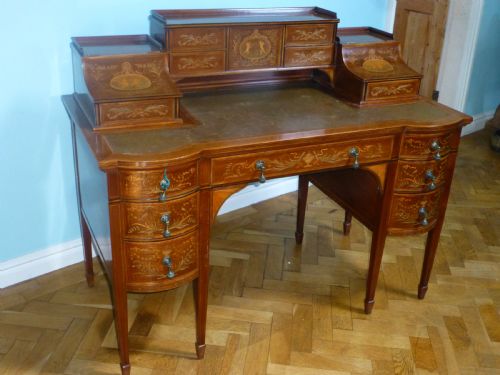


Mahogany Carlton House Desk
A mahogany carlton house desk brings curved drawers and compartments together in a refined writing space.

Mahogany Carlton House Desk
A mahogany carlton house desk presents a distinctive horseshoe superstructure of small drawers and pigeonholes that curves around the back and sides of the writing surface. The pieces appearing here predominantly date from the Edwardian and Victorian periods, alongside earlier eighteenth-century examples.
Most items on this page display the characteristics of Sheraton Revival styling, featuring veneered mahogany surfaces enhanced by contrasting satinwood inlay and banding. These desks were originally designed for domestic studies and drawing rooms, offering compartmentalised storage for stationery and correspondence within a freestanding footprint.
Materials and Construction
Makers constructed these desks primarily using solid mahogany and mahogany veneers, often selecting figured timbers such as flamed mahogany for primary visual surfaces. The writing planes are typically inset with panels of tooled leather to provide a durable and traditional writing surface.
Decorative detail relies on satinwood inlay, marquetry motifs, and fine brass hardware including pull handles and small drawer knobs. Cabinetmakers utilised these combined timber and brass elements to articulate the curved superstructure and multiple graduated drawers characteristic of the form.
Listings span the eighteenth, nineteenth, and early twentieth centuries, incorporating Edwardian, Victorian, and George III periods.
Distinctions in Quality
Quality in a mahogany carlton house desk rests on the selection of timber figures and the precision of the satinwood inlay across the curved superstructure. Finer pieces demonstrate meticulous hand-cut marquetry and seamless integration of the small stationery drawers into the main writing box.
The degree of original finishing, the weight and quality of the brass fittings, and the structural integrity of the curved galleries separate standard workshop productions from exhibition-grade furniture.
Edwards and Roberts·Maple of London·Maple and Co·Shoolbred and Co·Jas Shoolbred
The Mahogany Carlton House Desk Glossary
- Superstructure
- The tiered arrangement of small drawers and pigeonholes built onto the rear and sides of the main desk top. This curved structure defines the silhouette of the form.
- Satinwood
- A lustrous, pale yellow timber native to Ceylon and India, frequently utilised for contrasting inlay and banding on darker mahogany furniture.
- Marquetry
- The art of forming decorative patterns using thin veneers of various woods applied to a structural carcase. It frequently depicts floral or classical motifs on these desks.
- Banding
- A narrow strip of contrasting veneer bordering the edges of tabletops and drawer fronts. This technique frames the primary mahogany grain.
Mahogany Carlton House Desk: Frequently Asked Questions
How do I care for the leather top?
Clean the leather surface gently with a damp cloth and treat it periodically with neutral leather balm to prevent drying and cracking.
Avoid placing hot cups or liquids directly on the hide, and keep the desk away from direct sunlight and heat sources.
Where should I place a freestanding desk?
These desks feature finished backs designed to be viewed from any angle, making them suitable for positioning in the centre of a room rather than flat against a wall.
Ensure there is sufficient clearance around the curves of the superstructure to allow chairs to pull up comfortably.
How do I distinguish Edwardian pieces from earlier ones?
Edwardian and Sheraton Revival examples often display lighter satinwood banding and crisper marquetry combined with machine-assisted uniformity in internal drawer construction.
Earlier eighteenth-century and George III pieces generally exhibit heavier timber scantlings, hand-cut dovetails, and deeper patination acquired through age.
What were the pigeonholes originally used for?
The compartments and small drawers within the horseshoe superstructure held letters, writing paper, envelopes, and personal documents.
This compartmentalised layout kept correspondence organised within easy reach of the writer.