

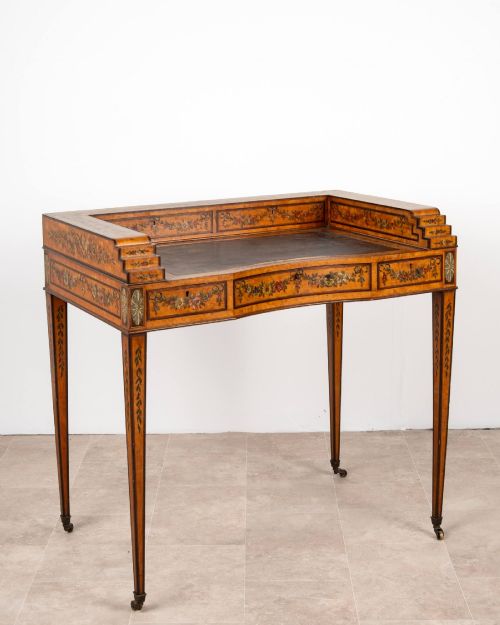
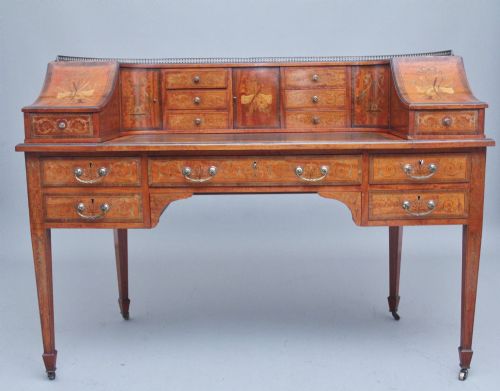
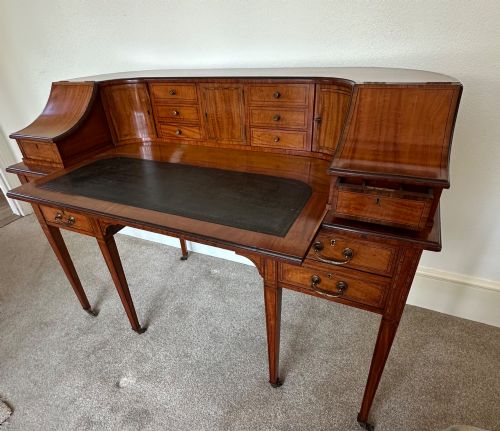
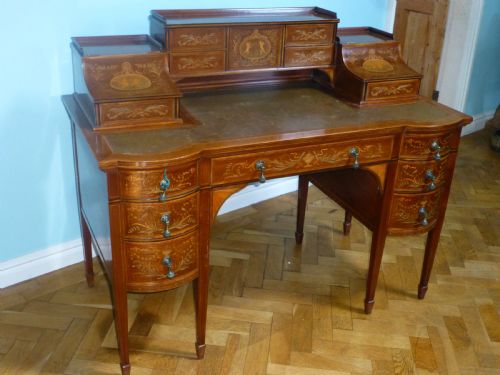



Edwardian Carlton House Desk
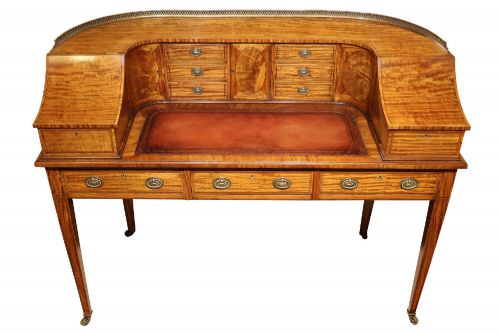
An Edwardian carlton house desk offers a distinctive curved superstructure of small drawers and pigeonholes above a writing surface, favoured for keeping correspondence organised in style.

Edwardian Carlton House Desk
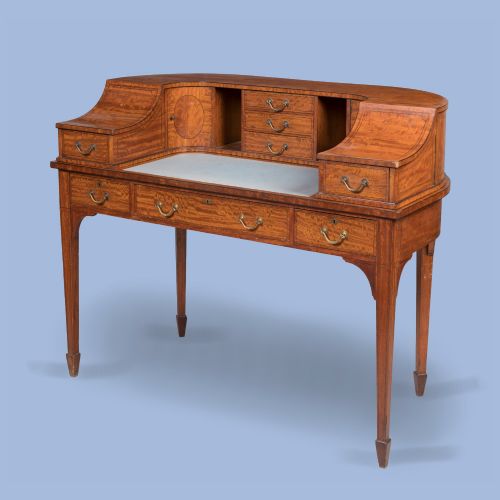
An edwardian carlton house desk combines a writing surface with a raised, concave superstructure enclosing banks of small drawers and pigeonholes. The design originated in the late eighteenth century, but the examples found here predominantly date from the Edwardian period, around nineteen hundred, alongside late Victorian manifestations.
Makers of the period worked mainly in mahogany or satinwood, frequently enriched with elaborate marquetry inlay or contrasting crossbanding. These pieces range from compact writing tables to substantial freestanding desks finished on all sides for placement in the middle of a room.
Distinctions in craftsmanship and materials
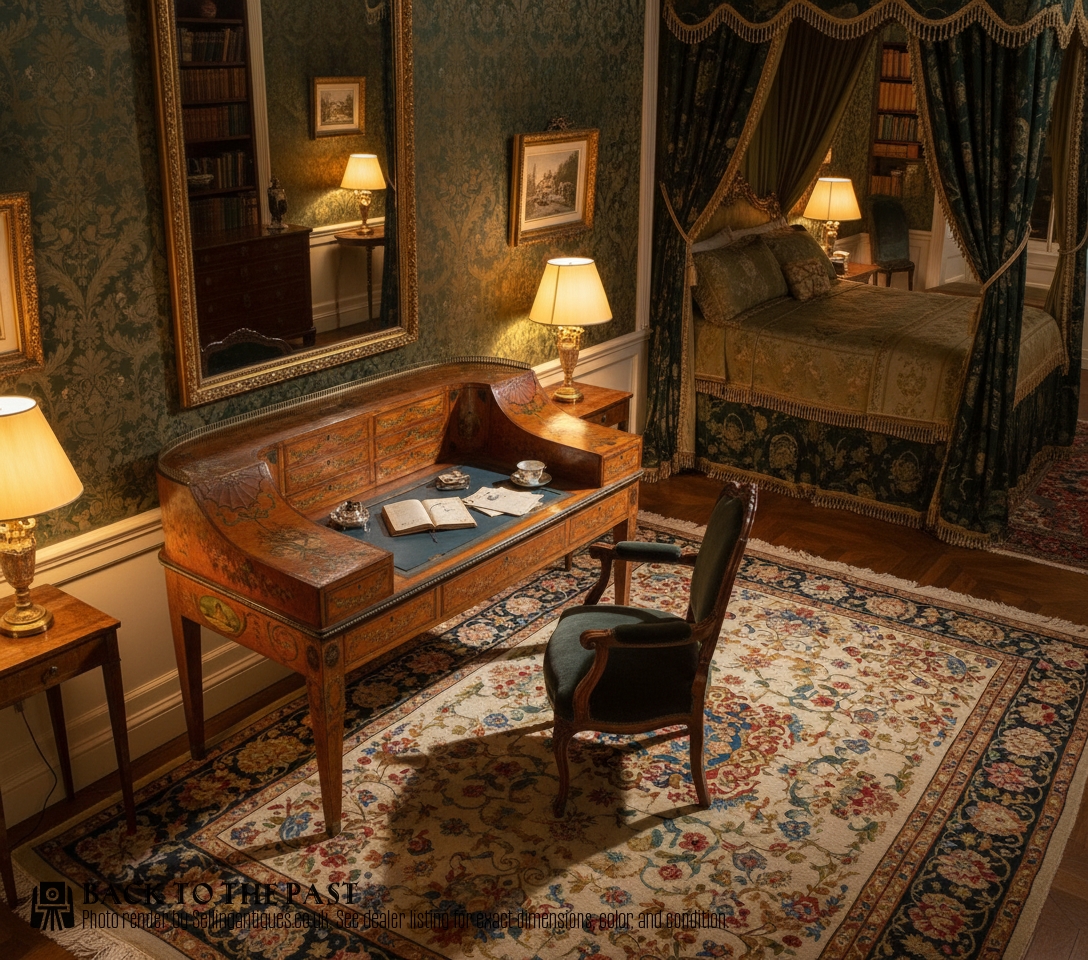
Superior examples exhibit finely figured timber grains, such as flamed mahogany or highly figured satinwood, matched symmetrically across the curved superstructure. The complexity and precision of the marquetry inlay or painted floral decoration further differentiate standard production from masterwork pieces.
Internal construction standards reveal the tier of manufacture, marked by secondary woods like solid oak for drawer linings and the retention of original brass handles rather than later replacements.
Edwardian Carlton House Desk Retail Price Guide 2026
Typical asking prices for edwardian carlton house desk among the pieces listed under this phrase on Sellingantiques today, from the lower quarter to the upper quarter. They describe what is for sale here now, not the wider market.
Superstructures hold enough tiny drawers and secret compartments to misplace a postage stamp for a century.
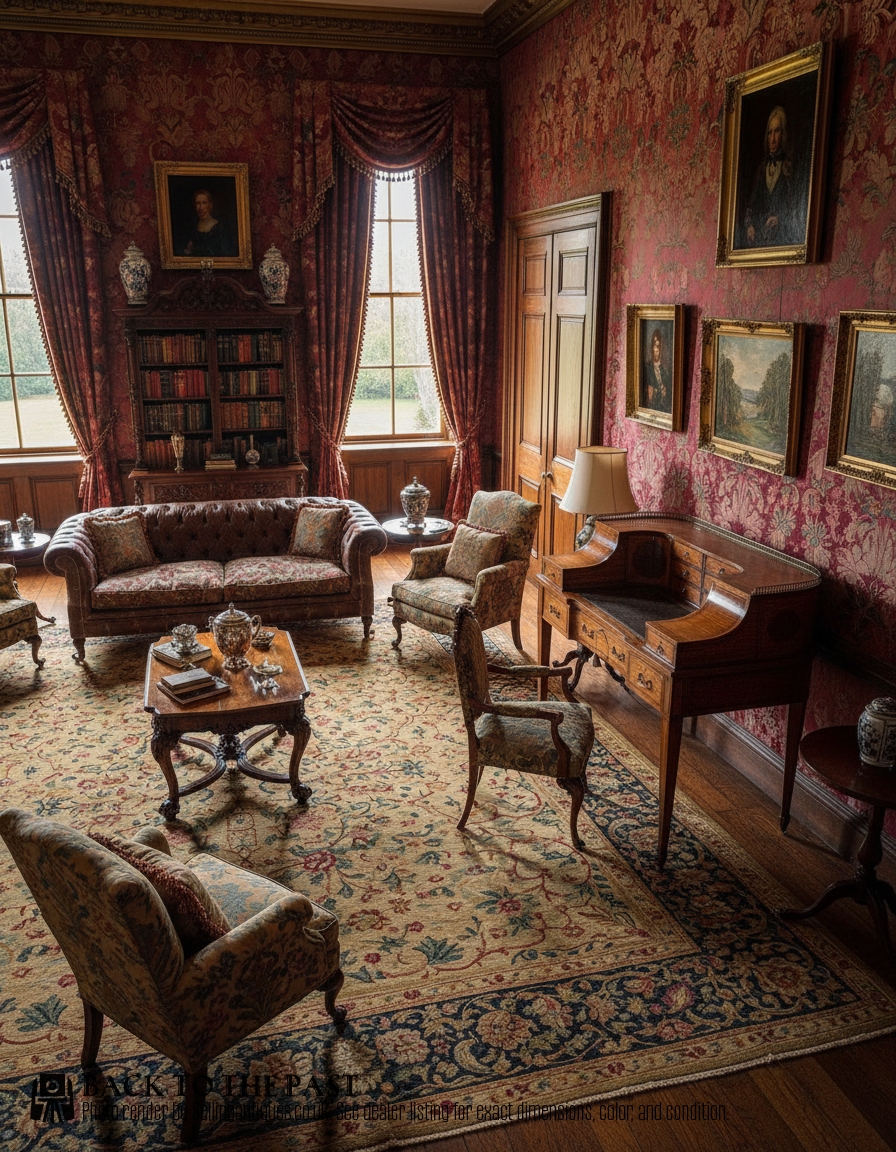
Edwards and Roberts·Maple of London·Maple & Co·Shoolbred & Co
The Edwardian Carlton House Desk Glossary
- Superstructure
- The raised tier of small drawers and pigeonholes curving around the back and sides of the writing surface. This defines the primary silhouette of the desk.
- Crossbanding
- A narrow strip of veneer applied perpendicularly to the grain of the surrounding wood around the edges of a top or drawer front. It creates a neat visual border.
- Marquetry
- Elaborate decorative patterns formed by fitting together contrasting veneers of wood. These pictorial or geometric designs often adorn the writing flap and drawer fronts.
- Pigeonhole
- A small, open compartment within the superstructure intended for sorting letters and papers. They are characteristic internal fittings of bureau and desk forms.
- Sheraton Revival
- A late nineteenth and early twentieth century design movement drawing inspiration from late eighteenth century neoclassical furniture. It popularised satinwood, painted details, and classical proportions.
Edwardian Carlton House Desk: Frequently Asked Questions
Where did the design originate?
The form derives from late eighteenth century prototypes attributed to furniture designers such as George Hepplewhite. Original examples inspired later revivals during the Victorian and Edwardian eras.
Twentieth century makers adapted these historical proportions for contemporary homes, producing lighter satinwood and mahogany interpretations.
Are these desks freestanding?
Many examples are finished with polished veneer on the reverse side so they can stand away from a wall in the centre of a room. Others are intended to be placed flush against a wall.
Checking the back panels reveals whether the piece was designed for open placement or traditional positioning.
How do I distinguish Edwardian from Victorian versions?
Pieces from the Edwardian era generally display lighter timbers such as satinwood and brighter floral painted decoration. Victorian equivalents tend towards darker figured mahogany and heavier architectural proportions.
Stylistic crossover remains common, as late nineteenth century workshops continued producing revival designs into the early twentieth century.
What is the writing surface usually made of?
The pull-out or fixed writing surface is typically inset with a panel of tooled leather. This provides a durable, flat plane for writing correspondence.
Surrounding wooden borders often feature delicate stringing or crossbanding to frame the leather insert.