
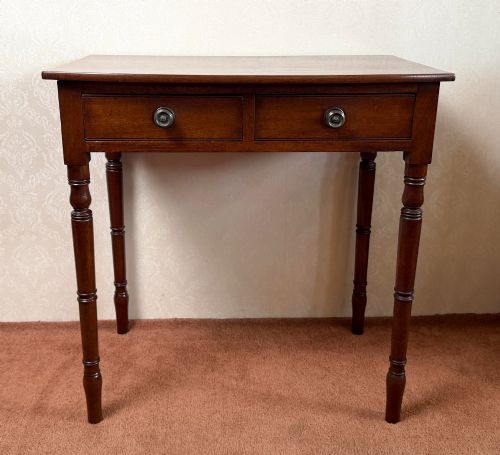
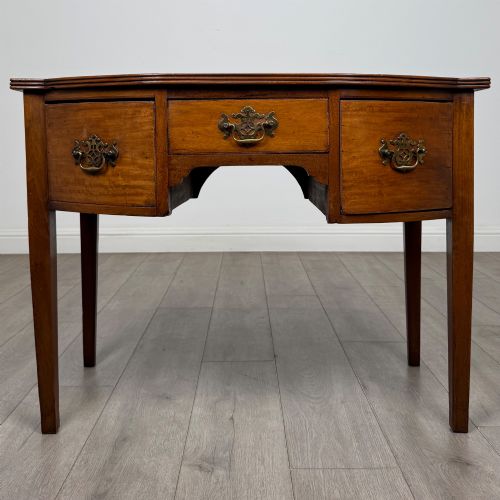
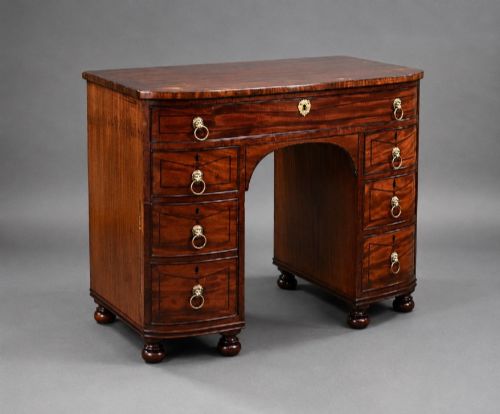
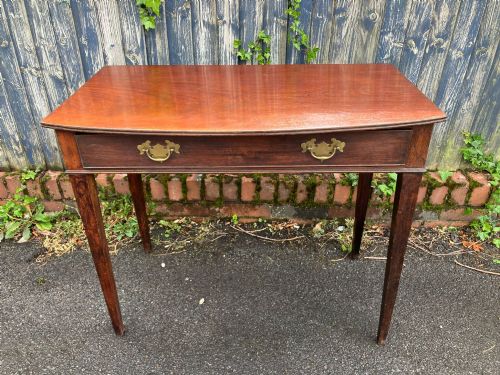
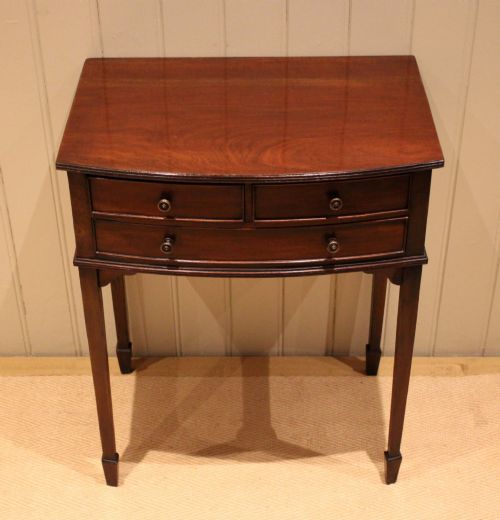


Mahogany Bow Front Desk
When you search for a mahogany bow front desk, you find curved timber writing furniture built to catch the light.
Mahogany Bow Front Desk
A mahogany bow front desk combines a gracefully curved front profile with a practical surface for writing and correspondence. These pieces span multiple eras, appearing in Georgian, Regency, Victorian and Edwardian iterations.
The form often crosses paths with side tables, dressing tables and compact sideboards. On this page, writing desks and writing tables form the core of what you encounter, alongside hybrid dressing furniture fitted with drawers.
Origins stretch from the late eighteenth century into the early twentieth century. Makers of the later revivals closely copied Georgian and Regency proportions, meaning both original period items and later interpretations populate the selection.
How they were made
Cabinet makers utilised solid mahogany alongside flame mahogany veneers to build the curved facades. Bending timber into a smooth convex bow required meticulous carpentry and steam techniques.
Details such as boxwood stringing, satinwood inlays and brass hardware frequently accent the main timber body. Some writing surfaces incorporate inset leather panels tooled with gilt borders.
Drawer construction typically relies on hand-cut dovetails. Secondary softwoods often line the interior compartments and drawer bases.
Listings feature items spanning from the Georgian era through to the Edwardian period, utilising mahogany, brass, boxwood and leather.
What varies in quality
The visual impact of the timber grain dictates much of the visual appeal. Matched flame mahogany veneer displays dramatic figuring across the curved drawers, whereas plain timber presents a uniform appearance.
Precision in the joinery determines how cleanly the bow front drawers track within their housings. Subtle stringing and crisp inlay work separate standard workshop output from exceptional cabinet making.
Original hardware, intact leather writing inserts and well-preserved structural framing elevate the standing of an individual piece.
Edwards and Roberts·Maples·S and H Jewell·JAS Shoolbred
The Mahogany Bow Front Desk Glossary
- Bow front
- A convex curved cabinet front that swells outward from the centre. This shape softens room geometry and maximises internal drawer space.
- Flame mahogany
- A veneer cut from timber fork where branches meet the main trunk, showing a distinctive flickering flame pattern. Cabinet makers reserved this figured wood for primary display surfaces.
- Stringing
- Thin inlaid lines of contrasting timber, such as boxwood, set flush into the mahogany surface. It outlines drawer fronts and borders panels.
- Pedestal desk
- A heavy writing desk featuring two separate banks of drawers supporting the top surface. They offer substantial storage beneath the writing area.
- Satinwood
- A pale, hard exotic wood utilised for contrasting inlay work and banding. It provides a bright visual counterpoint to dark mahogany.
Mahogany Bow Front Desk: Frequently Asked Questions
How do I spot a true Georgian desk?
Examine the timber selection and drawer construction methods used in the carcase. Georgian cabinet makers often employed oak or pine secondary woods with hand-cut dovetails.
Check for period-appropriate brass handles and hinges that match the expected manufacturing era. Revivals from later centuries frequently reveal modern machining marks or standardised screws.
Can I use a dressing table as a desk?
Many historical dressing tables and writing desks share identical proportions and drawer configurations. Modest kneehole spaces accommodate a chair quite comfortably.
Ensure the writing height suits your posture before committing to daily work use. Some dressing variants include upstands or mirrors that alter the surface utility.
How should I clean the mahogany surface?
Dust the timber regularly with a soft, dry lint-free cloth to prevent grit accumulation. Avoid modern silicone sprays that build up a hazy film over the finish.
Apply a quality beeswax polish sparingly to nourish the aged wood. Buff gently to maintain the natural sheen without creating a slippery residue.
What does boxwood stringing indicate?
Boxwood stringing points to decorative refinement common in late eighteenth and nineteenth-century cabinet making. Pale yellow lines frame the mahogany panels to create visual contrast.
Its presence suggests a workshop focused on stylish interior aesthetics. Craftsmen used this technique to elevate simpler furniture forms.