
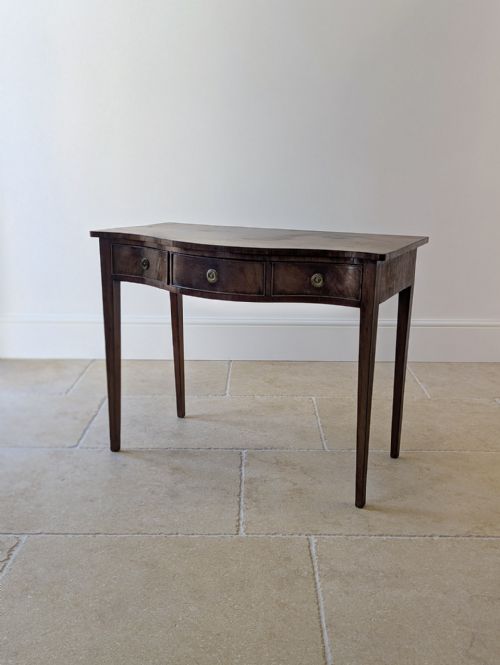


Curved Front Side Table
A curved front side table brings a refined line to a hall or drawing room, offering practical surface space without bulk.
Curved Front Side Table
When you search for a curved front side table, you are looking at items that soften the geometry of a room through bowfront, serpentine, or demi-lune profiles. These forms project gracefully outward or sweep in a half-circle, designed to sit flush against a wall while adding movement to an interior.
The versions you are most likely to meet on this page span the eighteenth, nineteenth, and early twentieth centuries, drawing on Georgian, Regency, and revival aesthetics. They appear as compact lamp tables, serving pieces, dressing tables, and console tables, executed primarily in rich timbers.
The selection ranges from understated George III mahogany pieces to twentieth-century burr walnut consoles and Italian serpentine designs. Each piece uses its curved silhouette to catch the light differently than a flat-fronted cabinet, making it both a utilitarian surface and an architectural accent.
How they were made
Cabinetmakers constructed these tables using solid and veneered timbers, predominantly mahogany and walnut, often enhanced with burr walnut figuring. Delicate stringing and contrasting details in boxwood and satinwood inlay define the edges of tabletops and drawer fronts.
Structural hardware such as brass feet and drawer pulls provide functional and decorative accents on both Georgian and later revival pieces. Tambour panels and shaped drawers required precise joinery to follow the sweeping contours of the frame without binding.
Listings feature mahogany, walnut, and burr walnut alongside decorative boxwood and satinwood inlay across multiple centuries.
What varies in quality
The distinction at the upper end of the range lies in the handling of the timber and the precision of the curved carcass. Superior examples display carefully chosen wood grain that flows naturally around the radius of the bow or serpentine front, paired with crisp, restrained inlay.
Proportion and architectural confidence separate standard production from exceptional work. Finer tables maintain structural integrity within their slender legs and curved rails, avoiding heavy or unbalanced profiles while retaining the smooth operation of shaped drawers.
The Curved Front Side Table Glossary
- Bowfront
- A convex furniture front that curves outward in an arc, softening the corners of a rectangular piece. This shape became popular during the Georgian period and remained a staple of nineteenth-century design.
- Serpentine
- A furniture front characterised by a central convex curve flanked by two concave curves, forming a continuous undulating line. It requires advanced woodworking skill to execute properly.
- Demi-lune
- A half-moon shape used for small tables and sideboards that stand flat against a wall. These pieces often feature hinged tops or tambour doors.
- Stringing
- A narrow strip of contrasting wood inlaid into the surface of a piece to create decorative borders and lines. It highlights the geometry of drawers and tabletops.
- Tambour
- A flexible shutter made of narrow vertical strips of wood glued to canvas, allowing a cupboard door to slide around a tight curve. It is frequently seen on late eighteenth-century Dutch pieces.
Curved Front Side Table: Frequently Asked Questions
Where should I place a curved front side table?
These tables suit hallways, narrow landings, and drawing rooms where a straight-edged piece might obstruct movement. Their rounded profile softens tight circulation areas while providing a convenient surface for lamps or decorative objects.
They also function effectively beneath mirrors or windows, where the reflected light plays across the curved timber grain and inlaid borders.
How do I distinguish a Georgian piece from a later revival?
Examination of the secondary woods inside the drawers and the method of carcass construction usually reveals the period of manufacture. Eighteenth-century pieces typically employ hand-cut dovetails and native timbers for internal framing.
Revival pieces from later periods often show machine standardisation or different secondary woods beneath the polished exterior, even when following traditional Georgian proportions.
Are curved front tables difficult to maintain?
Standard care involves dusting with a dry, soft cloth and occasionally feeding the timber with traditional wax to preserve the polish. Avoid placing them in direct sunlight or near heat sources to prevent the veneers from lifting along the curves.
The complex glued joints on serpentine and bowfront carcasses respond best to stable indoor humidity.
What is the difference between a console and a side table?
Console tables traditionally rely on the wall for some of their stability or are designed to stand fixed against a wall beneath a mirror. Side tables are generally freestanding pieces with four independent legs intended to serve utilitarian functions around a room.
In practice, makers and sellers often overlap the terms when describing decorative tables with curved fronts.