
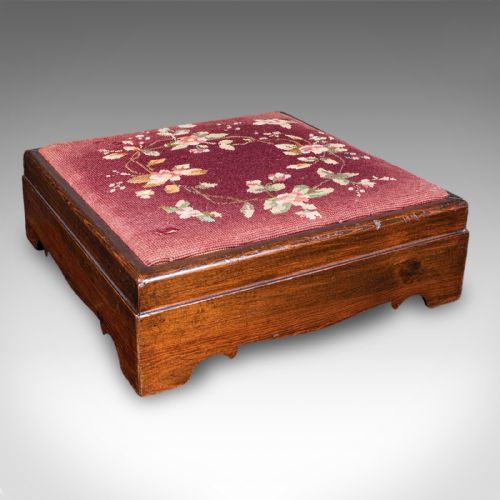


Low Tapestry Footrest
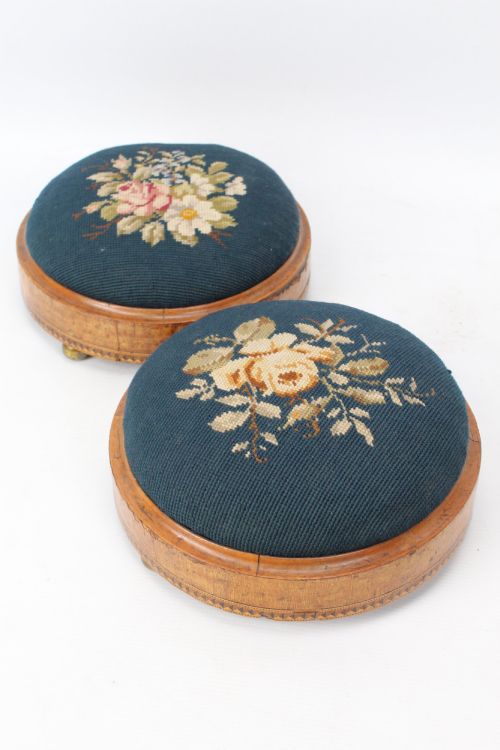
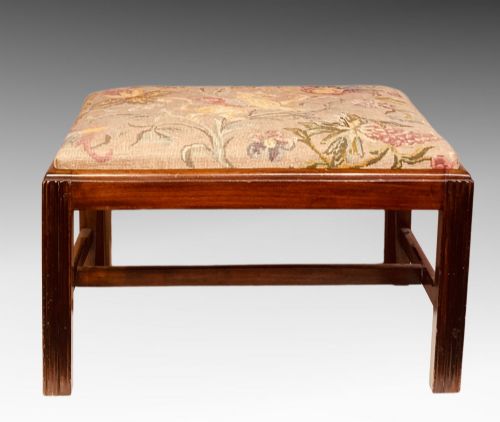
These low tapestry footrest pieces are upholstered fireside seats and low stools that bring tactile needlework and traditional timber frames into a room.
Low Tapestry Footrest
A low tapestry footrest combines a low timber frame with a textile or needlepoint upper surface designed for resting the feet by the hearth. You encounter these most frequently as Victorian or Edwardian examples featuring wool tapestry, crewelwork, or needlepoint covers set upon mahogany, walnut, rosewood, oak, or pitch pine structures.
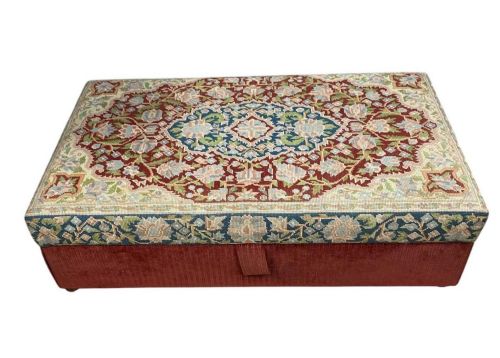
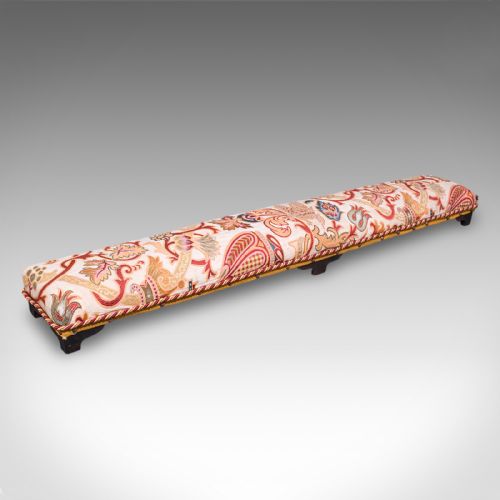
The forms range from compact individual footstools to longer carriage stools and ottoman seats reflecting stylistic revivals such as Queen Anne, Georgian, and Louis XIV. The woodwork varies from simple turned legs to carved cabriole supports, occasionally paired with painted or ebonized finishes.
These pieces function primarily as fireside furnishings and dressing stools, offering a direct link to nineteenth and early twentieth-century domestic life. Their survival depends heavily on the durability of the underlying textile and the sturdiness of the hardwood frames.
Materials and construction
Makers utilised dense timbers such as mahogany, walnut, rosewood, and oak to construct the supportive chassis of each footrest, ensuring stability under regular weight. Frames frequently incorporated carved detailing, turned wooden legs, or curved cabriole supports depending on the prevailing style of the period.
The upper sections rely on textile artistry, combining wool tapestry, needlepoint, and crewelwork stretched over padded foundations. These hand-worked covers required considerable time and skill to produce, distinguishing them from standard plain upholstery of the era.
The documented periods range from mid-nineteenth century Victorian up through the Edwardian era and the 1920s.
Judging quality in low tapestry footrests
The calibre of a low tapestry footrest is largely determined by the density and intricacy of the needlework cover, alongside the selection of timber used for the frame. Finer examples display meticulous hand-stitched wool tapestry or needlepoint with complex colour palettes and well-preserved fibre tension.
Structural refinement further separates standard production from superior pieces, evident in the crispness of carved wooden details, the choice of luxury woods like rosewood or walnut over simpler pitch pine, and the overall coherence of period revival design elements.
The Low Tapestry Footrest Glossary
- Crewelwork
- Embroidery executed with wool yarn on a sturdy linen or cotton foundation, commonly seen on traditional English footstools. This technique allows for textured, expressive floral and decorative patterns.
- Needlepoint
- A type of canvas work embroidery stitched with a count thread, frequently forming the pictorial or geometric tops of antique footstools. It provides a durable, firm surface suitable for daily foot support.
- Cabriole leg
- A furniture leg that curves outward in a convex arc at the top and bends inward in a concave arc below, ending in a pad or carved foot. This form is characteristic of Queen Anne and related revival styles.
- Ebonized
- Wood finished with a dark stain or lacquer to imitate the appearance of ebony. This treatment was popular during the Victorian era for formal or decorative seating.
Low Tapestry Footrest: Frequently Asked Questions
How do I clean a tapestry footrest top?
Surface dust can be removed gently using a soft brush or a low-suction vacuum attachment fitted with a protective mesh screen. Avoid vigorous rubbing or saturation to protect the old wool fibres.
Professional textile conservation is recommended for deep cleaning or stubborn marks. Keeping the piece away from direct sunlight prevents the wool tapestry colours from fading over time.
Are these footrests sturdy enough for daily use?
Most of these pieces are constructed from hardwoods like mahogany, walnut, and oak, built to withstand everyday domestic placement. Their low centre of gravity inherently provides good stability.
However, the load capacity depends on the age and condition of the internal wooden joints and webbing. Lighter footstools serve best for gentle support rather than heavy seating.
How do I tell a Victorian stool from an Edwardian one?
Victorian examples frequently utilise dark dense timbers such as rosewood and walnut, often accompanied by elaborate carvings or ebonized finishes. The needlework tends to feature dense floral or traditional motifs characteristic of mid-to-late nineteenth-century tastes.
Edwardian pieces often lean towards simpler constructions using alternative woods like pitch pine, reflecting lighter domestic interiors. Design revivals continued across both eras, making timber choice and upholstery style key indicators.
Can I use these as coffee tables?
Longer ottomans and wide footstools function well as low coffee tables when paired with a stable tray to protect the fabric surface. Their proportions suit placement in front of low sofas in traditional or eclectic interiors.
Care should be taken to ensure heavy or liquid items do not spill directly onto the historical needlepoint or wool tapestry cover.