


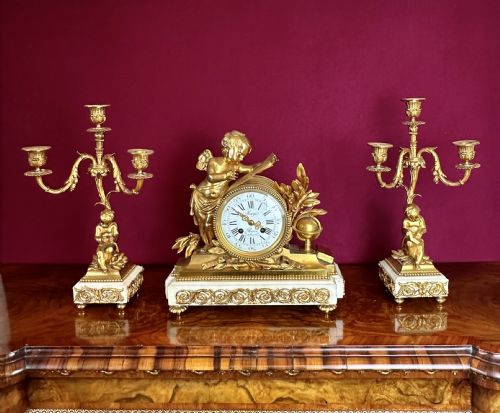
Louis XVI Style Candelabra
Louis xvi style candelabra bring classical symmetry and neoclassical ornamentation to an interior.
Louis XVI Style Candelabra
When you search for louis xvi style candelabra, you encounter decorative lighting designed to bring classical balance and architectural rigour into domestic spaces. These pieces draw upon eighteenth-century French design principles, translating them into nineteenth-century revivals that dominate the selections seen here.
Materials and Construction
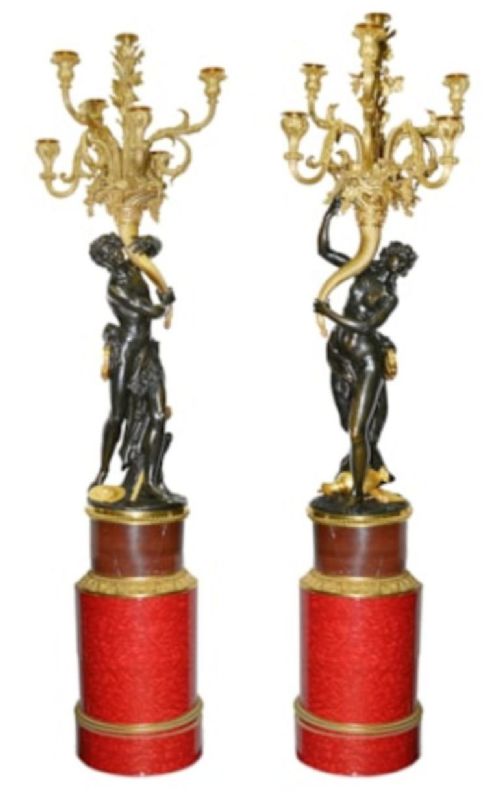
The construction of these pieces relies heavily on metal casting, utilising bronze, ormolu, and brass to build the structural arms and sculptural figures. Artisans applied mercury gilding or modern electroplating to achieve the bright golden surface known as ormolu, contrasting this with patinated dark bronze for depth.
Stone bases provide substantial weight and visual contrast, incorporating white marble, coloured marble, and occasionally fluorspar into the design. Glass drops, enamel dials, and porcelain components appear in related garniture pieces, completing the mixed-media approach typical of French neoclassical workshops.
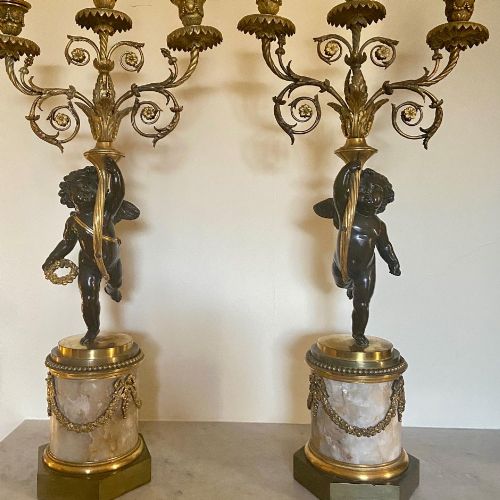
Listings demonstrate a strong preference for white marble and gilt bronze combinations, frequently paired with winged putti figures.
Distinctions in Execution
The division between standard production and exceptional work rests in the crispness of the bronze chasing and the harmony of the components. Master artisans spent hours hand-chiselling cast bronze details, whereas lesser examples retain soft edges and hurried finishing from the mould.
Material selection dictates the upper tier of the range, where solid white marble bases, heavy fire-gilt ormolu, and finely modelled figures of cherubs or putti create a cohesive visual weight. Lesser items substitute lighter brass alloys and simpler turning, lacking the architectural presence of the finer nineteenth-century revivals.
Francois Redmond·Claude Clodion·H Luppens Paris
The Louis XVI Style Candelabra Glossary
- Ormolu
- Gilt bronze produced by applying a gold and mercury amalgam to a bronze base and heating it. This technique creates a durable, luminous golden finish characteristic of fine neoclassical lighting.
- Garniture set
- A decorative grouping consisting of a central mantel clock flanked by a matching pair of candelabras or urns. These matched sets unified nineteenth-century interior mantelpiece decoration.
- Putti
- Depictions of chubby male toddlers, often winged, derived from classical mythology. They frequently support the arms of these lighting pieces or adorn the marble plinths.
- Patinated bronze
- Bronze treated with chemical solutions to produce a darkened, stable surface colour. This dark tone provides contrast against bright gilt bronze mounts.
- Neoclassical
- A style spanning the eighteenth and nineteenth centuries that revived classical Greek and Roman motifs. It emphasises straight lines, symmetry, urns, and architectural friezes.
Louis XVI Style Candelabra: Frequently Asked Questions
What is a clock garniture set?
A clock garniture set combines a central mantel clock with two matching side pieces, typically candelabras or decorative urns. These matching groups were designed to sit symmetrically upon a drawing-room mantelpiece.
Such sets became popular during the nineteenth-century revival periods, offering a unified decorative scheme for formal rooms.
Are these candelabra wired for electricity?
Many surviving examples retain their original configuration for holding wax candles rather than electric bulbs. Some pieces underwent conversion to table lamps during later periods.
Buyers often choose to utilise them with candles to preserve their original mechanical and decorative integrity.
How can you tell nineteenth century pieces apart?
Nineteenth-century revivals utilise manufacturing techniques and casting methods distinct from eighteenth-century originals. Examination of the bronze joins, screw threads, and marble turning reveals the period of manufacture. Ninetenth-century makers often incorporated heavier marble bases and crisper mechanical assembly marks compared to earlier work.