




Louis XVI Painted Fauteuil
A louis xvi painted fauteuil brings classical French symmetry and carved elegance directly into a modern room.
Louis XVI Painted Fauteuil
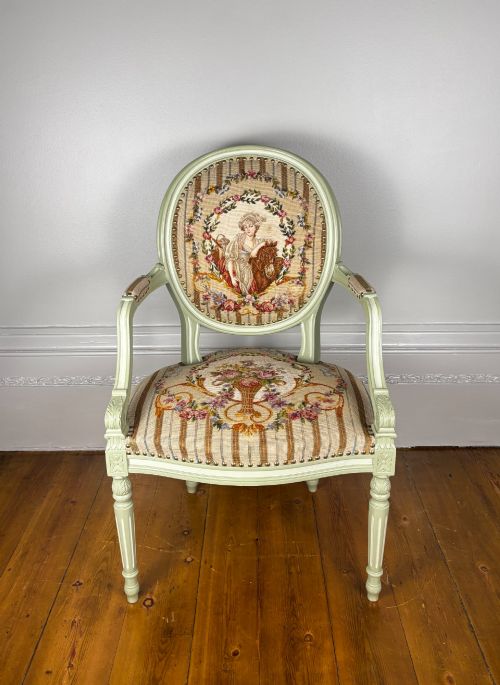
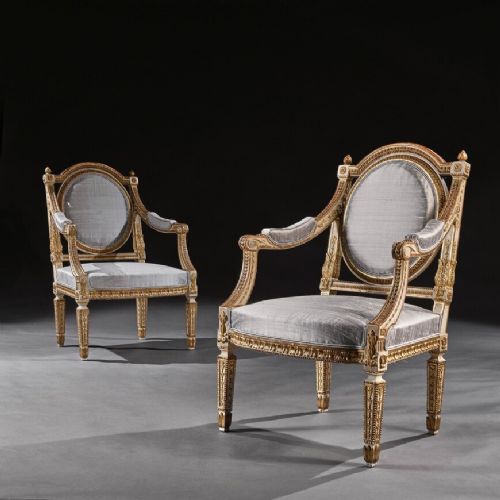
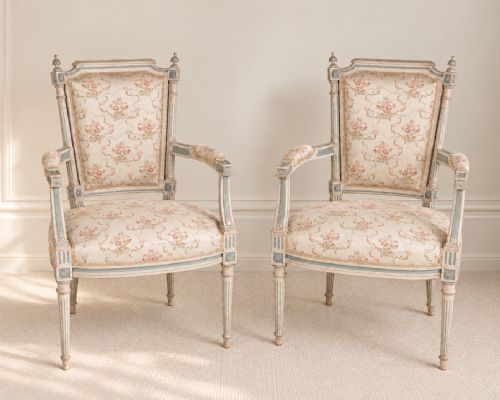
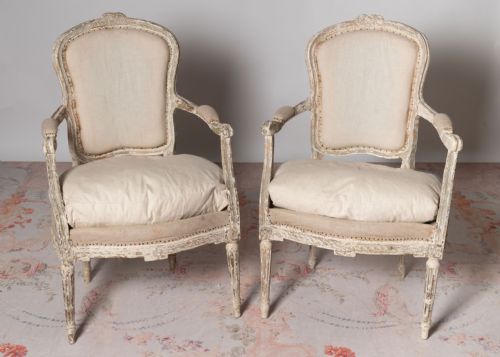
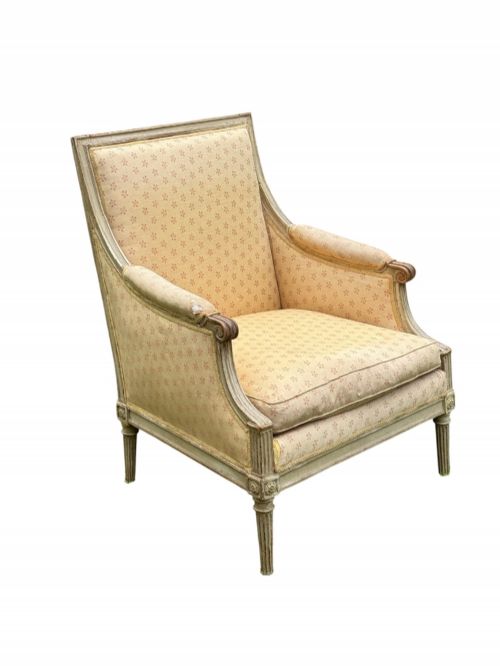
A louis xvi painted fauteuil is an open-framed upholstered armchair defined by neoclassical restraint, straight tapered legs and geometric symmetry. These seating forms developed in eighteenth-century France to replace the sweeping curves of earlier rococo designs with architectural straight lines and classical motifs.
Most examples found here emerge from nineteenth-century revivals rather than the original eighteenth-century workshops. Makers across the nineteenth and early twentieth centuries faithfully reproduced these proportions, using painted wood finishes alongside original or later textile upholstery.
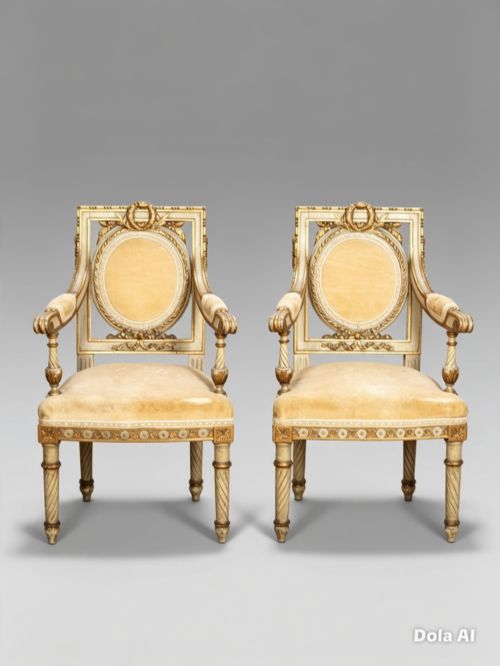
The inventory ranges from grand salon pairs to single children's salon chairs, spanning periods from the eighteenth century through Edwardian and later revival eras. Buyers encounter Italian neoclassical interpretations alongside French pieces, all sharing the distinctive open-arm architecture.
Materials and Construction
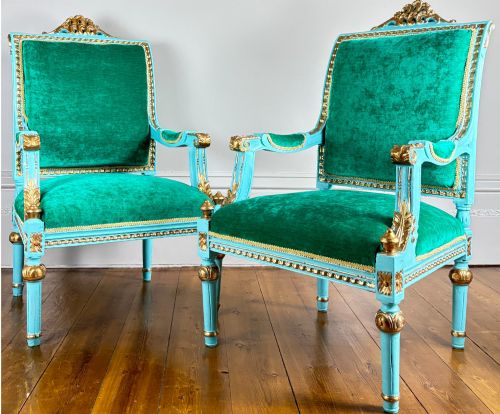
Frames are constructed from hardwoods such as beech, shaped through carving and finished with paint or parcel gilt surfaces. Surface decoration relies on layered paint treatments, often showing the mellowing effects of age on the wood beneath.
Upholstery techniques secure traditional fillings within open show frames using silk damask, velvet, tapestry panels or modern fabric coverings. Needlepoint panels and traditional textiles are fixed directly to the carved wooden structures, completing the classic armchair silhouette.
Louis XVI Painted Fauteuil Retail Price Guide 2026
Typical asking prices for louis xvi painted fauteuil among the pieces listed under this phrase on Sellingantiques today, from the lower quarter to the upper quarter. They describe what is for sale here now, not the wider market.
Children's salon chairs prove that miniature elegance was serious business in nineteenth-century French households.
Factors of Quality
Quality rests upon the crispness of the wood carving and the integrity of the painted surface. Hand-carved details on beech frames display sharp definition, whereas lesser pieces show softer, more rounded contours from mechanical production or heavy over-painting.
The structural stability of the open arm joints dictates daily usability. Superior examples maintain rigid joinery where the arm supports meet the seat rail, supporting the upholstered components without movement or structural weakness.
Henri Jacob
The Louis XVI Painted Fauteuil Glossary
- Parcel Gilt
- Woodwork decorated with partial application of gold leaf over a painted base. This technique highlights specific carved architectural details.
- Neoclassical
- A decorative style reviving classical Greek and Roman motifs. The aesthetic relies on straight lines, symmetry and restrained ornamentation.
- Show Frame
- Exposed structural woodwork forming the visible outline of an armchair. The carved wooden border frames the upholstered back and sides.
Louis XVI Painted Fauteuil: Frequently Asked Questions
How do I spot a true period piece?
Authenticating an eighteenth-century example involves examining the tool marks, timber shrinkage and hand-cut joinery hidden beneath the frame. Nineteenth-century revivals and later copies often utilise machine-cut elements and different wood preparation methods.
Studying the wear patterns on the painted surface also reveals age. Genuine historic paint layers show natural craquelure and thinning over decades of handling rather than artificial distressing.
Where should I place a fauteuil?
These open armchairs suit drawing rooms, bedrooms or studies where their architectural frames remain visible from all angles. Their compact proportions allow them to sit comfortably beside larger sofas without overcrowding the floor plan.
Because the arms are open rather than solid upholstered boxes, they maintain visual lightness in a room. Pairing two matching chairs creates a balanced seating focal point.
Are these chairs comfortable for daily use?
The seating posture is upright and supportive, designed for formal conversation rather than lounging. Traditional webbing and stuffing provide a firm seat foundation.
Some vintage examples feature modern interior padding updates while retaining their historic frames. Buyers planning daily seating often check the seat height and depth to match personal comfort preferences.
How do I care for painted wood?
Dusting with a soft, dry cloth prevents particle accumulation on delicate painted and parcel gilt surfaces. Avoid harsh chemical cleaners that can strip or soften historic paint layers.
Keeping the chair away from direct sunlight and steady moisture protects both the wooden frame and the fabric upholstery. Gentle handling preserves the original surface finish for future years.