


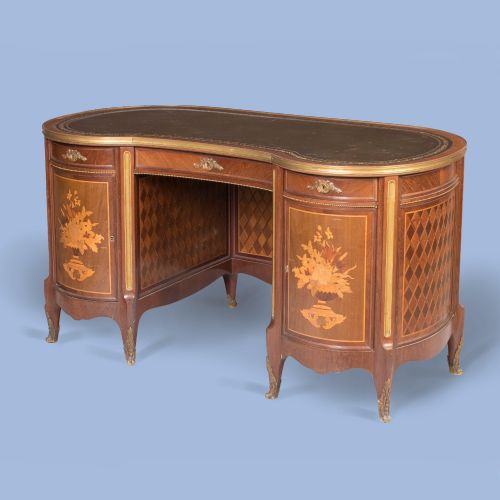


Louis XV Style Pedestal
A louis xv style pedestal brings curvaceous French flair and rich timber to a room, offering an elegant stage for your display pieces.
Louis XV Style Pedestal
A louis xv style pedestal presents a compact display surface raised on sinuous cabriole legs, capturing the fluid movement of the eighteenth-century French court. These pieces emerge in various forms across the nineteenth and twentieth centuries, spanning occasional tables, taller plant stands, and dedicated pedestals and plinths.
The selection here draws primarily upon revival periods, including late Victorian and early twentieth-century interpretations. Makers channel the aesthetic through French provincial and chateau influences, pairing organic timber structures with decorative metal mounts.
While traditional pedestals share floor space with related occasional tables, bedside cabinets, and clock cases, each retains the signature asymmetric curves and ornate casting associated with the style.
Materials and construction
Carpenters build these frames in walnut, mahogany, and bleached oak, frequently applying finely figured kingwood veneers in geometric parquetry and marquetry patterns. Stonework surfaces like marble and onyx inset into the tops add substantial weight and a cool, contrasting texture to the timber.
Gilt bronze and ormolu mounts punctuate the corners and feet, shaped into foliate scrolls and cascading sabots that protect the vulnerable wooden extremities. Enamel dials, porcelain inserts, and chiseled brass detailing further enrich the surfaces of these decorative stands and clock cases.
Louis XV Style Pedestal Retail Price Guide 2026
Typical asking prices for louis xv style pedestal among the pieces listed under this phrase on Sellingantiques today, from the lower quarter to the upper quarter. They describe what is for sale here now, not the wider market.
Some nineteenth-century makers hid secret compartments inside their pedestals, perfect for stashing love letters away from inquisitive eyes.
Distinctions in craftsmanship
Quality reveals itself in the crispness of the bronze casting and the precision of the parquetry layout across curved surfaces. Finer examples display hand-chiseled detail in the ormolu mounts rather than repetitive factory casting, alongside tightly fitted marble or onyx tops that sit flush within their wooden rebates.
Structural integrity separates utilitarian pieces from exceptional works, visible in the seamless movement of drawers and the stability of slender cabriole legs. The depth of the timber finishing and the sophistication of the veneer matching dictate the visual hierarchy within this group.
Zwiener Jansen Sucesseur
The Louis XV Style Pedestal Glossary
- Ormolu
- Gilt bronze applied as a decorative mount to furniture and clocks. The technique involves creating a mercury gilding finish over cast bronze, producing a bright gold appearance.
- Parquetry
- Geometric wood inlay forming patterns such as cubes or herringbones. Artisans use contrasting timbers like kingwood and walnut to create visual depth across flat and curved surfaces.
- Cabriole leg
- A furniture leg that curves outward in an upper convex arc and inward in a lower concave arc, ending in a pad or scroll foot. This shape mimics animal limbs and defines the louis xv aesthetic.
- Guéridon
- A small round table supported by one or more columns or figurative legs. These French tables often feature marble tops and gilt bronze mounts.
- Marquetry
- Elaborate veneer work forming pictorial or decorative designs using various wood types and tinted woods. It differs from parquetry through its use of organic motifs such as flowers and leaves.
Louis XV Style Pedestal: Frequently Asked Questions
What is a louis xv style pedestal used for?
These pieces serve primarily as elevated display surfaces for sculpture, clocks, urns, or decorative plants. Their compact footprints allow them to occupy corners and hallways where larger furniture cannot fit.
Beyond simple display, they introduce sculptural warmth and historic character to empty interior spaces. Their varied heights help break up flat sightlines in a room.
How do I care for marble and onyx tops?
Clean stone surfaces with a damp cloth and neutral soap, avoiding acidic substances like lemon juice or vinegar that etch the polish. Use coasters under drinks and felt pads beneath heavy objects to prevent scratching.
Apply a specialist stone wax periodically to maintain the sheen and protect against minor moisture marks. Regular dusting keeps abrasive grit from wearing down the smooth finish.
Are these pedestals genuine eighteenth-century pieces?
The majority of pieces bearing this style originate from revival periods spanning the late nineteenth and early twentieth centuries. Makers during the Victorian era and the nineteen-twenties enthusiastically reproduced eighteenth-century French designs using period techniques.
Examining the construction methods, wood shrinkage, and wear patterns helps determine the exact age of a specific stand. Revival pieces carry their own historical significance as expressions of late nineteenth-century taste.
How do I fit a pedestal into a modern interior?
Use a pedestal as a focal point in a minimalist room to create a sharp contrast between clean modern walls and ornate historical woodwork. Placing a contemporary ceramic or bronze sculpture on top bridges the gap between old and new.
Ensure the piece has adequate clearance in high-traffic walkways to protect delicate ormolu mounts from accidental knocks. Pairing timber tones with existing furniture creates a cohesive scheme without matching every item.