
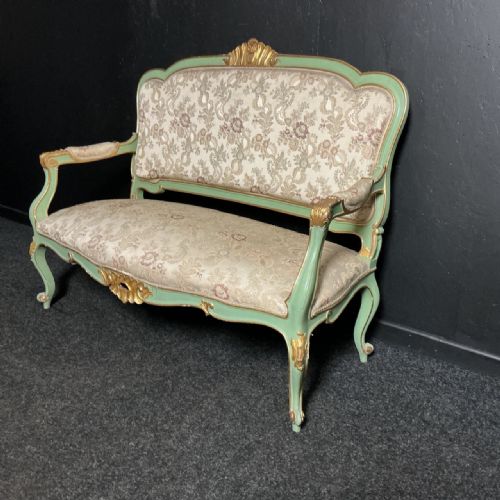


Louis XV Gilt Settee
A louis xv gilt settee brings sweeping curves and rich gilding straight into a modern salon, offering both elegance and traditional seating.
Louis XV Gilt Settee
A louis xv gilt settee represents a distinct seating form shaped by Rococo aesthetics, appearing in forms such as the canapé, two-seater window sofa, and salon couch. These pieces emerge predominantly in nineteenth-century revivals, alongside twentieth-century interpretations, capturing the French taste for flowing lines and carved wooden frames.
Buyers encountering this search phrase will find variations spanning the nineteenth century, including specific dates like 1870, 1890, 1900, 1910, and Victorian examples. The construction ranges from showframe gilded wood to painted finishes upholstered in damask, silk, or tapestry.
How they were made
Makers utilised timber, beech, and carved wood to build the structural frames of these settees, applying giltwood or paint finishes to the exterior surfaces. Caning appears alongside upholstered elements covered in fabric, silk, and damask.
The decorative vocabulary relies heavily on carved woodwork characteristic of the Louis XV style and Rococo Revival, creating flowing contours and intricate surface detailing.
Listings feature pieces utilising beech and timber, finished with giltwood or paint, alongside upholstered elements in silk and damask.
What varies in quality
The refinement of the carved wood details and the execution of the gilding set superior examples apart from simpler pieces. Hand-carved elements display sharper definition and deeper relief than mass-produced alternatives.
The integrity of the underlying timber frame and the quality of the chosen upholstery materials, whether silk, damask, or cane, determine the overall substance and longevity of the settee.
The Louis XV Gilt Settee Glossary
- Canapé
- A traditional French upholstered sofa or settee, typically featuring an exposed wooden frame and an arched backrest. This form sits at the centre of many formal nineteenth-century salon settings.
- Giltwood
- Timber that has been coated with gold leaf or a gold-coloured metallic finish to simulate solid gold. It provides the bright, reflective surface characteristic of many antique formal seats.
- Louis XV Style
- A design movement inspired by the mid-eighteenth-century French court, defined by asymmetrical curves, organic motifs, and a lack of straight lines. Revival versions appeared frequently throughout the Victorian era.
- Rococo Revival
- A nineteenth-century artistic movement that resurrected the exuberant curves and scrollwork of the original Rococo period. This style dominates the aesthetic of most Victorian-era gilded couches.
- Showframe
- A wooden sofa frame where the structural woodwork remains visible around the upholstered margins. It allows the carved and gilded decoration to form a prominent part of the visual design.
Louis XV Gilt Settee: Frequently Asked Questions
Where did people use a louis xv gilt settee?
These pieces traditionally furnished formal reception rooms, boudoirs, and grand salons where entertaining took place. Their decorative carved frames were designed to be viewed from all angles within an open room.
Today, they serve a similar purpose in modern drawing rooms or large bedrooms, functioning as statement seating rather than everyday lounging furniture.
How do I clean a gilded wooden frame?
Gilded surfaces require delicate maintenance to preserve the thin layer of gold leaf or metallic paint. Dust the carved wooden areas gently with a soft, dry microfibre cloth without applying liquid cleaners.
Avoid commercial polishes entirely, as chemical agents can strip the historic finish from the timber beneath.
Can I reupholster a vintage settee safely?
Upholstery can be replaced to match modern interior palettes while preserving the historic timber frame underneath. Traditional webbing and stuffing techniques should be used to maintain the correct profile of the piece.
Consult a professional restorer who understands antique showframes to ensure the structural woodwork is not damaged during the process.
Are these settees comfortable for daily sitting?
These seats were originally designed for upright posture during formal social interactions rather than relaxed lounging. The firm padding and rigid wooden backs reflect the etiquette of nineteenth-century salons.
While perfectly suitable for resting, they offer a very different sitting experience compared to modern deep-cushioned sofas.