


Gold Damask Canape
A gold damask canape brings French revival elegance into a room, offering wide upholstered seating dressed in rich patterned silk and gilt frames.
Gold Damask Canape
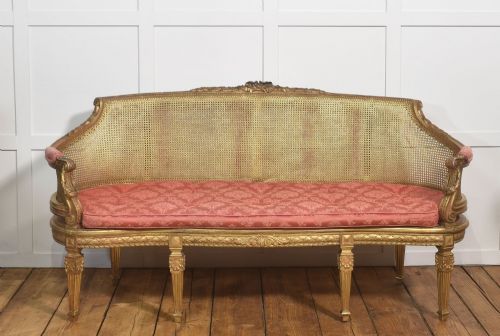
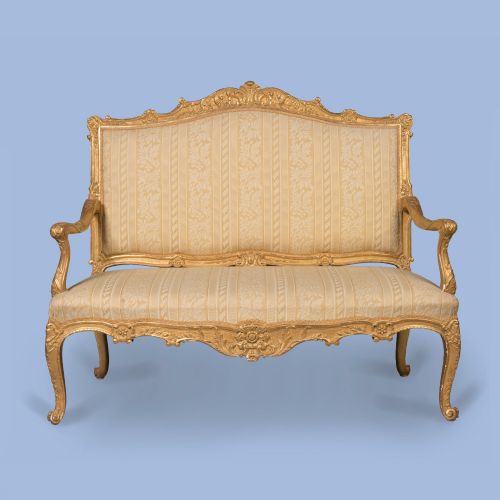
A gold damask canape is a classic French-style settee or sofa, typically featuring a carved wooden frame finished in gilt, paint or polished walnut. These grand seats draw on Louis XV and Louis XVI revival designs, bringing historic seating forms into nineteenth and early twentieth-century interiors.
Most examples found here date from the nineteenth century up to nineteen-twenty, reflecting enduring Victorian and Edwardian tastes for continental seating. You will encounter both single settees and larger salon suites that pair a sofa with matching armchairs.
The frames range from ornate rococo curves to the straighter, neoclassical lines of the Louis XVI style. Upholstery leans heavily on silk damask and patterned textile fabrics, often paired with exposed cane panels on select frames.
Materials and construction
Makers shaped these canapes from solid timbers such as beech, walnut and giltwood, carving the frames with floral motifs and classical detailing. Giltwood surfaces received thin layers of gold leaf or metallic paint over a prepared ground, creating a bright reflective finish.
Upholstery relied on traditional textile techniques, securing damask fabric over padded foundations to create a firm yet comfortable seat. Cane work was woven directly into wooden channels on lighter frames, offering a contrasting texture to the carved woodwork.
Current listings feature pieces spanning the nineteenth century up to nineteen-twenty, utilising giltwood, walnut, beech, and silk damask fabrics.
Assessing quality and craftsmanship
Quality in a gold damask canape rests on the depth and crispness of the wood carving, where hand-tooled details surpass simpler mechanical shaping. Finer frames show confident proportions and seamless joinery that hold up across sweeping cabriole legs or fluted neoclassical posts.
The choice of finishing materials also sets pieces apart, from genuine gold leaf applications down to standard paint finishes. Upholstery quality shows in the weight of the damask textile and the precision with which patterns align across the seat and back.
The Gold Damask Canape Glossary
- Canape
- An upholstered French sofa or settee designed with an exposed wooden frame. It typically seats two or three people.
- Damask
- A reversible figured fabric woven on a jacquard loom, featuring patterns formed by contrasting warp and weft threads. Silk damask provides a notable sheen.
- Giltwood
- Timber that has been coated with gold leaf or a metallic powder finish. This treatment creates a bright, decorative surface.
- Louis XVI Style
- A neoclassical design movement characterised by straight lines, symmetry, and classical motifs such as fluting and ribbons. It contrasts with the curving asymmetry of earlier rococo forms.
Gold Damask Canape: Frequently Asked Questions
What is a gold damask canape?
A gold damask canape is a traditional French-style sofa featuring a gilt or painted wooden frame and patterned damask upholstery. These pieces were designed for formal reception rooms and parlours.
They combine decorative carved woodwork with soft seating, serving both as functional furniture and decorative statements in period interiors.
How do I date a canape?
Dating relies on examining the framing timber, carving style, and upholstery methods used in the piece. Nineteenth-century examples often draw on specific revival periods like the Louis XV or Louis XVI styles.
construction marks, tool traces, and the wear on gilt surfaces help establish whether a piece originates from the nineteenth century or the early twentieth century.
Can I use a canape daily?
These antique settees function well for everyday use provided the frame joints remain solid and the internal webbing is secure. Many survive from the nineteenth century because they were built with robust hardwood frames.
Placing them away from direct sunlight protects the silk damask fabric from fading, preserving the textile over years of normal seating.