
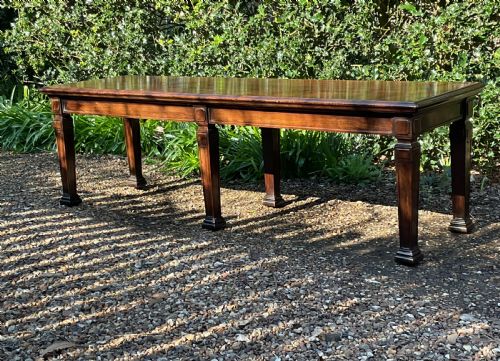


Long Mahogany Table
A long mahogany table anchors a room with deep timber grain and generous proportion, offering the surface area needed for grand dining and formal halls.
Long Mahogany Table
When you search for a long mahogany table, you encounter substantial dining furniture alongside narrow console tables and refectory formats. These pieces originate from Georgian, Victorian and Edwardian periods, carrying the heavy presence characteristic of those eras.
Dining boards and console variations dominate the listings, featuring multi-pedestal bases or long stretches designed to accommodate numerous guests. Alongside these dining formats, smaller runs include sideboards and benches utilising the same dense timber.
The material unites these objects, bridging centuries of British cabinet making from the eighteenth century into the twentieth. Buyers select these tables for formal dining spaces and large hallways requiring historic weight.
How they were made
Cabinet makers constructed these pieces primarily from solid mahogany and timber frames, sometimes incorporating brass castors and fittings to support heavy extensions. The dense wood required skilled hand planing and joining techniques to create stable, level surfaces across expansive lengths.
Extended dining versions frequently utilise removable leaves and pillar supports, allowing the timber to expand and contract without warping. Secondary woods like pine appear in hidden structural elements, while the visible exterior displays rich mahogany grain.
The listings span from the Georgian era through the Victorian period and into Edwardian times, using mahogany, brass and pine.
What varies in quality
Quality rests in the selection of the timber grain and the integrity of the underlying construction methods. Superior pieces display book-matched veneers or dense solid mahogany boards that have aged evenly without excessive surface distortion.
The sophistication of the leg joinery, the smoothness of extending mechanisms and the retention of original brass hardware distinguish workshop standards. Tables retaining their original leaves and uncompromised structural frames represent the higher tier of surviving examples.
The Long Mahogany Table Glossary
- Refectory table
- A long, narrow dining table traditionally built for communal dining halls. These examples often feature simple stretcher bases supporting solid timber tops.
- Pedestal table
- A table supported by one or more central pillars rather than four corner legs. This construction allows for flexible seating arrangements along the length of the top.
- Console table
- A narrow side table designed to stand flat against a wall. They frequently appear in hallways and formal reception rooms.
- Extending table
- A dining table equipped with a mechanism and removable leaves to alter its overall length. This design accommodates variable seating capacities.
- Tilt top table
- A table featuring a mechanism that allows the surface to pivot to a vertical position when not in use. This design saved space in period interiors.
Long Mahogany Table: Frequently Asked Questions
How do I seat guests comfortably?
Consider the placement of pedestal bases or legs underneath the timber top. Tables with multiple pedestals offer more legroom along the sides than traditional four-legged designs.
Measure the clearance from the floor to the underside of the rails to ensure standard dining chairs fit underneath without obstruction.
How do I care for the surface?
Dust the mahogany regularly with a soft, dry cloth to prevent particulate build-up in the grain. Avoid placing the timber near direct heat sources or strong sunlight to prevent fading and splitting.
Apply natural beeswax periodically to nourish the wood and maintain a soft, protective sheen across the top.
How do I tell periods apart?
Examine the leg styles, edge profiles and construction marks underneath the top. Georgian examples often feature slender proportions and hand-cut dovetails, while Victorian pieces tend to be heavier with carved cabriole legs or robust pedestals.
Edwardian furniture frequently combines traditional forms with lighter inlay work or simpler Edwardian joinery techniques.
Can I use these daily?
Solid mahogany provides a durable surface suitable for regular daily use when treated with appropriate care. Use heat mats and coasters to protect the polish from moisture rings and hot serving dishes.
Routine use develops a deeper patina on the timber over time, enhancing the historic character of the piece.