
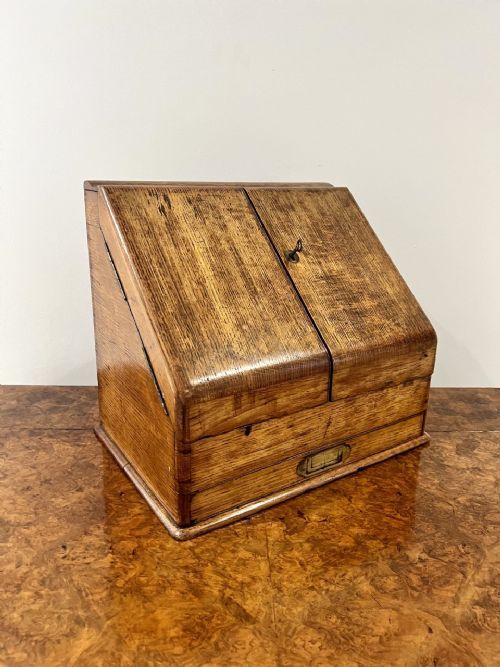


Locking Stationery Box
These locking stationery box examples are secure desk pieces designed to keep correspondence private, built from figured woods and fitted with working brass locks.
Locking Stationery Box
When you search for a locking stationery box, you are looking at secure desk furniture designed to house letters, post, and writing paper away from prying eyes. The pieces listed on this page span the Victorian and Arts and Crafts periods, moving from polished walnut cabinets to sturdy golden oak letter boxes.
How they were made
Cabinet makers constructed these boxes using solid timbers and decorative veneers such as burr walnut and figured mahogany, often reinforcing the corners with brass banding. Interiors were carefully divided with wooden partitions to hold envelopes, stamps, and folded sheets of correspondence.
Security was a central consideration, achieved through mortise locks, Bramah mechanisms, and working keys that secured the fall-front doors or hinged lids. Details like mother-of-pearl inlay and carved oak panels added visual richness to the structural joinery.
Listings feature items from the Victorian period, the nineteenth century, and the Arts and Crafts movement, spanning materials from brass and oak to mother-of-pearl.
What varies in quality
Quality in these boxes rests upon the selection of timber veneers, the precision of the internal dividers, and the integrity of the locking mechanism. Superior pieces display book-matched burr walnut or deeply carved oak, alongside sophisticated internal arrangements like secret drawers released by hidden springs.
The presence of an original, functioning lock by a notable maker elevates a piece significantly beyond standard commercial production. Simpler pine-lined boxes with plain brass fittings occupy the more utilitarian end of the spectrum.
The Locking Stationery Box Glossary
- Bramah lock
- A high-security cylindrical lock invented by Joseph Bramah in the late eighteenth century. These mechanisms were frequently fitted to fine writing slopes and document boxes for superior protection.
- Writing slope
- A portable desk featuring a sloping lid that opens to reveal a velvet or leather-lined writing surface and compartments for stationery. Many examples incorporate secret drawers beneath the inner fittings.
- Correspondence box
- A desk accessory designed specifically to store incoming and outgoing post, letters, and envelopes. They often feature tiered interior slots and glazed or panelled fall-front doors.
- Burr walnut
- A prized wood veneer harvested from the distorted growth knots of walnut trees. It yields a rich, swirling grain pattern highly favoured by nineteenth-century cabinet makers.
- Mother-of-pearl
- The iridescent inner layer of certain mollusc shells, sliced into thin plaques and embedded into wood surfaces for decorative inlay.
Locking Stationery Box: Frequently Asked Questions
What is a locking stationery box?
A locking stationery box is a desk accessory or small cabinet designed to organise letters, envelopes, and writing paper securely. They feature hinged lids or drop-front doors secured by metal locks.
These pieces were essential items on nineteenth-century desks, keeping private correspondence confidential in busy Victorian and Edwardian households.
How were writing slopes used?
Writing slopes served as portable desks that folded open to provide an angled, covered surface for writing letters. The interior compartments held inkwells, pens, and paper.
When closed and locked, the entire case secured the writer's personal documents and correspondence safely inside.
What woods were used for these boxes?
Cabinet makers utilised a variety of native and imported timbers, most commonly oak, walnut, rosewood, and burr walnut veneers. Sturdier varieties like golden oak were typical of the Arts and Crafts movement.
More decorative pieces incorporated contrasting inlaid woods and brass banding to protect the corners and edges.
How do I spot a Bramah lock?
A Bramah lock is distinguished by its cylindrical key and small, slotted metal keyhole rather than a traditional flat key mechanism. They represent a high standard of period security.
Finding an original working key with a Bramah lock adds considerable interest to a Victorian writing box.