


Leather Throne Chairs
Leather throne chairs are substantial seats combining commanding timber frames with hide upholstery, built to anchor a room with architectural authority.
Leather Throne Chairs
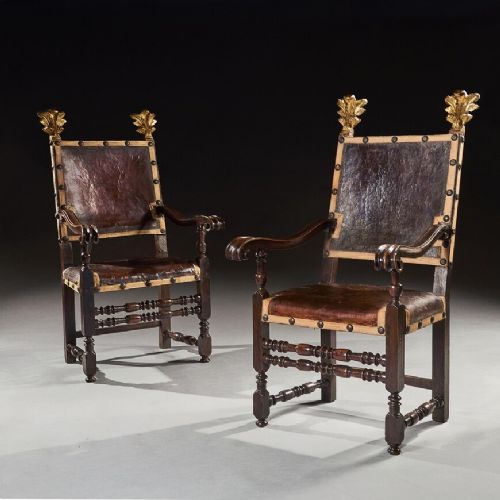
When you search for leather throne chairs, you encounter imposing high-backed seats primarily constructed from solid oak and walnut, frequently echoing earlier historical eras. The pieces on this page span from the seventeenth century through to the early twentieth century, with nineteenth-century Victorian revival examples appearing most frequently.
These seating forms encompass heavy armchair variants, carver chairs, and occasional high-backed hall chairs. Stylistically, the selection draws heavily on Gothic Revival, Jacobean, and Renaissance revival idioms, resulting in deep relief carving and commanding silhouettes.
Makers often employed substantial timber framing to support upholstered leather panels on the backrests and seats. These heavy forms served domestic libraries, halls, and formal reception spaces where status and physical presence were paramount.
How they were made
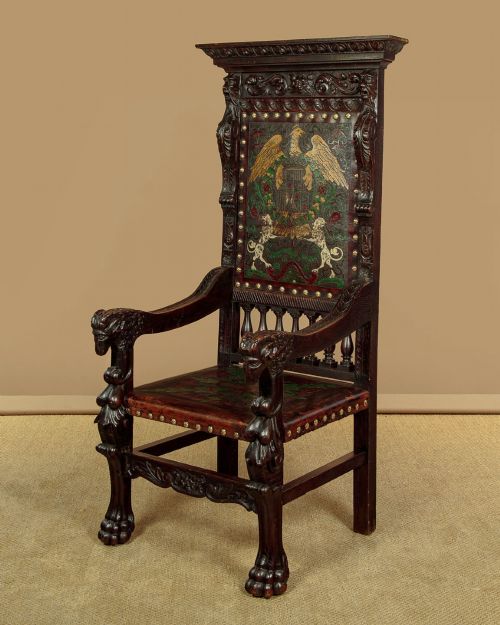
Construction relies upon dense hardwoods such as oak and walnut, shaped through mortise and tenon joinery to bear the weight of tall frames and heavy backs. Timber surfaces received hand-carved detailing, panel moulding, and occasionally parcel-gilt or painted enrichment.
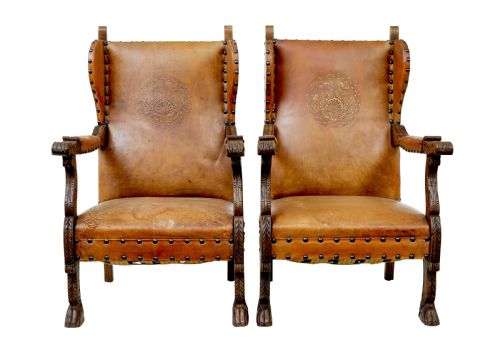
Upholstery involves thick hides, sometimes embossed, painted, or secured with brass studding along the framework. Buttoned leather panels and padded armrests appear on later nineteenth-century iterations, combining structural rigidity with padded comfort.
Listings feature oak and walnut frames combined with leather upholstery across nineteenth-century Gothic Revival and seventeenth-century Baroque styles.
What varies in quality
Quality rests upon the depth and crispness of the timber carving, alongside the selection of heavy, well-seasoned hardwoods for the structural frame. Superior examples demonstrate rigorous joinery that keeps tall backrests rigid over centuries of use.
The treatment of the leather upholstery dictates much of the visual merit, distinguishing simple tacked hides from elaborate embossed or painted panels. Original surface patination on both the timber and the leather separates utilitarian workshop pieces from exceptional commissions.
A.W.N. Pugin
The Leather Throne Chairs Glossary
- Carver chair
- An armchair designed with arms, traditionally placed at the head of a dining table or used as a standalone seat. These pieces often match a set of simpler side chairs.
- Gothic Revival
- A nineteenth-century design movement drawing inspiration from medieval architecture. Pieces adopt pointed arches, tracery, and clustered columns.
- Parcel-gilt
- A decorative technique where specific carved details of a wooden object are partially gilded with gold leaf. This method highlights particular architectural motifs against a dark timber background.
- Jacobean Revival
- A later stylistic movement reviving the heavy, rectilinear furniture forms of the early seventeenth century. Such items utilise bold turning, panelled backs, and deep geometric carving.
- Wainscot chair
- An early form of wooden armchair constructed with panelled backs, traditionally associated with sixteenth and seventeenth-century domestic interiors. These seats are precursors to heavier library and hall seating.
Leather Throne Chairs: Frequently Asked Questions
What rooms suit leather throne chairs?
These commanding seats suit spaces with high ceilings and substantial proportions, such as libraries, studies, or grand hallways. Their architectural frames provide a strong visual anchor against panelled walls or heavy bookcases.
In smaller modern rooms, a single throne chair functions as an accent piece rather than a primary lounge seat. Pairing them with understated surroundings allows the carved woodwork and leather panels to stand out.
How do I maintain leather upholstery?
Historic leather requires gentle cleaning using specialised conservation waxes or mild saddle soap to prevent the hide from drying and cracking over time. Avoiding direct sunlight and intense heat sources preserves both the suppleness of the material and its original colour.
Checking the brass tacks and underlying webbing periodically ensures the upholstery remains secure within the timber frame. Professional conservation is recommended for fragile embossed or painted leather panels.
How do I date a throne chair?
Dating relies on identifying the convergence of timber species, joinery methods, and revival stylistic markers. Seventeenth-century originals display hand-split timbers and pegged joinery, whereas nineteenth-century revival pieces utilise machine-sawn components alongside period-correct historicism.
Decorative motifs also clarify the timeline, with Gothic lancets and Jacobean strapwork appearing in distinct waves of nineteenth-century revivalism. Comparing the carving depth against documented examples helps narrow the decade of manufacture.
Were these chairs used for sitting?
Historical throne chairs were designed for formal seating by heads of households or honoured guests, prioritising upright posture over casual lounging. Their rigid high backs and solid armrests reflect an era when seating denoted social hierarchy.
Today, they remain functional seating options, though their firm padding and upright angles differ significantly from modern upholstered armchairs.