


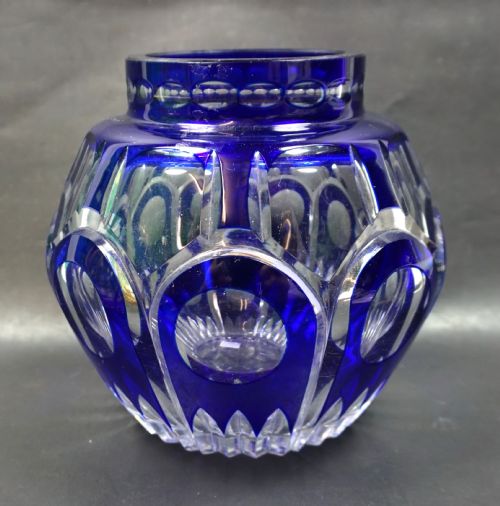


Lead Crystal Vase
These heavy lead crystal vase examples bring genuine weight and refractive brilliance to a room, offering a functional vessel that catches light.
Lead Crystal Vase
A lead crystal vase serves as a decorative or functional vessel designed to hold floral arrangements or display brilliant light refraction through deep facet cutting. When searching for a lead crystal vase, a buyer encounters pieces originating from the Regency, Victorian, Edwardian, and Art Deco periods. These vessels range from towering celery forms and lidded urns to vibrant cased and overlay glass pieces produced in England and Belgium.
The most frequent examples appearing on this page span the early nineteenth century up to the mid-twentieth century. English Regency and Victorian workshops supply heavily cut clear crystal, while continental makers from Belgium contribute striking coloured cased glass designs from the nineteen-thirties.
How they were made
Maker workshops utilised lead crystal, crystal glass, and cased or overlay glass to build heavy blanks before applying cold-working techniques. Skilled cutters ground geometric facets, flutes, and botanical engravings directly into the heavy material using abrasive wheels.
Coloured pieces involved fusing a layer of coloured glass over a clear crystal core, known as cased or overlay glass, allowing cutters to slice through the top layer to reveal the contrasting clear crystal underneath.
The site listings feature lead crystal vase examples spanning the Regency, Victorian, Edwardian, and Art Deco periods, in both clear and cased glass.
What varies in quality
The standard of a lead crystal vase depends primarily on the depth, crispness, and symmetry of the wheel-cut facets. Sharply defined edges and brilliant optical clarity distinguish master-carved studio pieces from simpler pressed or moulded glassware.
Weight and balance also define superior examples, alongside the richness of colour in cased glass items where the outer layer contrasts cleanly with the clear crystal beneath.
Charles Graffart for VSL·Joseph Simon for Val St. Lambert·Val St. Lambert·Keith Murray for Stevens & Williams
The Lead Crystal Vase Glossary
- Lead crystal
- Glass containing a significant lead oxide content, which increases the material weight, refractive index, and working time for cutting. This high density allows the glass to scatter light into prismatic colours.
- Cased glass
- A vessel formed from two or more distinct layers of glass of different colours fused together while molten. This technique permits decorative contrast when the exterior layer is carved away.
- Overlay glass
- A specific form of cased glass where a deeply coloured outer layer completely covers a clear or contrasting inner body. Cutters slice through this top layer to create complex patterns of colour and light.
- Celery vase
- A tall, footed vessel originally designed to hold stalks of celery on formal dining tables during the nineteenth century. These deep vessels frequently double as large floral vases today.
- Facet cut
- A surface finish composed of multiple flat, polished planes ground into the glass body. These geometric cuts maximise the internal reflection and sparkle of the crystal.
Lead Crystal Vase: Frequently Asked Questions
What is a lead crystal vase used for?
These pieces function primarily as decorative centrepieces or sturdy vessels for cut flowers. Their substantial weight makes them particularly suitable for supporting tall stems without tipping.
Historically, specific forms such as celery vases served specialised dining purposes before transitioning into decorative display items in modern interiors.
How do I date an old lead crystal vase?
Dating relies on identifying stylistic markers, cutting techniques, and specific maker signatures or silhouettes. Regency and Victorian pieces often feature heavy hand-cut facets and polished pontil marks on the base.
Later twentieth-century examples from designers like Keith Murray or Belgian glassworks display distinct modernist geometries and coloured cased glass overlays typical of the Art Deco era.
What makes coloured crystal different from clear?
Coloured variations typically utilise cased or overlay glass techniques where a vibrant outer shell fuses to a clear crystal base. This requires precise dual-layer glassblowing before the cutter exposes the clear layer underneath.
Clear crystal relies entirely on deep refractive cutting and high lead content to achieve its signature brilliance and weight.
How do I care for antique crystal?
Hand washing in warm water with mild soap preserves the surface polish and prevents thermal shock from automatic dishwashers. Drying immediately with a lint-free cloth maintains the optical clarity of the faceted cuts.
Avoiding harsh abrasives protects the historic glass surface and keeps the sharp edges of the wheel-cut facets crisp.