




Lattice Back Armchair
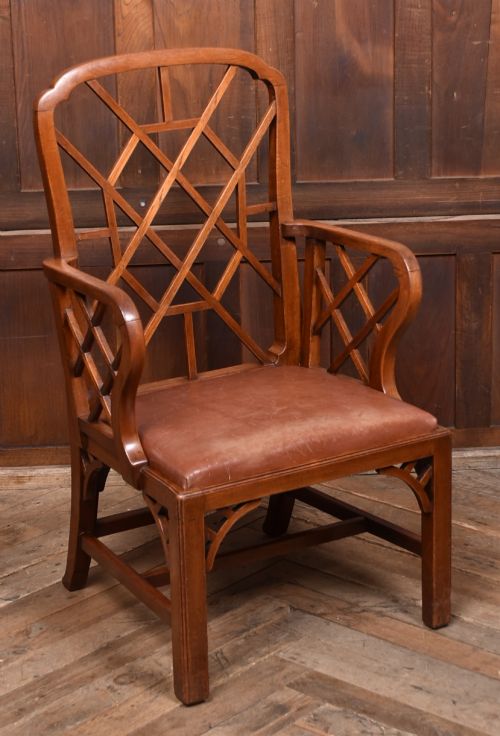
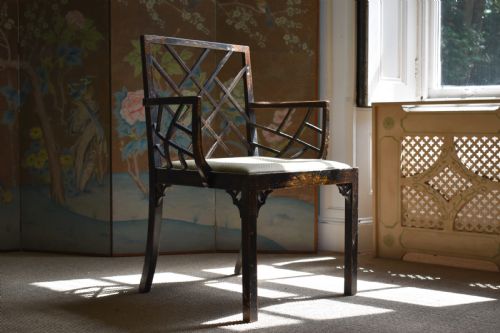
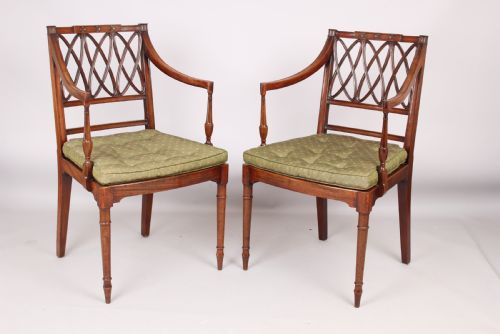
These lattice back armchair examples range from Georgian and Edwardian periods to the early twentieth century, offering solid mahogany, ebonised timber and cane construction.
Lattice Back Armchair
A lattice back armchair is a seating form defined by an open framework back, appearing here in styles such as Chippendale, Jacobean Revival and Chinese Export. When you search for this phrase, you meet dining chairs and armchairs shaped by cabinetmakers across several centuries.
The versions most commonly met on this page span the nineteenth century and the Edwardian period, frequently rendered in mahogany or ebonised wood. These pieces include Cockpen chairs and Chinese carved elm forms alongside George III period elbow chairs.
How they were made
Construction relies upon dense hardwoods such as mahogany and oak, shaped into intersecting lattice patterns that form the structural backrest. Joinery techniques connect the arms and frames to withstand regular seating use.
Surface treatments range from clear polish on mahogany to ebonised finishes and lacquer. Canework and upholstered pads in fabric, leather or textile provide the seat base.
Listings feature mahogany, ebonised wood, and cane across periods from the eighteenth century to the 1920s.
What varies in quality
Quality rests in the precision of the open lattice work and the choice of primary timber, where finely figured mahogany sits above simpler elm or pine frameworks. The crispness of carved details distinguishes standard production from more ambitious workshop execution.
Proportions and structural integrity dictate the standing of a piece, with large proportions and matching pairs demonstrating greater original ambition from makers.
Collier and Plucknett·Heals
The Lattice Back Armchair Glossary
- Cockpen
- A type of lattice back armchair influenced by Chinese designs, featuring a geometric grid pattern in the backrest. This form gained popularity during the Georgian period and saw revivals later.
- Ebonised
- Timber treated with a dark stain or pigment to imitate ebony. This finish appears frequently on nineteenth-century aesthetic movement seating.
- Elbow chair
- An alternative term for an armchair, particularly those designed to sit at the ends of a dining table. These pieces feature structural arms framing the seat.
- Canework
- Woven rattan or cane material utilised for chair seats and backs. It provides a resilient and flexible surface.
- George III period
- The era spanning the reign of George III, associated with refined cabinetmaking and classical proportions. Pieces from this time often utilise solid mahogany.
Lattice Back Armchair: Frequently Asked Questions
How do I identify a Georgian lattice back armchair?
Georgian examples display classic proportions and are typically constructed from dense timbers like mahogany. They often incorporate restrained carving alongside the open fretwork back.
Comparing the joinery and timber grain helps distinguish genuine eighteenth-century pieces from later revival items produced in the Edwardian era.
Where were lattice back armchairs used?
These chairs served primarily as dining seating or occasional chairs within domestic parlours and reception rooms. Armchair versions with elbow supports typically stood at the heads of dining tables.
Their decorative open backs made them suitable for placement where the rear of the chair remained visible within a room.
How do I care for antique wood and cane chairs?
Maintain timber surfaces by applying appropriate furniture wax sparingly to preserve the polish of mahogany or ebonised finishes. Avoid placing the chairs near direct heat sources to prevent wood splitting.
Canework benefits from light dusting and occasional dampening to keep the natural fibres supple and prevent snapping.