


Chinoiserie Armchair
A chinoiserie armchair brings together European seating forms and decorative motifs inspired by traditional East Asian art.
Chinoiserie Armchair
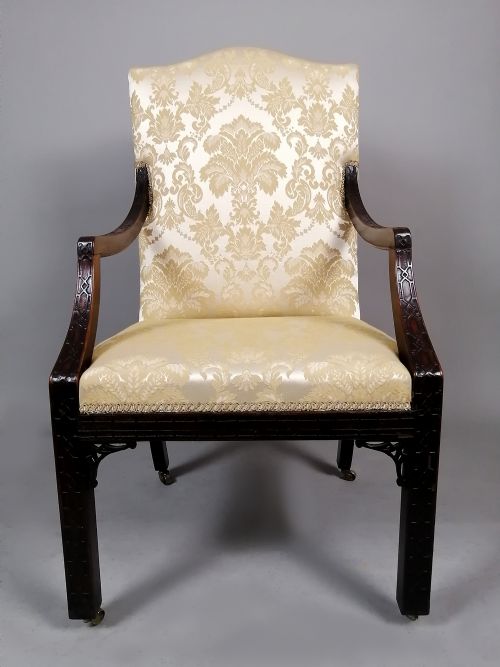
A chinoiserie armchair is a seating piece finished with decorative motifs inspired by traditional East Asian art, taking various structural forms across several centuries. The selections found here span from the 18th century through to the 20th century, encompassing styles such as Chinese Chippendale, Regency, Edwardian, and Victorian.
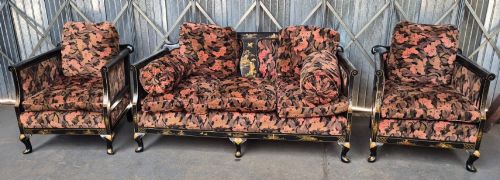
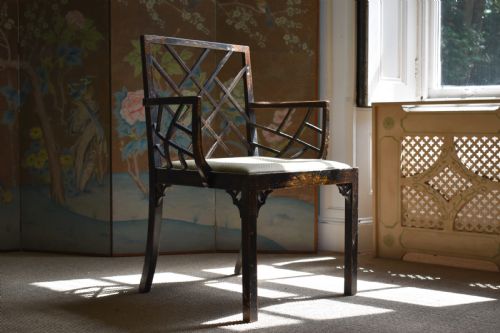
Buyers will encounter multiple configurations including library chairs, bergere seats, wing backs, and open armchairs. Common variations include the geometric open lattice work known as Cockpen, alongside faux bamboo framing and three-piece suites.
Origins represented in the record range from English interpretations to pieces produced in Italy and China. These chairs serve both as functional seating and as striking decorative statements within a room.
Materials and Construction
Makers constructed these chairs using hardwoods such as mahogany and satinwood, alongside supportive canework for seats and backs. Structural components were frequently shaped into faux bamboo forms to echo East Asian motifs.
Surface finishes rely heavily on paint, japanning, and lacquer work to apply the characteristic ornamentation. Textiles and fabrics are utilised for upholstered cushions, pads, and complete suite coverings.
Several chairs mimic bamboo using solid hardwood, proving that even a humble plant can inspire stubborn carpentry.
Assessing Quality
Quality in a chinoiserie armchair rests upon the depth and preservation of the hand-applied paint, lacquer, or japanned decoration. Pieces featuring original, undisturbed decorative schemes command greater appreciation than those subject to later re-painting.
The sophistication of the timber framework, whether carved mahogany or delicate satinwood, dictates the structural integrity of the seat. The complexity of the joinery, particularly in intricate Cockpen lattices or faux bamboo turnings, marks the distinction between standard production and master craftsmanship.
The Chinoiserie Armchair Glossary
- Chinoiserie
- European decorative style imitating Chinese and East Asian artistic traditions. It appears across furniture surfaces through painted motifs and lacquering.
- Cockpen
- A lattice-work chair design formed of straight intersecting bars, associated with mid-18th century Chinese Chippendale furniture. This geometric pattern creates an open, structured back.
- Bergere
- An enclosed upholstered armchair with wooden framing exposed around the sides and back. Canework panels are frequently integrated into the sides and back.
- Japanning
- A European technique imitating East Asian lacquer work using heat-cured varnishes. It produces a glossy black or coloured surface embellished with raised metallic motifs.
Chinoiserie Armchair: Frequently Asked Questions
What is a chinoiserie armchair?
A chinoiserie armchair is a seating piece decorated with European interpretations of East Asian artistic motifs, spanning periods from the 18th century onwards.
These chairs use techniques such as lacquering, painting, and japanning on frames made from mahogany, satinwood, or bamboo.
How do I identify period chinoiserie furniture?
Period identification relies on examining the underlying wood, the framing style, and the execution of the surface decoration. Georgian pieces often feature mahogany Chinese Chippendale forms, while Edwardian and later examples introduce brighter colours and canework.
Comparing structural details and finishing methods helps distinguish 18th-century work from 19th-century revivals and 20th-century interpretations.
Are these chairs comfortable for daily use?
Many chinoiserie armchairs include upholstered pads, fabric seats, or canework panels designed to offer support. Bergere and wing back variations provide deep seating suitable for relaxed daily placement.
Selecting a library chair or desk armchair configuration ensures ergonomic suitability for prolonged sitting.
How should I care for lacquered surfaces?
Lacquered and painted finishes require gentle dusting with a soft, dry cloth to protect the decorative layer. Direct sunlight and excessive moisture should be avoided to prevent surface cracking.
Maintaining stable indoor temperatures preserves the integrity of both the wood substrate and the applied ornamentation.