


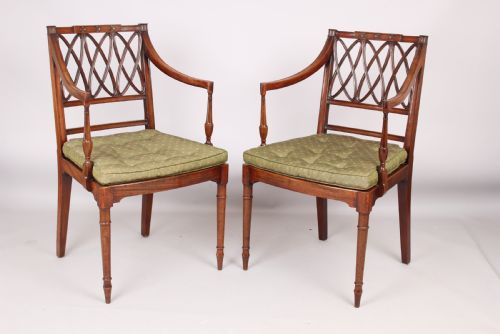


Georgian Lattice Back Chairs
Georgian lattice back chairs bring classical poise to a room, offering sturdy joinery and carved fretwork that anchor a dining table.
Georgian Lattice Back Chairs
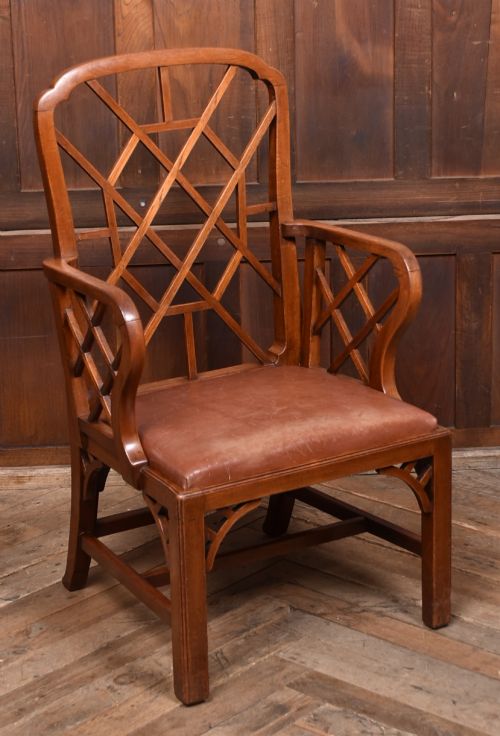
When you search for georgian lattice back chairs, you encounter seating built for dining rooms and parlours, spanning formal mahogany armchairs to painted country variants. The records show examples from the Georgian era alongside later revivals from the nineteenth and early twentieth centuries.
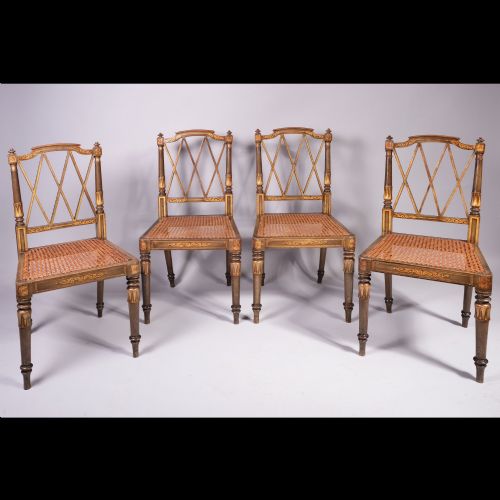
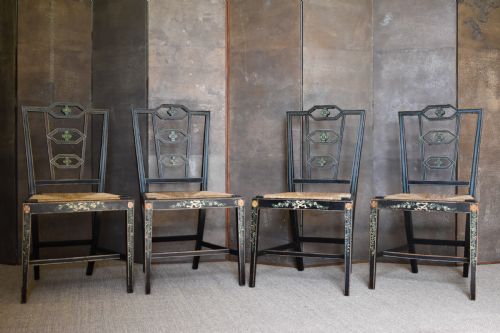
Most pieces on this page take the form of dining chairs and elbow chairs, frequently appearing in matched sets rather than single items. Mahogany remains the dominant timber, often complemented by painted surfaces, lacquer, and decorative inlay.
The aesthetic draws heavily on classical Chinese fretwork and Gothic tracery adapted by eighteenth-century cabinet makers. You will find styles ranging from strict George III designs to Chippendale revivals and country kitchen seating.
How they were made
Makers relied primarily on solid mahogany for formal seating, shaping the intricate back splats through precise hand-carving and fretsawn joinery. Elm and other local hardwoods served for vernacular kitchen chairs, constructed to endure daily domestic use.
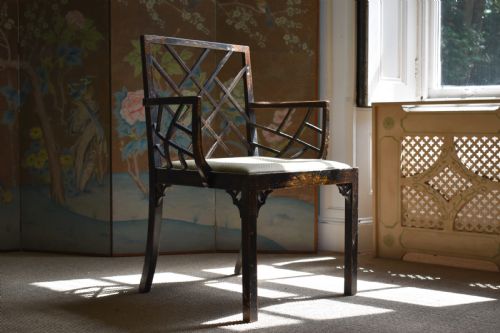
Surface decoration involved sophisticated techniques such as hand-painting, gilding with gold leaf, and ebonising. Chinoiserie examples incorporated detailed lacquer work, while later revival pieces utilised fine inlaid veneers to emulate eighteenth-century models.
Some nineteenth-century makers borrowed Chinese temple designs for dining chairs, proving that eighteenth-century Scots and Londoners loved a pagoda just as much as anyone.
What varies in quality
The distinction between ordinary and exceptional seating lies in the depth and sharpness of the hand-carved lattice work on the back splat. Superior examples maintain crisp geometric intersections without clumsy repairs or heavy sanding.
Timber selection dictates longevity; dense, well-figured mahogany with tight graining distinguishes high-grade London production from softer secondary woods. Original surface finishes, whether patinated polish or authentic paint, elevate the integrity of a piece above stripped or heavily restored alternatives.
Thomas Chippendale·Brights of Nettlebed
The Georgian Lattice Back Chairs Glossary
- Cockpen chair
- A lattice-back seating form featuring an open geometric grid inspired by Chinese screens and railings. This design gained popularity in Britain during the eighteenth century.
- Fretwork
- Openwork carving cut from a thin board in decorative patterns, forming the characteristic open lattice of the chair back. Craftsmen utilised fretsaws to achieve intricate interlaced designs.
- Splat
- The vertical central strip of wood down the back of a chair, which in these pieces is pierced and carved into lattice motifs. It provides both structural support and aesthetic focus.
- Elbow chair
- A dining or parlour chair fitted with arms, often created as carvers to match a set of side chairs. These pieces typically occupied the heads of the dining table.
Georgian Lattice Back Chairs: Frequently Asked Questions
How do I spot a true Georgian chair?
Examine the timber underneath and the construction methods used in the frame. Eighteenth-century makers utilised traditional mortise and tenon joints secured with wooden pegs.
Look for signs of age in the wear patterns and the depth of the mahogany patina. Later revival pieces often display machine tooling or subtle differences in proportion.
What is a carver chair?
A carver is an armchair designed to match a set of single dining chairs, traditionally placed at the head of the table. These provided extra comfort for the host.
They share the same lattice back design as the accompanying side chairs but feature curved armrests supported by shaped uprights.
Can I use these chairs daily?
Solid mahogany construction makes these chairs robust enough for regular seating around a modern dining table. Their sturdy joinery was built to withstand generations of use.
Ensure the joints remain tight and check the upholstery webbing periodically if the seats are dropped-in or padded.
What does Chinoiserie mean?
Chinoiserie refers to European interpretations of Chinese artistic motifs, popular during the Georgian period. This style manifested in pagoda-shaped crest rails and intricate fretwork.
Such chairs often featured painted or lacquered finishes in contrasting colours rather than standard polished mahogany.