
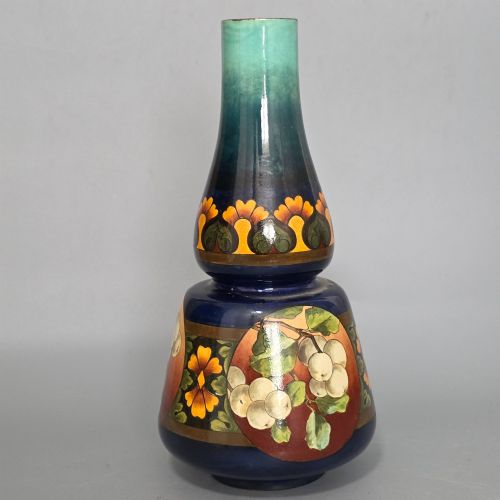
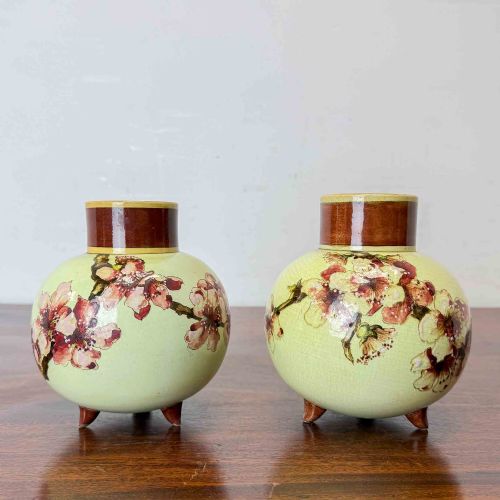


Late Victorian Doulton Pottery
Late Victorian Doulton pottery pieces are tactile vessels of the nineteenth century that bring rich ceramic texture and historic ornament into a modern room.
Late Victorian Doulton Pottery
When you search for late victorian doulton pottery, you are looking at nineteenth century vessels ranging from the 1860s through to 1900, covering the Victorian era, the Aesthetic Movement, Art Nouveau, and Arts and Crafts styles.
The pieces you are most likely to meet on this page are vases, jugs, pitchers, ewers, bowls, and washstand sets.
The origins span specific English potteries, most notably Doulton Lambeth and Doulton Burslem, displaying diverse decorative techniques and glazes.
How they were made
The makers utilised ceramic, stoneware, and earthenware as the primary bodies for these vessels, applying glaze, enamel, and salt glaze techniques to finish the surfaces.
Decoration often involved hand painting, gilt, gold leaf, and specialised methods like Slater's Patent and Intarsio faience, frequently paired with silver plate mounts.
Puzzle jugs were designed with pierced necks to challenge drinkers to consume the liquid without spilling it down their front.
What varies in quality
The distinction between standard production and the top of the range lies in the complexity of the surface decoration and the involvement of named artists.
Pieces bearing specific artistic attribution and intricate Persian or cherry blossom motifs demonstrate a higher tier of studio execution than basic utilitarian wares.
Alice Euphemia Thatcher·Frank Butler
The Late Victorian Doulton Pottery Glossary
- Salt glaze
- A vitreous silicate coating formed by throwing common salt into the kiln during the high temperature firing of stoneware. This creates a distinctive orange peel texture on the surface of the vessel.
- Faience
- Earthenware decorated with opaque coloured glazes, often utilised for pictorial or floral ceramic panels and vases. It provides a smooth canvas for detailed Victorian ornamentation.
- Carrara Ware
- A ceramic body developed to imitate white Italian marble, presenting a smooth, matte finish. Miniature vases in this finish often feature hand-painted garlands.
- Intarsio
- A ceramic technique developed by Doulton that produced brightly coloured, tile-like patterns resembling inlaid wood. It allowed for complex figurative and geometric designs on pottery.
- Ewer
- A large jug with a wide spout and a curved handle, traditionally used for holding water alongside a washbasin. In later periods, these served primarily decorative functions.
Late Victorian Doulton Pottery: Frequently Asked Questions
What is Doulton Lambeth?
Doulton Lambeth refers to the division of the pottery works located in south London, famous for its artistic stoneware and salt-glazed vessels.
This studio output often involved individual artists who signed their work, distinguishing it from mass-produced factory output.
How do I identify Art Nouveau pieces?
Art Nouveau examples display characteristic flowing organic lines, stylised floral motifs, and sinuous plant forms.
These pieces typically date towards the end of the nineteenth century and into 1900.
What is Slater's Patent pottery?
Slater's Patent involves pressing lace or other textiles into the damp clay body before firing to create a textured pattern.
Potters then hand-painted and gilded these impressed areas to highlight the fabric texture.
How should I clean my pottery?
Dust these ceramic and stoneware pieces gently with a dry, soft cloth to preserve the glaze and any delicate gold leaf.
Avoid using water or chemical cleaners, especially on pieces with enamel or gilt surface decorations.