


Late Qing Stools
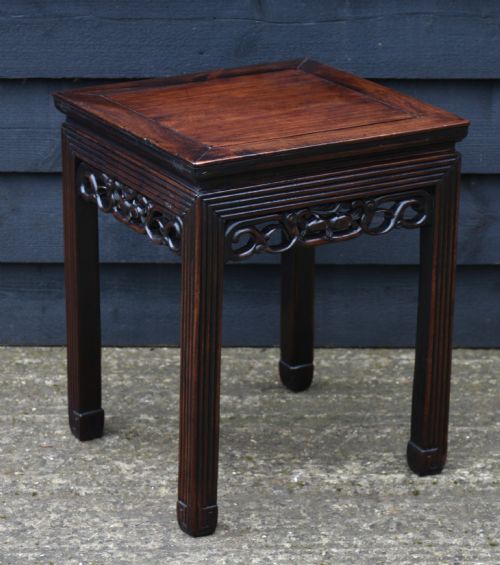
Late qing stools are solid hardwood and porcelain seating and stands valued for their intricate carving and natural stone insets.
Late Qing Stools
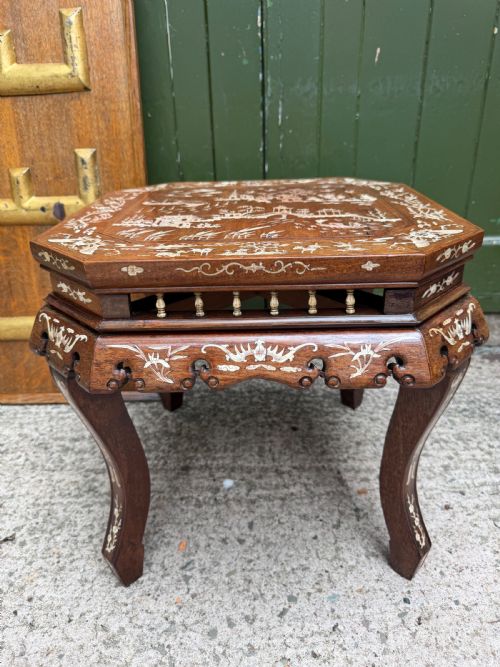
When you search for late qing stools, you find carved wooden and porcelain pieces dating from the late nineteenth century. These objects include dressing stools, window seats, and drum-shaped tables originating from the Qing Dynasty.
The versions most frequently met on this page are carved hardwood stands and low tables featuring inset marble or quartz tops. They function equally well as compact seating or ornamental display surfaces in traditional and contemporary interiors.
How they were made
Maker-craftsmen utilised dense timbers such as huali wood, rosewood, and rootwood, often ebonising the surfaces for a dark, uniform finish. These heavy woods supported deep, sculptural relief carving without warping over time.
Many examples incorporate mineral insets like rouge marble and quartz fitted directly into the wooden frame. Other variations employ famille rose porcelain and mother-of-pearl inlay to create contrasting textures and colours.
Listings feature items dated from 1880 through the turn of the twentieth century, encompassing Victorian-era trade periods.
What varies in quality
The refinement of the woodwork dictates the standing of each piece, distinguishing simple turned supports from deeply undercut floral and scroll carving. Finer examples display crisp edges and precise joinery that remain tight across the joints.
The choice and figuring of the inset stone also determine the grade of the piece, with richly patterned marble or deep quartz commanding greater visual presence than plain panels.
The Late Qing Stools Glossary
- Huali wood
- A fragrant tropical hardwood prized in Chinese furniture making for its rich grain and density. It resists wear and takes a fine carved edge.
- Famille rose
- A palette of opaque enamel colours dominated by pink, introduced to Chinese ceramics during the Qing Dynasty. It adorns porcelain garden seats and vessels.
- Rootwood
- Timber fashioned from the root burls of trees, retaining gnarled, organic contours. Makers selected these irregular shapes to build rustic stands and tables.
- Rouge marble
- A reddish ornamental limestone used for decorative table tops. It provides a smooth, cool surface contrasting with dark hardwood frames.
Late Qing Stools: Frequently Asked Questions
What are late qing stools used for?
These pieces served multiple functions in nineteenth-century households, acting as portable seating, window benches, and raised surfaces for plants or decorative objects.
Today, they find places in modern rooms as bedside tables, low stools, or prominent display stands for art.
How do I identify qing dynasty pieces?
Identification relies on recognising traditional construction methods, such as mortise and tenon joinery executed in dense Asian hardwoods.
Stylistic markers include specific floral carving motifs, inset marble panels, and the absence of modern metal fasteners.
Are these pieces sturdy enough to sit on?
Most surviving examples are constructed from heavy timbers like rosewood and huali wood, giving them substantial structural integrity.
However, delicate frames or those with inset stone tops are often better suited for use as display stands rather than heavy seating.
What is ebonised hardwood?
Ebonised hardwood is timber treated with a chemical stain or black finish to imitate the appearance of expensive ebony wood.
This technique was common in late nineteenth-century Asian furniture production to achieve a uniform, dark decorative surface.