


Late Qing Export Painting
Late qing export painting brings together delicate pith paper works and vivid gouache maritime scenes made for Western markets.
Late Qing Export Painting
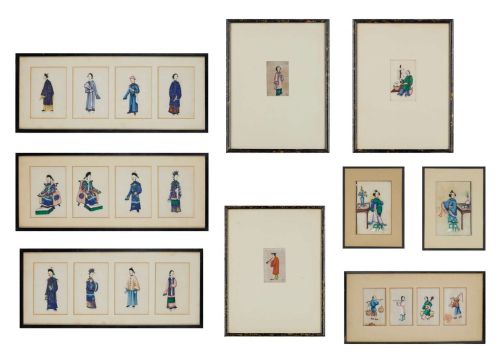
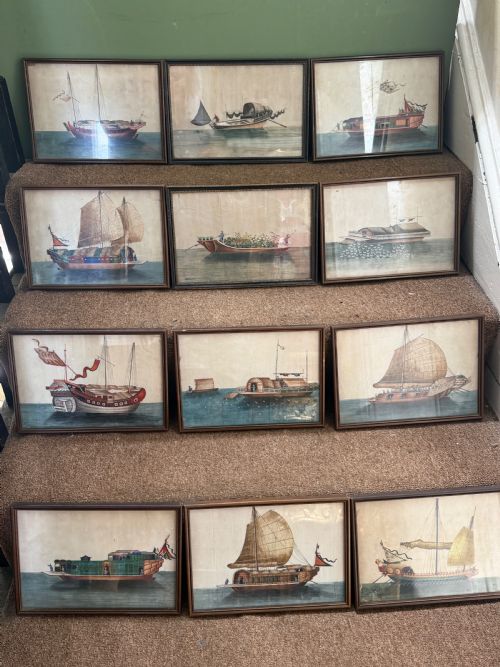
When you search for late qing export painting, you encounter works produced during the nineteenth century specifically for international buyers. These items include framed groupings of gouache watercolours depicting ships alongside individual studies executed on delicate pith paper. Most pieces belong to the nineteenth century, reflecting the dynamic commercial and artistic exchange between China and the West during the Qing Dynasty.
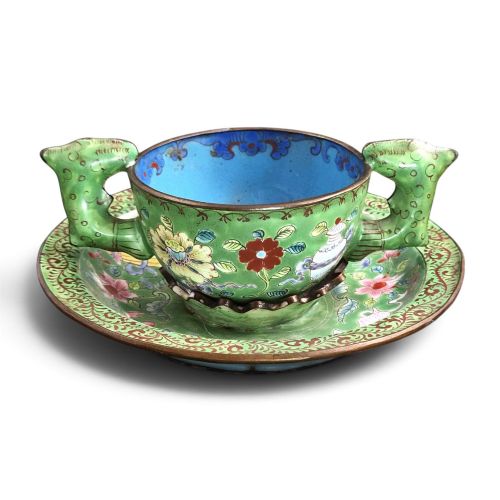
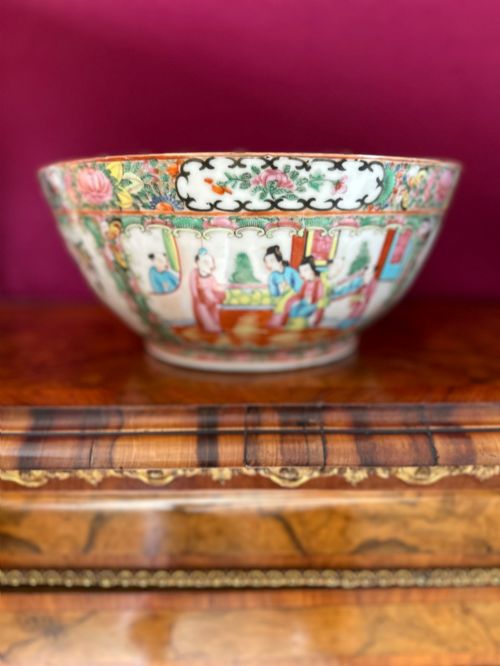
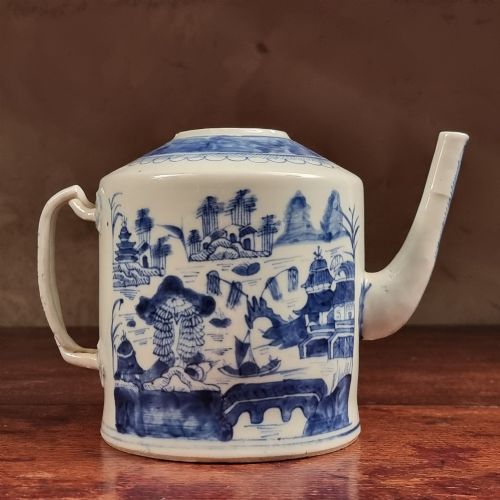
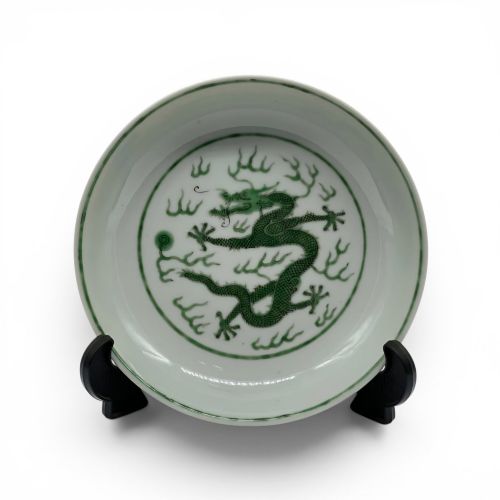
The assortment on this page also extends to related decorative objects that share the visual language and period aesthetic of export art. You will find Cantonese porcelain punch bowls, famille rose eggshell vessels, and reverse painted mirrors alongside the works on paper. These diverse objects demonstrate how the export trade encompassed both paintings and luxury household goods.
How they were made
The works on paper utilise gouache and watercolour applied directly to organic supports like pith paper, which yields a velvety and luminous surface texture. Other items employ reverse painting techniques on glass, creating mirrored surfaces with intricate pictorial depth. Porcelain pieces combine high-fired ceramic bodies with detailed enamel decoration, often enhanced with gold leaf.
Wood and lacquer also appear in the material record, demonstrated by red lacquer tables constructed in traditional forms. Pigments were meticulously mixed by hand to achieve the vibrant palettes seen in Cantonese famille rose wares and maritime illustrations. Artisans combined traditional Chinese brushwork with compositional layouts tailored to European tastes.
The material record includes delicate eggshell porcelain bowls alongside robust Cantonese punch bowls and reverse painted mirrors.
What varies in quality
Quality in these works rests upon the precision of the brushwork and the preservation of the delicate mediums. Fine examples on pith paper maintain crisp outlines and unfaded pigments, whereas lesser instances suffer from surface flaking and brittle degradation. The complexity of the composition, particularly in multi-figure groupings or detailed maritime scenes, separates standard commercial production from masterwork output.
Material refinement dictates the upper tiers of porcelain and decorative objects. Eggshell porcelain bowls and intricately potted famille rose vessels demonstrate superior control in the kiln and exceptional fineness in the body. Conversely, heavier, coarser bodies represent the more utilitarian end of the export spectrum.
The Late Qing Export Painting Glossary
- Pith paper
- A delicate material cut from the pith of the Tetrapanax papyrifer plant, commonly used for watercolour and gouache paintings in the nineteenth century. It possesses a spongy texture that absorbs pigments deeply.
- Gouache
- An opaque water-based paint composed of pigment, a binding agent, and inert white material. It provides the dense, matte colour fields seen in export maritime paintings.
- Famille rose
- A major palette of Chinese ceramic enamel colours introduced in the Qing dynasty, dominated by opaque pink or rose enamels. The style allowed for subtle tonal gradations.
- Reverse painted mirror
- A technique where an image is painted directly onto the back of a glass panel, viewed through the front to create a reflective and luminous picture. This method required artists to paint foreground details before background elements.
- Cantonese porcelain
- Porcelain decorated in Guangzhou for the export market, typically featuring crowded, colourful panels of figures, birds, and flowers. It is strongly associated with late nineteenth century production.
Late Qing Export Painting: Frequently Asked Questions
What is pith paper?
Pith paper is a natural vegetable material derived from the pith of a shrub native to southern China. Artists used it in the nineteenth century for vibrant watercolours because its cellular structure gives painted pigments a unique velvety glow.
Despite its name, it is not true paper made from macerated pulp. It requires careful handling today due to its inherent fragility and sensitivity to moisture.
How do I care for export paintings?
Works on paper and pith require strict protection from direct sunlight and high humidity to prevent pigment fading and support degradation. Framing them behind conservation-grade UV-filtering glass ensures physical stability.
Keep them away from fluctuating temperatures which can cause organic materials to warp or become brittle over time.
What defines the Qing dynasty style?
The Qing dynasty style encompasses a vast range of artistic production spanning centuries, marked by technical mastery in porcelain, lacquer, and painting. It blends Manchu court preferences with rich traditional Han motifs and later Western trade influences.
Export pieces within this tradition often balanced traditional Chinese iconography with compositions designed to appeal to European and American buyers.
Are export paintings hand-painted?
Export paintings from the nineteenth century were executed entirely by hand in specialised studio workshops in port cities like Guangzhou. Large workshops employed numerous painters who divided labour to produce series of maritime views or figural studies.
Individual brushstrokes remain visible upon close inspection, confirming the absence of mechanical reproduction in these period works.