


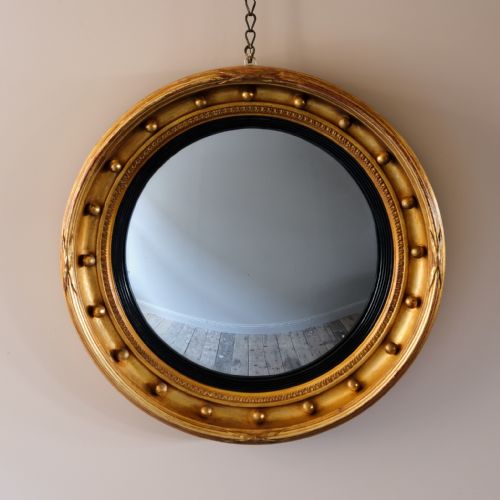


Late Georgian Mirror
A late georgian mirror brings refined proportion and reflective depth to a room, drawing the eye with carved timber or gilded detail.
Late Georgian Mirror
When searching for a late georgian mirror, buyers encounter a variety of forms spanning wall hung pieces, overmantels, and dressing glasses. These items originate predominantly from the late eighteenth and early nineteenth centuries, reflecting styles such as Regency, Neoclassical, and Rococo. The most common survivals on this page are wall mirrors and overmantels framed in gilded wood, pine, or rich mahogany.
Many examples incorporate distinct regional or stylistic details, including Chinese reverse painted glass, eglomise decoration, and intricate fretwork featuring birds or floral motifs. Pieces range from compact toilet mirrors designed for box bases to large triptych overmantels intended for grand chimney breasts. Selecting a piece involves weighing the domestic scale of a dressing table glass against the architectural presence of a pier glass.
What varies in quality
The standard of carving and the crispness of moulded gesso ornamentation set the finest examples apart from simpler utilitarian pieces. Superior frames display deeply undercut foliage, sharply defined motifs, and harmonious proportions that demonstrate the confident hand of a skilled artisan rather than routine production.
The retention of original mirror plates and untouched gilding significantly influences the character and integrity of an item. Pieces retaining their early glass exhibit a characteristic waviness and depth, whereas later replacements change the visual weight and historical authenticity of the object.
Several pieces feature Hoho birds perched atop their fretwork frames, surveying the room with whimsical eighteenth-century charm.
The Late Georgian Mirror Glossary
- Giltwood
- Timber coated with gold leaf over a prepared gesso ground. This finish provides a warm, reflective surface characteristic of formal mirrors.
- Gesso
- A plaster mixture applied to wood frames to create a smooth base for carving or gilding. It allows for intricate moulded details along the border.
- Eglomise
- The technique of cold painting and gilding on the reverse of glass. It appears in borders and panels to add decorative colour and historic charm.
- Pier glass
- A tall mirror designed to hang on the wall space between windows. These vertical pieces maximise natural light within a room.
- Fretwork
- Openwork ornamentation cut from thin wood using a fretsaw. It frequently decorates the scroll ears and crestings of mahogany wall mirrors.
Late Georgian Mirror: Frequently Asked Questions
Can these mirrors be hung safely on modern walls?
Most pieces possess substantial weight due to timber frames, thick glass, and plaster elements. Secure hanging requires fixings rated for the specific wall type and ideally anchored directly into studs or masonry.
Professional mirror hangers use heavy-duty D-rings and wire or split battens to distribute the load evenly across the structure of the frame.
Why do some mirror plates look wavy?
Early glass production methods involved blowing or cylinder techniques followed by manual flattening and polishing. This process left natural irregularities and microscopic variations across the surface.
Such optical distortion is a desirable sign of age and confirms that the mirror plate belongs to the period of manufacture.
What is the difference between an overmantel and a wall mirror?
Overmantel mirrors are specifically proportioned to sit horizontally above a fireplace mantelpiece. They often feature triptych panels or landscape orientations designed to fill broad architectural wall spaces.
Standard wall mirrors are built in various shapes for general room placement and are not restricted to chimney breast dimensions.