


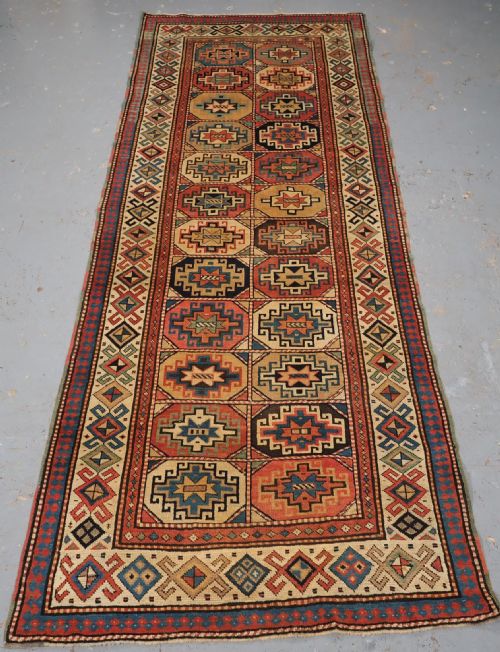


Latched Medallion Rug
These latched medallion rug examples bring geometric tribal authority into a room, forged by nomadic weavers across Anatolia, the Caucasus, and Persia.
Latched Medallion Rug
A latched medallion rug displays bold geometric central motifs adorned with small hooked protrusions along their edges. These pieces emerge from tribal and nomadic traditions in regions such as the Caucasus, Anatolia, and Persia, dating from the late nineteenth and early twentieth centuries.
You will most commonly encounter Kazak and Baluch productions on this page, often featuring distinct regional colour palettes and robust wool foundations. Runners and area rugs form the main body of available formats, serving both utility and decoration.
The aesthetic bridges utilitarian floor covering and symbolic tribal art, carrying motifs passed down through generations of weavers. Each piece reflects the specific regional weaving vocabulary of its maker, from Caucasian Bordjalou and Moghan workshops to Kurdish and Turkish looms.
How they were made
Weavers constructed these textiles entirely from handspun wool, utilising durable pile knots tied tightly to wool warp and weft foundations. Certain examples incorporate camel hair into the ground, lending a natural warmth and subtle textural variation to the field.
Dyes derived from natural sources provided the deep reds, blues, and soft neutrals that define the visual character of these pieces. The knotting technique allowed for precise rendering of angular latch hook polygons and stepped diamond medallions.
Latched Medallion Rug Retail Price Guide 2026
Typical asking prices for latched medallion rug among the pieces listed under this phrase on Sellingantiques today, from the lower quarter to the upper quarter. They describe what is for sale here now, not the wider market.
Materials recorded across the selection are restricted to wool and camel hair, reflecting traditional nomadic pastoral resources.
What varies in quality
The clarity of the geometric drawing separates exceptional examples from ordinary ones, where sharp outlines give the medallions their distinct presence. Precision in the repeat and the balance of secondary motifs dictate the visual rhythm across the field.
Material selection and dye saturation heavily influence the overall success of a weaving. Softer, nuanced wools and harmonious colour ageing elevate the piece, ensuring the complex latch hook patterns remain legible and striking.
The Latched Medallion Rug Glossary
- Latch hook
- A small, stepped protrusion extending from the edge of a medallion or border motif. This geometric detail is characteristic of tribal weaving traditions across the Caucasus and Persia.
- Kazak
- A term applied to rugs woven in the southern Caucasus region, known for bold primary colours and heavy geometric designs. These pieces typically feature wool pile and sturdy construction.
- Camel ground
- A field woven using undyed camel hair wool, providing a soft, resilient foundation with a natural golden-brown tone. It often appears in Baluch and regional nomad pieces.
- Bordjalou
- A specific village or tribal design attribution within the Kazak group, recognised for distinctive large medallions and open fields. These rugs display strong colour contrasts and precise geometry.
- Kiz Bergama
- A Turkish rug type originating from the Bergama region, associated with classical Anatolian village aesthetics and warm chromatic ranges.
Latched Medallion Rug: Frequently Asked Questions
Where were latched medallion rugs made?
These rugs were produced by nomadic and village weavers across the Caucasus, Anatolia, and parts of Persia. Each region developed its own distinct palette and geometric vocabulary.
Tribal groups such as the Baluch, Kurdish, and various Caucasian communities utilised local wool to create these durable floor coverings.
How do I care for a wool rug?
Regular gentle vacuuming without a beater bar helps remove grit that settles deep within the wool pile. Professional cleaning should be undertaken periodically by a specialist familiar with antique textiles.
Keep the rug out of direct, prolonged sunlight to protect the natural dyes from fading unevenly over time.
What is a latch hook motif?
A latch hook is a stepped, hooked corner extension attached to a central medallion or border element. It represents a classic tribal design device found across nineteenth-century weaving.
Weavers used these sharp angles to create dynamic visual movement and symbolic protection within the rug's field.
How old are these antique rugs?
The pieces listed here date from the late nineteenth century through to the early twentieth century, spanning decades of traditional production. This era captures the final period of purely vegetable-dyed tribal weaving before synthetic dyes became widespread.
Construction details, wool quality, and palette help anchor these textiles within their respective historical decades.