


Large Turkish Rug
When you search for a large turkish rug, you encounter room-sized floor coverings from Anatolia that anchor spacious interiors with weathered natural dyes and generous proportions.
Large Turkish Rug
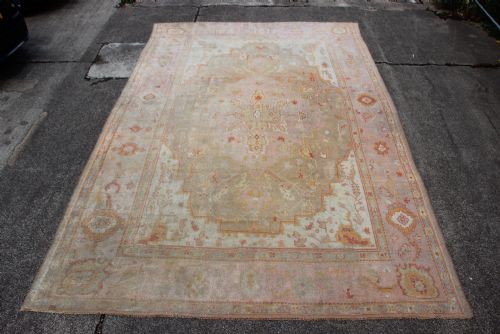
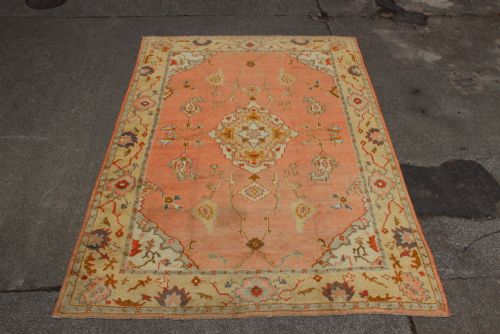
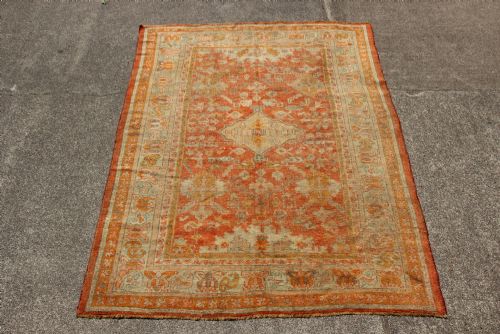
A large turkish rug is typically a generous room-sized floor covering originating from Anatolian weaving centres such as Oushak, Ghiordes, Bergama, and Milas. These pieces span periods from the late nineteenth century into the early decades of the twentieth century, reflecting traditional village and workshop weaving traditions.
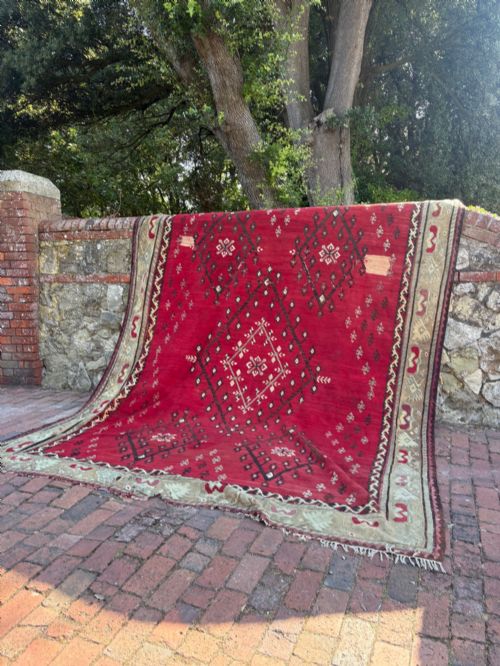
The most common examples encountered in this selection are substantial Oushak carpets featuring pale grounds, large-scale medallions, and muted floral or geometric motifs. Alongside knotted pile carpets, flatweave kilims provide lighter options with bold repeat patterns and flat surfaces.
Buyers select these substantial formats to anchor large living spaces, dining rooms, and hallways where repetitive motifs and aged wool tones soften modern architectural expanses. Each piece bears the distinct regional palette of Western Turkey, ranging from faded pinks and soft blues to deep greens.
How they were made
Weavers constructed these carpets using hand-spun wool for the pile and cotton or wool foundations for the warp and weft. Selected pieces incorporate angora wool, which imparts a subtle sheen to the surface pile.
Dyers utilised natural organic materials to achieve deep, lasting colours that mellow gracefully over decades of light and wear. The resulting pile is hand-knotted securely onto sturdy foundations, while flatweave kilims rely on interlocking weft techniques to create pattern without pile.
An enthusiastic weaver once slipped a tiny stray knot of bright pink wool into an otherwise stern green field just to keep everyone guessing.
What varies in quality
Quality in these floor coverings rests upon the balance of the wool, the clarity of the natural dye palette, and the integrity of the structural weave. Finer examples display harmonious secondary colours and resilient pile density that withstands centuries of foot traffic.
The sophistication of the design draft and the crispness of regional motifs distinguish master workshop pieces from standard village production. Even with timeworn repairs or faded ground colours, superior aesthetic proportion and balanced composition define the upper tier.
The Large Turkish Rug Glossary
- Oushak
- A traditional weaving centre in Western Turkey known for large decorative carpets with open fields and soft pastel dye palettes. These pieces often feature large central medallions and subtle floral sprays.
- Kilim
- A flatweave textile produced without pile by tightly interweaving warp and weft threads. These rugs offer lighter floor coverings with sharp geometric designs.
- Warp
- The vertical foundation threads stretched tightly on the loom before knotting begins. The visible ends often terminate in decorative fringes.
- Weft
- The horizontal threads passed across the warp to secure each row of knots or weave the structure of a flatweave. They bind the fabric together across the width of the carpet.
- Medallion
- A large central ornamental design motif placed in the middle of the carpet field. It serves as the primary focal point of the composition.
Large Turkish Rug: Frequently Asked Questions
How do I clean a large turkish rug?
Vacuum gently without using a rotating brush bar to protect the aged wool pile and structural foundation.
For deeper cleaning, professional specialist washing is recommended to preserve the integrity of natural dyes.
Are these rugs suitable for high-traffic areas?
Sturdy wool construction and dense hand-knotting allow these room-sized floor coverings to endure regular movement in hallways and living rooms.
Using a quality underlay provides additional cushioning and prevents slipping on smooth floors.
How do I identify an Oushak carpet?
Oushaks are typically recognised by their expansive proportions, relaxed floral drawing, and distinctive muted wool colours.
They frequently feature pale ivory, blue, or terracotta fields with oversized geometric medallions.
What is the difference between a kilim and a carpet?
Carpets feature a thick hand-knotted wool pile that creates a plush surface texture underfoot.
Kilims are woven flat without pile, resulting in a lighter textile suitable for summer rooms or layering.