
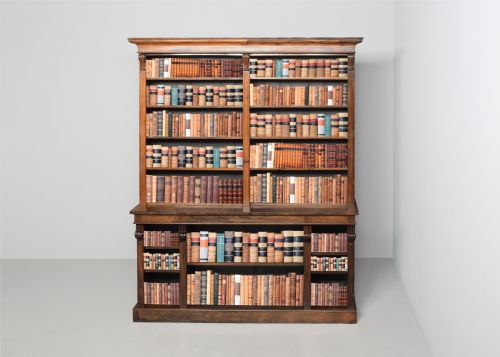

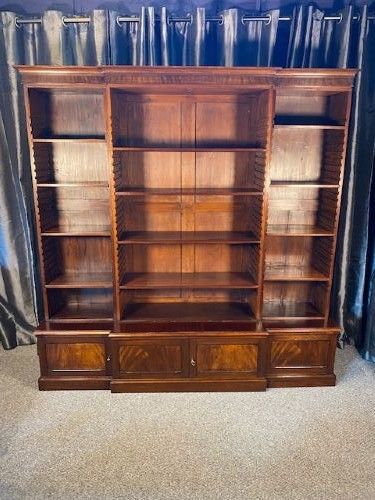
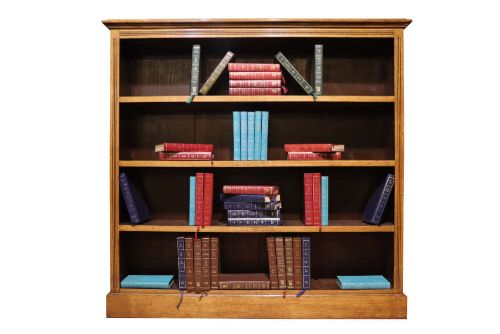
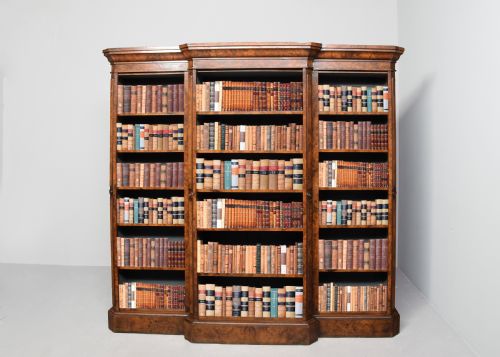
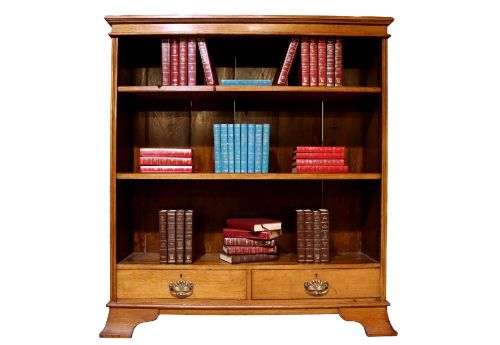
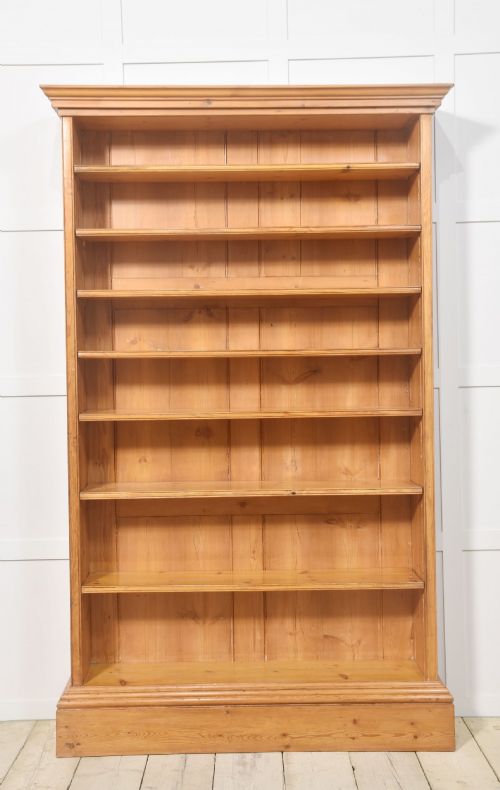
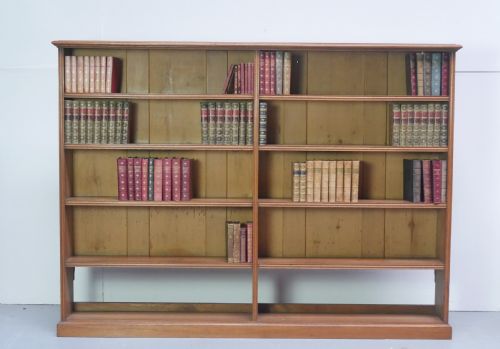
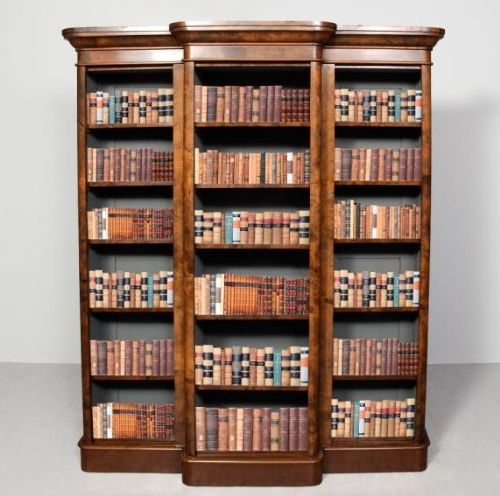


Large Open Book Cabinet
A large open book cabinet gives a room immediate architectural presence while keeping an entire library within arm's reach.
Large Open Book Cabinet
A large open book cabinet offers unfettered access to heavy volumes and displays without the barrier of glass doors. These pieces serve as the architectural backbone of a study, drawing room, or library, designed specifically to hold substantial collections of literature.
Most examples encountered on this page date from the nineteenth and early twentieth centuries, spanning straightforward pine and deal utility pieces to grand breakfront designs in burr walnut and mahogany. Makers built these bookcases tall and wide to maximise wall storage, often incorporating adjustable shelving to accommodate varying book sizes.
The styles range from severe Gothic Revival oak and structured Victorian breakfronts to rustic country pine and inlaid Arts and Crafts elm. Buyers searching for a large open book cabinet will find that proportion and timber choice define the character of each individual piece.
How they were made
Cabinet makers constructed these large carcases using dense hardwoods like mahogany, oak, walnut, and Spanish mahogany, alongside softer utilitarian timbers such as pine, deal, and elm. Heavier woods provided the necessary structural rigidity to support long spans of loaded shelves without sagging.
Joinery techniques relied on sturdy tongue-and-groove backs, robust carcase construction, and precise housing joints for fixed or adjustable shelf supports. Finer examples incorporated brass mounts, delicate inlay work, and ebonised detailing to elevate the visual weight of the timber.
Design idioms across these cabinets range from Gothic Revival and Empire style to rustic country pine and Arts and Crafts.
What varies in quality
Quality rests upon the selection of timber and the ambition of the architectural format, moving from simple planked deal and pine utilities to figured burr walnut and Spanish mahogany breakfronts. Superior pieces utilise book-matched veneers, rich grain patterns, and sophisticated period styling such as Gothic Revival tracery.
The sophistication of the internal mechanics and secondary details also separates standard output from exceptional cabinet-work. Finely engineered adjustable shelving systems and solid brass mountings indicate a higher grade of commission for an affluent Victorian or Edwardian library.
The Large Open Book Cabinet Glossary
- Breakfront
- A cabinet design where the central section projects forward from the flanking wings. This configuration breaks the flat plane of a long wall and adds significant formal presence.
- Burr Walnut
- A highly prized timber veneer harvested from the wart-like growths on walnut trees. It yields a swirling, highly decorative grain pattern used on high-status Victorian furniture.
- Ebonised Wood
- Timber treated with chemical stains or dark paint to imitate expensive ebony. This technique was favoured during the nineteenth century for sharp, contrasting decorative effects.
- Spanish Mahogany
- A dense, durable hardwood historically imported from the Caribbean and Central America. Cabinet makers valued it for its deep colour, stability, and resistance to worm.
Large Open Book Cabinet: Frequently Asked Questions
How do I style a large open book cabinet?
Balance heavy rows of vertical books with horizontal stacks and carefully chosen decorative objects. Leave small pockets of empty space to prevent the shelves from feeling overcrowded.
Anchor the heaviest volumes on the lower shelves for visual stability, and use the upper tiers for smaller volumes or display items.
How do I date a Victorian bookcase?
Examine the secondary timbers used for the backboards and drawer linings, alongside the fixing methods and overall stylistic revival cues. Mid-Victorian pieces often display rich burr walnut veneers and breakfront proportions.
Later nineteenth-century examples may incorporate industrial machine-sawn elements or simpler oak and pine construction.
Will a large bookcase fit my room?
Measure your ceiling height and wall space carefully, remembering that these pieces often arrive as a single tall unit or a multi-section breakfront. Ensure stairwells and doorways can accommodate deep cornices and wide plinths.
Allow clearance for skirting boards so the back of the cabinet sits flush against the wall.