
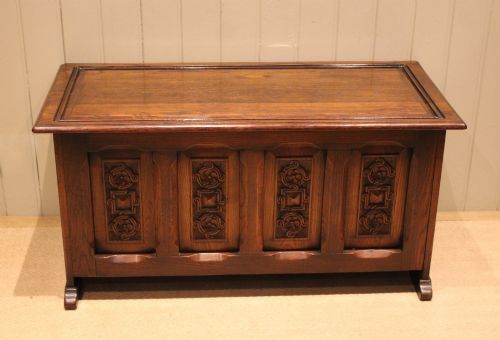


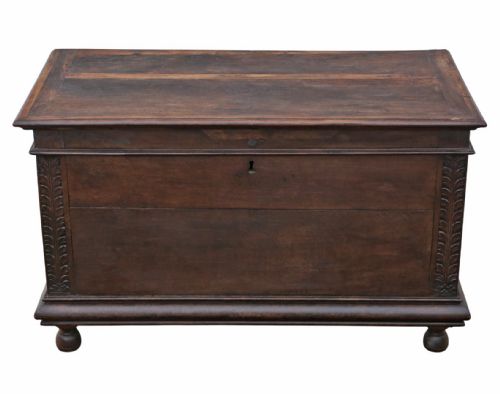


Large Oak Trunk
A large oak trunk provides robust domestic storage, spanning centuries of British and European craftsmanship.
Large Oak Trunk
A large oak trunk functions as a substantial receptacle for household linen, blankets, and personal possessions, originating in forms such as coffers, mule chests, and travel chests. These pieces span the 17th, 18th, and 19th centuries, reflecting changing domestic requirements from early boarded and panelled construction to fitted travelling chests.
The version most commonly encountered on this page is the traditional solid oak coffer or mule chest, often featuring panelled construction and internal storage compartments like candle boxes. Examples range from William III and Georgian periods through to Victorian iron-bound shipping trunks and later revival pieces.
How they were made
Makers utilised solid oak, supplemented by secondary timbers, assembled through pegged frame-and-panel techniques that allowed the wood to expand and contract naturally. Structural rigidity was achieved using robust iron or brass banding, corner braces, and heavy hinges.
Surface ornamentation involved hand carving, panel moulding, and occasional wood inlay, alongside utilitarian applications of iron bindings and brass mounts for travel durability.
Listings feature oak trunks spanning the 17th, 18th, and 19th centuries, incorporating iron, brass, and wood inlay.
What varies in quality
Quality rests in the integrity of the timber selection, the crispness of any period carving, and the survival of original hardware such as hinges, locks, and metal bands. Superior examples maintain their structural joinery without excessive timber shrinkage or inappropriate replacement parts.
The presence of integrated drawers, such as in mule chests, or specialised internal fittings like candle boxes and fabric linings, elevates the sophistication of a piece beyond a simple boarded box.
H D Dean·Bond Street Silversmith Retailer
The Large Oak Trunk Glossary
- Coffer
- A heavy wooden chest traditionally used for storing valuables, textiles, or documents. These pieces often feature boarded or panelled construction from the 17th and 18th centuries.
- Mule chest
- A storage chest featuring one or more drawers built into the base beneath the main compartment. This form emerged during the late 17th and 18th centuries to improve accessibility.
- Candle box
- A small internal lidded compartment fixed inside a chest to hold wax candles safely away from linens. It represents a thoughtful interior detail found in better domestic coffers.
- Iron-bound
- A descriptor for trunks reinforced with exterior straps, brackets, and bands of iron. This technique provided necessary strength for transit and shipping.
- Panelled construction
- A method of joining framing members around a floating central wooden panel. This technique prevents splitting as the oak reacts to humidity changes.
Large Oak Trunk: Frequently Asked Questions
What is the difference between a coffer and a mule chest?
A coffer is a traditional storage chest accessed entirely from a hinged lid at the top. A mule chest adds one or more drawers beneath the main storage well for easier access to contents.
This evolution in design appeared during the late 17th century, allowing users to retrieve smaller items without disturbing the heavy items stacked on top.
How were large oak trunks used historically?
These pieces served multiple domestic functions, including storing woollen blankets, fine linens, and valuable household silver. In smaller homes, they doubled as seating benches or window seats.
Later Victorian examples were adapted for travel, functioning as robust shipping trunks and campaign chests for transit by carriage or rail.
How do I date an antique oak trunk?
Dating relies on observing construction methods, hardware styles, and decorative motifs. Early 17th-century pieces typically display hand-riven oak panels and peg joinery, while 18th-century examples often incorporate lower drawer sections.
Victorian trunks are usually distinguished by machine-rolled iron bands, brass mounts, and specific maker or retailer stamps.
Are iron-bound trunks meant for travel?
Yes, trunks featuring heavy iron bands and reinforced corners were engineered for transportation. Retailers sold these as silver chests, carriage trunks, and shipping chests.
The metal reinforcement protected the oak body from the heavy impacts associated with historical travel by sea and coach.