
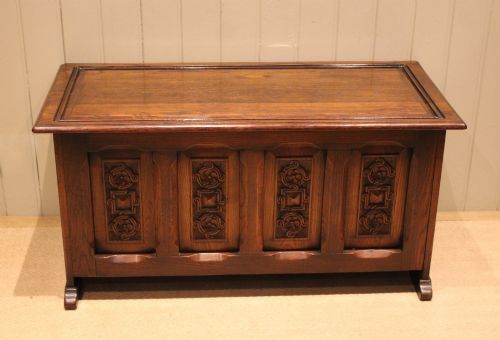


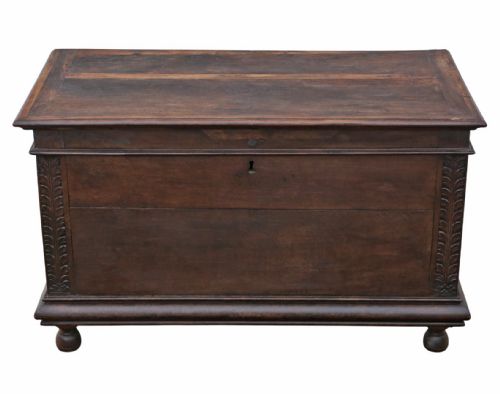


Large Oak Storage Trunk
A large oak storage trunk is a heavy timber chest built to hold household goods, most often seen here as seventeenth-century coffers or eighteenth-century mule chests.
Large Oak Storage Trunk
When you search for a large oak storage trunk, you encounter robust coffers and chests spanning the seventeenth century through to the Victorian era. These pieces served practical domestic needs for linen, silver, and travel before finding a place in modern rooms.
Forms range from plain panelled blanket boxes to elaborately carved William III coffers and iron-bound shipping trunks. Buyers frequently find pieces raised on stands or fitted with internal candle boxes.
What varies in quality
Quality in these trunks rests on the integrity of the timber, the depth and crispness of any carved ornamentation, and the survival of original hardware such as hinges and locks. Pieces that retain their original internal fittings, like candle boxes or drawer configurations, carry greater distinction.
The sophistication of the joinery and the balance of proportions between the coffer body and added drawers or stands further separate standard utilitarian boxes from finer workshop productions.
The listings combine seventeenth-century carved coffers with eighteenth-century mule chests and Victorian iron-bound silver trunks.
H D Dean
The Large Oak Storage Trunk Glossary
- Coffer
- A heavy wooden box with a hinged lid, traditionally used for safekeeping valuables and textiles. Earlier examples often display formal carved panels.
- Candle box
- A small internal lidded compartment built inside a chest to store tallow candles away from linens. It sits tucked into the side of the main storage well.
- Frame and panel
- A method of construction where a grooved wooden frame holds a floating central panel. This technique allows the wood to expand and contract without splitting.
Large Oak Storage Trunk: Frequently Asked Questions
What is a mule chest?
A mule chest is a storage chest that combines a traditional lift-top compartment with one or more drawers built into the base. This design bridges the gap between a standard coffer and a chest of drawers.
Cabinetmakers developed this form to provide easier access to stored clothing without requiring items on top to be moved every time a drawer was opened.
How were these trunks used?
These trunks served multiple household functions, acting as secure storage for woollens, household linen, and family silver. Their sturdy construction also allowed them to double as seating or tables when space required.
Travelling versions were reinforced with iron for transit on carriages and ships, protecting valuables during long journeys.
How do I date an oak coffer?
Dating relies on observing construction methods, timber characteristics, and decorative styles such as chip carving, linenfold, or geometric moulding. Seventeenth-century pieces typically show pegged frame-and-panel work, while later Georgian and Victorian examples incorporate functional drawers and machine-sawn components.
Hardware styles like iron strap hinges and iron locks also offer clues to the period of manufacture.
Can I use one as a coffee table?
These trunks function well as coffee tables or window seats while providing practical concealed storage for blankets and books. Their flat lids and solid timber construction make them durable enough for daily living spaces.
Buyers should measure the height and length carefully to ensure the chest suits the proportions of surrounding seating.