
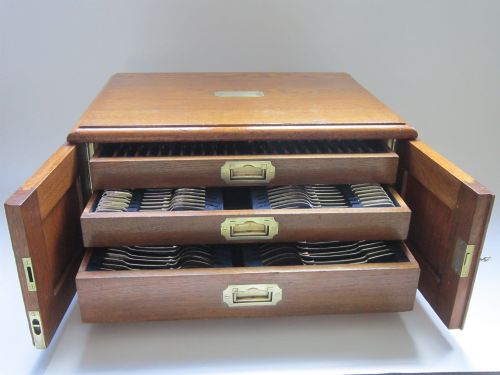


Fitted Oak Silver Chest
A fitted oak silver chest is a sturdy timber box designed to protect fine flatware, appearing here in Victorian and Edwardian iterations.
Fitted Oak Silver Chest
When you search for a fitted oak silver chest, you encounter robust storage trunks built to safeguard precious tableware. These pieces range from country house boxes and campaign silverware trunks to dedicated cutlery canteens on stands.
The versions most commonly met on this page date from the nineteenth century into the Edwardian period, often featuring compartmentalised interiors designed for specific flatware sets. Makers such as Elkington, Walker & Hall, and Mappin & Webb supplied these items to affluent households and retail silversmiths.
Many examples double as robust travel chests or shipping trunks, equipped with metal bindings and secure locks. Their primary purpose was the preservation and transport of valuable silver service.
How they were made
Construction relies heavily on solid timber and metal reinforcement, with golden oak and heavy oak boards forming the primary carcase. Iron straps, brass corners, and reinforced handles provide structural integrity for heavy transport.
Interiors are typically lined with velvet, felt, or baize to prevent silver from scratching during transit. Dedicated slots and fitted trays organise specific services, from fiddle pattern cutlery sets to large multi-piece canteens.
Listings feature oak combined with velvet, felt, brass, and iron across Victorian, Edwardian, and Art Deco periods.
What varies in quality
The distinction between standard storage and top-tier pieces lies in the sophistication of the interior fitments and the integrity of the hardware. Superior examples retain original retailer plaques, complex locking mechanisms, and bespoke internal layouts tailored for specific flatware collections.
Material selection also dictates standing, with dense golden oak carcases and heavy hand-forged iron or brass mounts commanding greater presence. The condition of the internal fabric lining and the completeness of the fitted trays further distinguish finer items.
Elkington·Walker & Hall·Mappin & Webb
The Fitted Oak Silver Chest Glossary
- Fitted interior
- An internal arrangement of trays, partitions, and slots designed to hold specific pieces of tableware securely. This organisation prevents shifting and damage during movement.
- Campaign chest
- A portable trunk built in sections or with reinforced edges for military or travel use. These pieces feature recessed handles and robust corner brackets.
- Canteen
- A fitted case or chest specifically designed to hold a set of cutlery. They range from tabletop boxes to large freestanding canteen tables.
- Fiddle pattern
- A traditional eighteenth and nineteenth-century flatware handle shape widening gently at the terminal. It appears frequently in period cutlery sets housed within these chests.
- Iron-bound
- A descriptor for timber chests reinforced with exterior iron straps and brackets. This technique provided durability for shipping and heavy domestic storage.
Fitted Oak Silver Chest: Frequently Asked Questions
What is an oak silver chest?
An oak silver chest is a heavy timber trunk built to store and transport family silver. These boxes utilise robust oak boards to protect valuable flatware and hollowware from damage.
Many examples feature reinforced iron or brass corners and secure locks. Their interiors contain tailored compartments for organised tableware storage.
How were these chests used?
Households utilised these chests to secure expensive cutlery between dining occasions. Servants packed flatware into lined slots to prevent tarnish and scratching.
Some pieces travelled between town residences and country houses as shipping trunks. Others remained stationary in dining rooms as dedicated canteen furniture.
How do I date an oak silver chest?
Dating relies on construction methods, hardware design, and retailer marks. Nineteenth-century examples often display heavy iron strapping and campaign-style recessed handles.
Edwardian and later pieces frequently incorporate labeled plaques from established silversmiths. Interior fabrics and hinge types also offer clues to the period.
Can I use them for modern storage?
These chests suit modern interiors well for organising blankets, documents, or collections. Their deep compartments and sturdy construction handle heavy daily use.
Placing them in living spaces provides functional surface area alongside historical character. The fitted trays often lift out for flexible storage.