
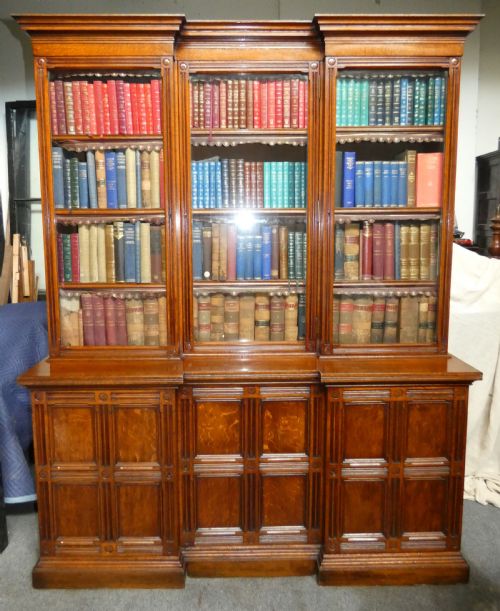

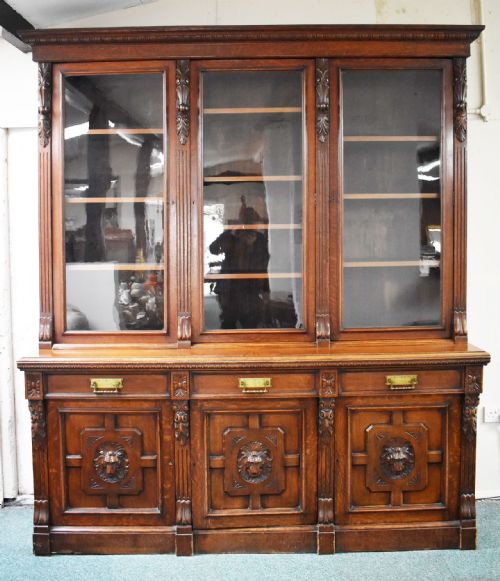


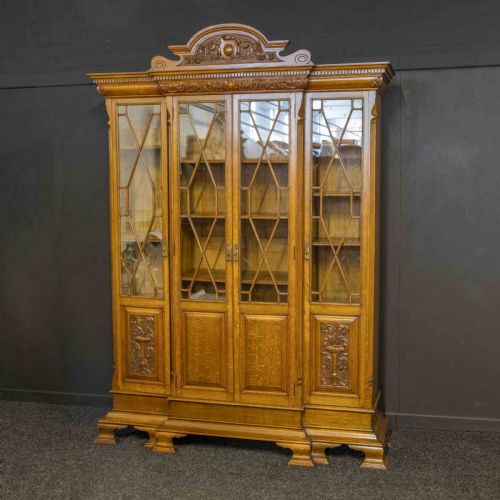


Large Oak Breakfront Bookcase
A large oak breakfront bookcase commands a room with its projecting central section, offering monumental proportions and generous shelving for serious libraries.
Large Oak Breakfront Bookcase
A large oak breakfront bookcase provides substantial architectural presence in a library or study, defined by its forward-projecting centre section. These impressive pieces emerge most frequently from the Victorian and nineteenth-century periods, alongside Edwardian and eighteenth-century examples.
Makers construct these grand library furnishings primarily in oak, incorporating glass doors, wire mesh, and brass hardware. Styles range from plain English country house designs to elaborate Victorian Gothic Revival and Elizabethan Revival pieces.
The layout accommodates extensive book collections through multiple doors, sometimes reaching monumental proportions with three, four, or five doors. Housekeeper's cupboards also appear among these heavy timber formats.
How they were made
Cabinet makers utilise solid oak and pollard oak veneers over sturdy carcases, shaping the prominent breakfront facade with architectural mouldings. Artisans integrate glass panels and brass fittings to secure the extensive shelving within.
Carvers apply intricate hand-carved details, Renaissance motifs, and barley twist columns across Victorian and Gothic Revival examples. Ironwork and wire mesh occasionally replace wooden door panels on library and open bookcase variants.
Some nineteenth-century libraries required integrated rolling library ladders just to reach the top shelf of these monumental oak bookcases.
What varies in quality
The refinement of the carving and the choice of timber set finer pieces apart, particularly where makers select figured pollard oak or execute deep, crisp architectural reliefs. Monumental scale and documented attribution to prominent cabinet makers elevate the stature of a bookcase.
Proportion and structural integrity define the overall execution, ranging from utilitarian country house furniture to exceptional Renaissance style library centerpieces commissioned for stately homes.
Wylie & Lochhead·Maple & Co·Morison & Co·Gillows
The Large Oak Breakfront Bookcase Glossary
- Breakfront
- A cabinet design where the central section projects forward from the flanking wings, creating a stepped facade. This architectural arrangement adds depth and shadow to large library pieces.
- Pollard oak
- Timber taken from trees that have been pollarded, producing a dense, highly figured grain pattern with decorative knots. Cabinet makers prize this wood for formal Victorian library furniture.
- Gothic Revival
- A nineteenth-century architectural and decorative style drawing on medieval forms, featuring pointed arches and heavy mouldings. This aesthetic appears frequently on Victorian bookcases.
- Wire mesh
- Fine metal screening fitted into doors instead of glass to allow ventilation for books. This material characterises functional library bookcases.
Large Oak Breakfront Bookcase: Frequently Asked Questions
How do I date a large oak breakfront bookcase?
Examine the timber selection, hardware, and decorative motifs to determine the period of manufacture. Victorian examples frequently display heavy Gothic carvings, whereas eighteenth-century pieces show simpler lines.
Construction methods inside the cabinet also reveal age. Hand-cut joints and original brass fittings point towards nineteenth-century workshop practices.
Where should I place a large oak breakfront bookcase?
Position these monumental pieces against a sturdy wall in a library, study, or principal drawing room with sufficient ceiling height. Ensure the room maintains stable humidity to protect the heavy oak timbers and veneer.
Allow adequate floor space for the projecting central section and the swing of large wooden or glass doors. Adequate clearance ensures the proportions of the room balance the scale of the furniture.
How are these bookcases transported?
Large breakfront bookcases typically dismantle into manageable modular sections, including a breakfront cornice, upper shelving units, and a lower base cupboard. Professional antique handlers separate these components carefully prior to transit.
Reassembly requires precise leveling on site to ensure the doors align correctly within the breakfront frame. Experienced handlers manage the weight of the solid oak and glass panels.