
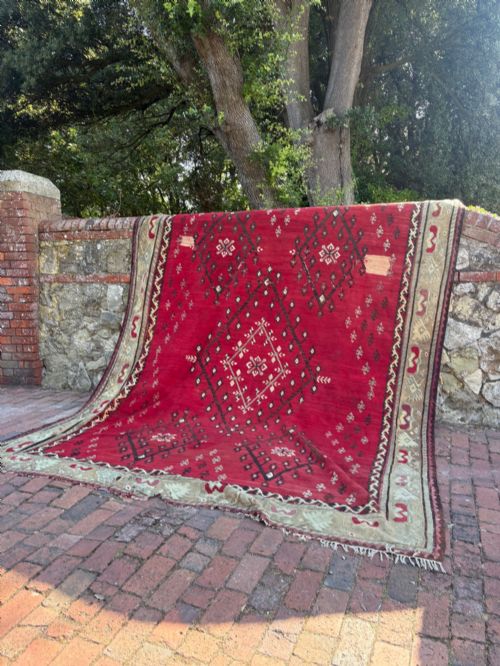


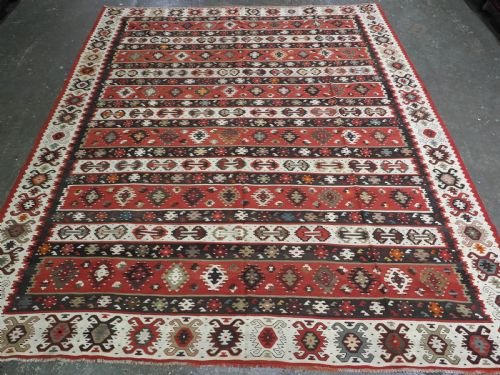
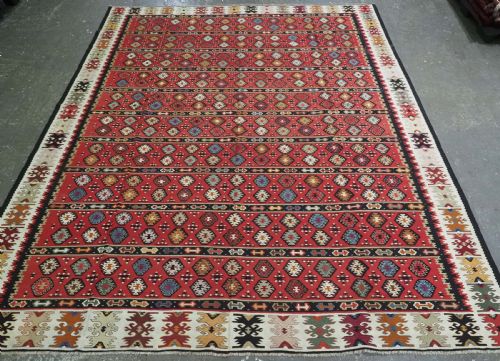


Large Kilim Rug
A large kilim rug brings graphic presence to a floor, offering flatwoven history from the late nineteenth and early twentieth centuries.
Large Kilim Rug
A large kilim rug provides substantial room coverage through flatwoven construction rather than a deep pile. These pieces span origins from Anatolia and the Caucasus to the Balkans and Central Asia, reflecting tribal and regional weaving traditions.
Most examples date from the decades around nineteen hundred, ranging from eighteen eighty up to the nineteen twenties. Buyers encounter room-size formats featuring bold geometric layouts, repeat medallions, or delicate floral compositions.
Materials and Construction
Weavers utilised wool and cotton, combining handspun yarns to create durable flatweaves without knots. The slit-weave technique produces sharp geometric edges where different colour blocks meet.
Natural dye traditions yield the characteristic palette seen across these textiles, from deep indigo and madder reds to softer pastel tones in later Balkan pieces.
Assessing Quality and Character
The precision of the slit-weave design and the subtlety of the dye palette separate standard production from superior artistic achievement. Tightly beaten wool foundations ensure longevity under foot.
Condition varies from timeworn repairs and distress to preserved surfaces, where historic restoration or original integrity influences the visual rhythm of the piece.
The Large Kilim Rug Glossary
- Kilim
- A flatwoven textile produced by tightly interweaving warp and weft strands to form a smooth surface without pile.
- Slit-weave
- A structural technique in flatweaving where weft yarns return at the boundary of a colour area, creating a small slit.
- Medallion
- A central ornamental motif dominating the field of the rug, often geometric or floral in structure.
- Warp
- The stationary vertical threads stretched across a loom that form the structural foundation of the weave.
- Weft
- The horizontal threads passed through the warp to create the visible pattern and colour of the textile.
Large Kilim Rug: Frequently Asked Questions
How do I clean a large kilim rug?
Gentle surface brushing and regular light vacuuming without a beater bar remove embedded dust. Professional textile cleaning is necessary for deeper care.
Water saturation and aggressive scrubbing risk damaging the historic wool fibres and bleeding natural dyes.
Can I put a flatweave in a hallway?
Room-size flatweaves suit low-traffic living spaces or bedrooms where their expansive designs remain visible. Narrower runner formats handle corridors better than broad carpets.
A quality underlay prevents slipping and cushions the thin wool structure against hard floors.
What is a Pirot or Sharkoy kilim?
These terms refer to flatweaves originating from the Balkan region, specifically associated with Pirot and Sharkoy traditions. They often display fine banded or repeat patterns.
Porter and trade routes distributed these distinctive European flatweaves widely across neighbouring regions.
How do I date an antique kilim?
Examining the dye palette, wool consistency, and regional weave structure helps establish an approximate period. Natural dyes and handspun wool typically point to nineteenth or early twentieth-century production.
Design motifs often reflect the specific tribal or folk traditions active during those decades.