
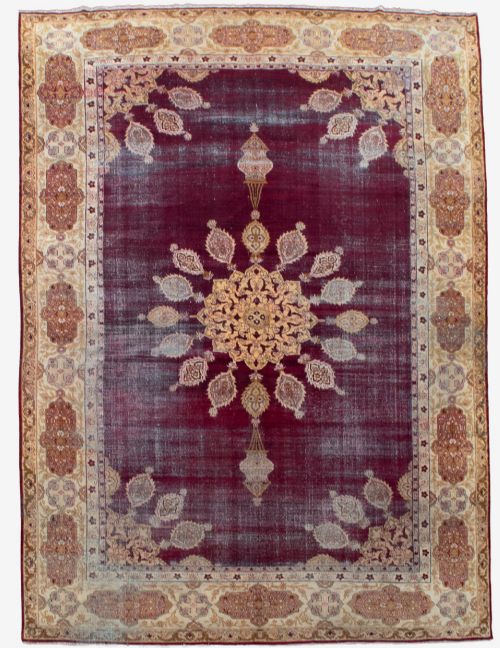
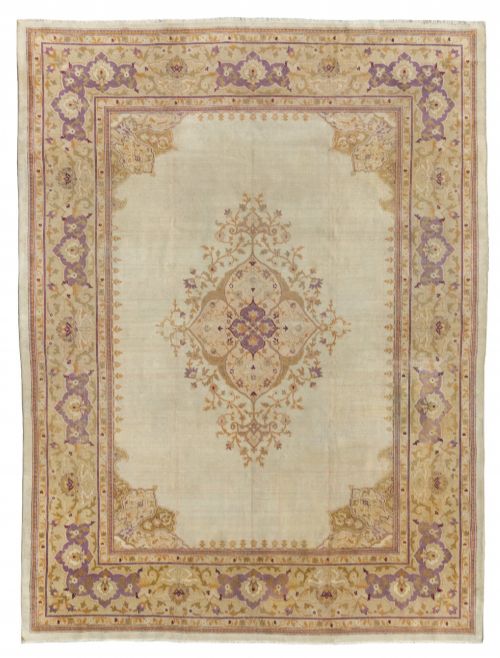


Large Indian Area Rug
A large indian area rug brings heavy, patterned presence to a floor, offering deep wool pile and traditional motifs from Northern India.
Large Indian Area Rug
A large indian area rug represents substantial floor coverings originating from Northern India across the eighteenth and nineteenth centuries, including distinct production centres such as Amritsar and Agra. Buyers searching this phrase encounter generous dimensions designed for country houses and substantial rooms, often spanning large floor areas.
The selections available here showcase significant rugs and carpets rather than small mats, dominated by nineteenth-century examples alongside fragments from the eighteenth century. These pieces display traditional Indian, Mughal, and Victorian Indian styles, reflecting both courtly design traditions and regional weaving practices.
Most examples you meet on this page date from the late nineteenth century, specifically around the 1870s, 1880s, and 1890s, alongside an occasional older Mughal fragment or a later twentieth-century Indian carpet. These floor coverings utilise substantial formats, frequently exceeding four or five metres in length.
How they were made
These carpets are constructed primarily using wool pile knotted onto cotton foundations, creating a dense and durable surface capable of enduring heavy foot traffic. The quality of the wool determines the tactile weight and resilience of the pile across the large surface area.
Weavers employed traditional techniques rooted in Mughal and regional North Indian aesthetics, incorporating intricate design vocabularies such as the Timuri Baluch influence seen in specific Agra pieces. The resulting textiles combine structural robustness with complex patterned fields.
Some nineteenth-century Agra pieces emerged from institutional production, quietly turning penal labour into palatial floor coverings.
What varies in quality
Quality in these carpets rests upon the fineness of the knotting and the clarity of the design across the expanse of the rug. Denser knotting allows for sharper delineation of traditional Mughal motifs and geometric patterns.
The condition of the wool pile and the integrity of the cotton foundation dictate the structural grade of each piece, distinguishing intact country house carpets from partial fragments or heavily worn examples.
The Large Indian Area Rug Glossary
- Amritsar
- A style and origin designation originating from the city in Punjab, known for producing large nineteenth-century carpets with distinctive decorative schemes. These pieces frequently feature muted palettes and expansive fields.
- Agra
- A northern Indian production centre associated with carpet weaving, particularly works from the nineteenth century that sometimes incorporated institutional or jail production methods. Agra carpets often display robust proportions and detailed borders.
- Mughal
- Pertaining to the imperial dynasty of the Indian subcontinent, whose artistic traditions heavily influenced later carpet design through balanced floral arrangements and refined symmetry. Mughal fragments demonstrate the earlier roots of these decorative arts.
- Area Rug
- A moveable floor covering that occupies a portion of a room rather than wall-to-wall installation, allowing timber or stone flooring to remain visible around the edges.
- Fragment
- A surviving portion of a larger historical carpet, retaining original weave and pattern structure despite the loss of full dimensions.
Large Indian Area Rug: Frequently Asked Questions
Where were these rugs made?
These rugs were produced in Northern India, with specific centres like Amritsar and Agra emerging as primary hubs for large-scale carpet weaving during the nineteenth century.
The influence of Mughal court aesthetics also shaped the regional designs found across these historic pieces.
How do I date a large indian area rug?
Dating relies on stylistic markers, construction materials, and documented periods ranging from eighteenth-century Mughal fragments to late nineteenth-century Amritsar and Agra productions.
Examining the complexity of the wool knotting and design motifs helps place a carpet within the 1860 to 1930 timeframe.
What materials make up the pile?
The pile is traditionally spun from wool, chosen for its durability and capacity to hold rich dye colours across large expanses.
This wool sits upon a sturdy cotton foundation that provides structural support for the heavy textile.
How do I place one in a room?
These substantial carpets function well as central anchors in large reception rooms or country house spaces, providing warmth and textural contrast to wooden floors.
Their generous dimensions require open floor space to allow the intricate border patterns and central fields to remain visible.