
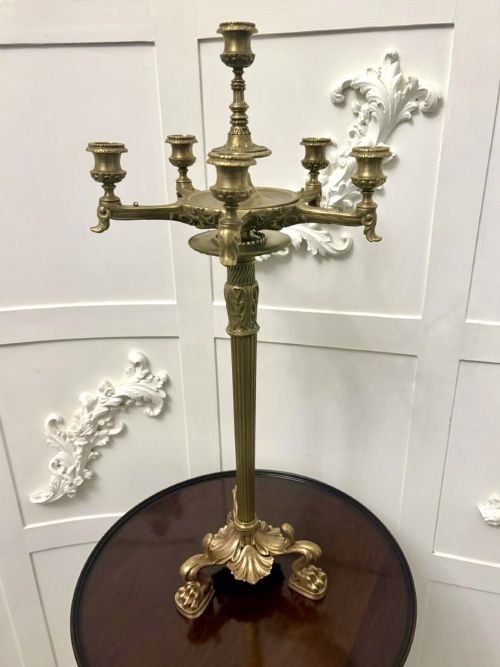



Large Brass Table Candelabra
These large brass table candelabra bring weight and presence to a room, offering multiple branching lights cast in gilded or patinated metals.
Large Brass Table Candelabra
When you search for large brass table candelabra, you are looking at substantial lighting pieces designed for dining tables, sideboards, and mantelpieces. The items seen here span the nineteenth and early twentieth centuries, capturing the ornate tastes of the Victorian era and French revival styles.
The version you are most likely to meet on this page is a nineteenth-century French or Victorian pair in gilded brass or ormolu, featuring three to six branches. Alongside standard candelabra, the listings include related forms such as table lamps, a mantel clock set, and glass-hung table lustres.
Origins represented across the selection lean heavily towards French workshops and Victorian English makers, drawing on Empire, Rococo, and Louis XVI design vocabularies. These pieces range from simple three-branch brass stems to heavy five-kilogram bronze and ormolu compositions.
Materials and construction methods
Construction relies on cast brass, bronze, and ormolu, often combining patinated dark bronze with bright gilded highlights to create textural contrast. Many nineteenth-century examples incorporate multiple cast sections screwed or pinned together to form complex multi-branch arrangements.
Surface decoration is achieved through mercury gilding, lacquer, and fine hand-chiselling of the cast metal surface after removal from the mould. Certain decorative variations include cut glass crystal drops hung from brass rings, and occasional silk components.
One hefty French candidate weighs in at five kilograms, ensuring dinner table stability even during lively nineteenth-century debates.
Distinctions in quality and finish
The top of the range is distinguished by crisp, deep chasing in the cast bronze or ormolu, where decorative motifs retain sharp edges and intricate relief details. Heavier metal gauge and substantial overall weight indicate superior material use, whereas lower quality pieces rely on softer, shallower casting.
Integration of the components also defines the hierarchy, with finer examples showing seamless joints between branches, stems, and heavy weighted bases. Signed works from documented founders demonstrate the highest level of workshop execution.
Deniere Paris
The Large Brass Table Candelabra Glossary
- Ormolu
- Gilded bronze produced by applying a mercury and gold amalgam to a bronze base and heating it until the mercury evaporates. This technique creates a durable, rich golden surface characteristic of fine French decorative objects.
- Candelabra
- A branched candlestick holder designed to support multiple candles simultaneously. In later adaptations, these frames are sometimes wired for electricity.
- Patinated Bronze
- Bronze treated with chemical solutions to produce a darkened surface finish. This technique contrasts sharply with bright gilt elements.
- Table Lustre
- A candelabra or candle holder adorned with glass pendants or drops. The cut glass reflects candlelight across the room.
- Louis XVI Style
- A neoclassical design movement characterised by straight lines, symmetry, and classical motifs such as urns and ribands. It experienced major revivals throughout the nineteenth century.
Large Brass Table Candelabra: Frequently Asked Questions
How do I clean large brass candelabra?
Dust gently with a soft brush and avoid harsh commercial metal polishes that can strip original gilding or patination. Traditional gilded surfaces require minimal moisture to preserve their historic finish.
Heavier bronze components benefit from occasional wiping with a dry microfiber cloth to remove airborne residue without disturbing the underlying metal.
Were these originally wired for electricity?
Nineteenth-century examples were designed exclusively for wax candles and featured solid cast drip pans and nozzles. Later adaptations often thread electrical wiring through the central stem.
When conversion has occurred, original sockets and fittings can sometimes be dated by their electrical components, though the primary structure remains antique.
How can I tell French Empire style apart?
French Empire pieces rely on strict symmetry, classical military motifs, and austere architectural lines influenced by antiquity. They frequently combine dark patinated bronze with bright gilded ormolu mounts.
This aesthetic contrasts with the later flowing, asymmetrical curves of Rococo revival pieces found from the same century.
Where should I place a heavy pair?
Substantial pieces require a sturdy surface such as a heavy sideboard, dining table, or deep mantelpiece capable of supporting significant weight. Ensure the base sits level to prevent tipping.
Allow adequate clearance around the branching arms so the metalwork is visible from multiple angles in the room.