
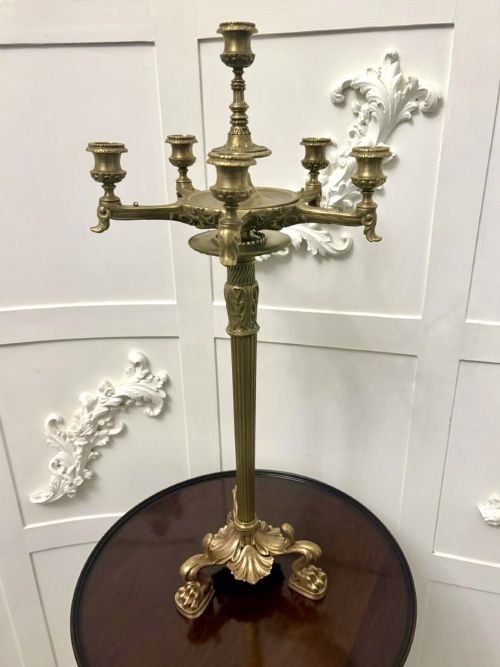
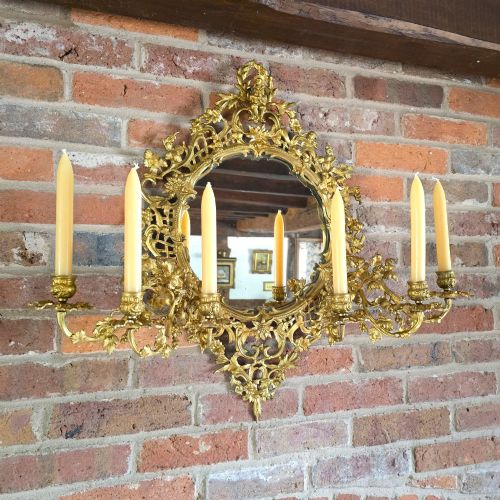
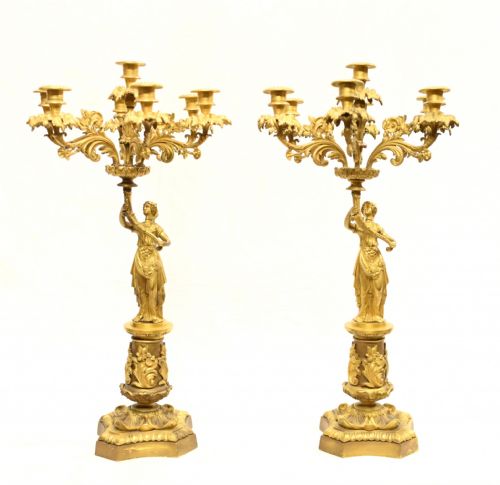


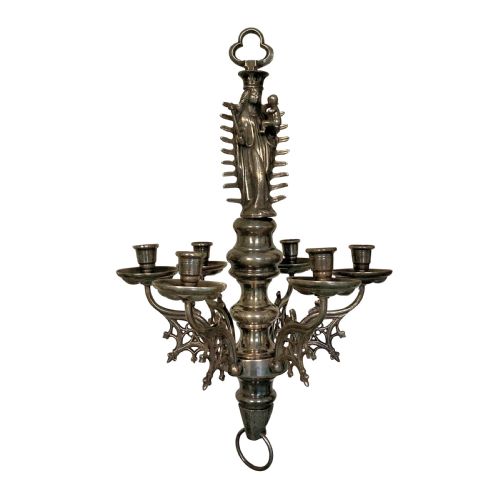


Brass Six Light Candelabra
These brass six light candelabra pieces bring weight and warmth to a room, offering distinct period character through heavy metalwork and branches.
Brass Six Light Candelabra
When you search for brass six light candelabra, you encounter substantial metal and gilt illumination pieces originating largely from nineteenth century France and Britain. The forms range from heavy freestanding candelabra stands and wall mirrors with branch attachments to related chandeliers and girandoles.
The nineteenth century examples dominate the selection, spanning from the Victorian era through Louis XVI style revivals and French Rococo designs. You will also find pieces incorporating crystal drops, glass elements, and fabric components alongside the foundational brass structure.
While primarily associated with candelabra forms, the search encompasses related six branch lighting variations including chandeliers and table lamps. These objects reflect various historicist revivals, notably Flemish Gothic and classical French aesthetics.
How they were made
The construction relies heavily on cast brass, ormolu, and gilt bronze, often finished with applied gilding or polished surfaces to achieve rich metallic lustre. Metal casting forms the primary structural stems and branches that support six distinct light points.
Many examples integrate cut glass and crystal pendants or droplets, suspended from the arms to refract candlelight and gaslight. Fabric elements occasionally appear in related lamp configurations, complementing the heavy metal framework.
Several pieces weigh in at a hefty five kilograms, proving that nineteenth century dining rooms took their lighting very seriously indeed.
What varies in quality
Quality rests in the crispness of the metal casting and the depth of the gilt bronze or ormolu finish. Finer pieces display sharply chiselled details along the floral and classical motifs rather than soft, smoothed contours.
The integration of materials dictates the visual hierarchy, where cut crystal and heavy brass work together cohesively. Structural solidity across all six branches separates substantial architectural pieces from lighter decorative alternatives.
The Brass Six Light Candelabra Glossary
- Ormolu
- Gilded bronze produced by applying a mercury and gold amalgam to a bronze base. This technique creates a durable, rich golden surface characteristic of French decorative arts.
- Girandole
- A branched wall sconce or candelabra featuring a mirrored backplate. The reflective glass multiplies the illumination from the candles.
- Rococo Revival
- A nineteenth century design movement reviving the asymmetrical scrolls, shell motifs, and natural curves of the eighteenth century French style. It appears frequently in ornate candelabra branches.
- Louis XVI Style
- A neoclassical aesthetic defined by symmetry, straight lines, and classical architectural motifs such as urns and ribands. This style provides a restrained contrast to earlier curved designs.
Brass Six Light Candelabra: Frequently Asked Questions
How do I clean brass candelabra?
Dust the metal gently with a soft cloth to prevent accumulation in the intricate cast details. Avoid harsh commercial polishes that strip historic patination from gilt surfaces.
Take particular care around crystal drops and glass components if they are integrated into the frame. Mild soapy water on a damp cloth usually suffices for routine maintenance.
Where should I place a candelabrum?
Position freestanding candelabra on heavy sideboards, mantelpieces, or dedicated stands where their weight and height command attention. Ensure the surface is stable enough to support several kilograms of metal.
Wall mounted variations require secure fixings into solid masonry or stud work to bear the substantial load of the branches. Keep them away from high traffic corridors where garments might catch the arms.
How do I identify a nineteenth century piece?
Examine the casting quality and joinery methods visible on the underside or structural joints of the branches. Nineteenth century pieces often show hand finishing marks and heavier gauge brass components.
Compare the stylistic vocabulary, such as Victorian or French neoclassical revival motifs, against documented period design books. The patination of the brass and ormolu also develops distinct ageing characteristics over decades.
What is the difference between a candelabrum and a chandelier?
A candelabrum is designed to stand upon a horizontal surface or mount directly to a vertical wall. It supports multiple candle branches from a base or backplate.
By contrast, a chandelier suspends from the ceiling on a chain or rod, distributing its six light points downward into the room. Both share similar branch configurations and decorative metalworking techniques.