


Large Brass Prickets
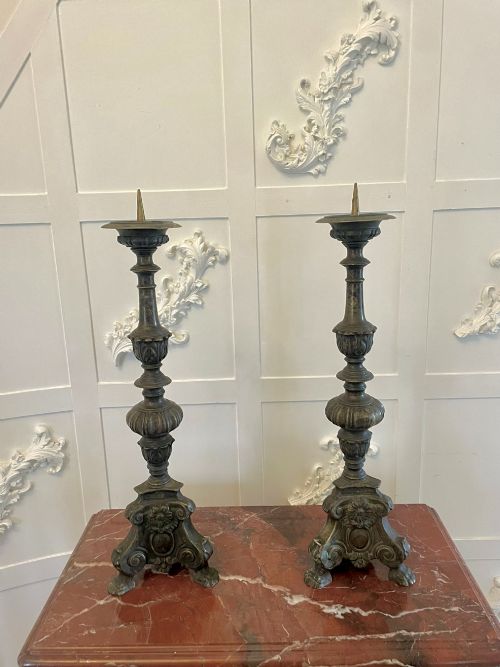
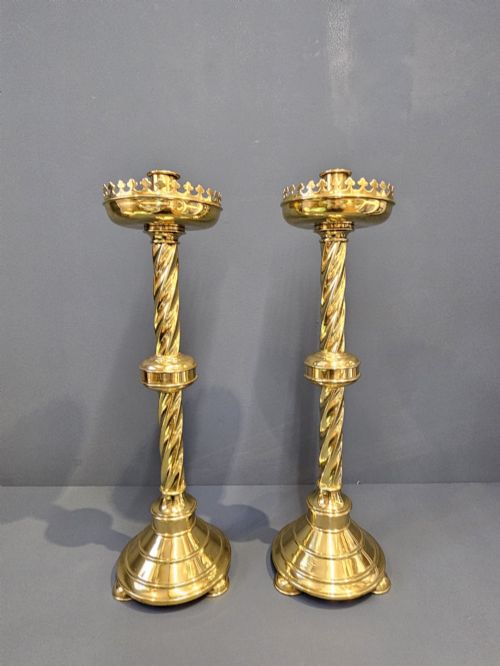
Large brass prickets are substantial altar lights that anchor a room with vertical presence, built to hold tall candles on sharp spikes rather than in sockets.
Large Brass Prickets
Large brass prickets are substantial lighting devices designed with a central spike to support large candles, originating largely from ecclesiastical settings and church interiors. When searching for large brass prickets, you encounter ecclesiastical candlesticks and floor standing candle holders spanning from the seventeenth century through to the mid-twentieth century.
The pieces appearing on this page most commonly date from the Victorian era and the early twentieth century, showing influences from the Gothic Revival and the Amsterdam School. Forms range from matched pairs of heavy altar sticks to individual floor standing holders and occasional sets of four.
Materials extend beyond standard yellow brass to encompass cast brass, gilt brass, bronze, copper, and mixed compositions incorporating wrought iron or hardwood elements. These tall forms bring architectural gravity to domestic interiors, shifting the function of church metalwork into decorative focal points.
How they were made
Construction relies heavily on foundry casting in brass, bronze, and copper, producing thick structural shafts and wide drip pans designed to catch melted wax. Components are frequently turned on lathes and assembled in sections, threaded together or secured with internal rods to achieve tall, balanced proportions.
Mixed media construction appears in pieces that combine cast brass with wrought iron, copper sheeting, or turned hardwood bases, particularly in twentieth-century Dutch and Art Deco designs. Surface finishes vary from bright gilt-brass to patinated bronze and mixed metals that show the tool marks and structural joints of their manufacture.
Listings demonstrate materials spanning cast brass, bronze, copper, gilt brass, wrought iron, and hardwood, reflecting centuries of metalworking traditions.
What varies in quality
Quality rests in the weight of the casting and the crispness of turned decorative profiles, distinguishing heavy architectural metalwork from lighter domestic adaptations. Superior examples retain their original pricket spikes, balanced circular drip pans, and stable bases without excessive wobble or replacement components.
Design ambition separates standard church brasses from exceptional pieces showing distinct artistic movements like the Amsterdam School or Art Nouveau. The integrity of the surface metal, whether displaying a deep natural patination or surviving gilt highlights, dictates the visual authority of the piece.
The Large Brass Prickets Glossary
- Pricket
- A sharp metal spike set on top of a candlestick to impale and hold a candle secure. This method predates the socket candlestick and remains standard on ecclesiastical altar lights.
- Drip pan
- A wide circular tray positioned beneath the pricket spike to catch falling wax. It prevents molten wax from running down the main shaft and damaging altar cloths or furniture.
- Gilt brass
- Base brass metal treated with a thin layer of gold or gold-coloured wash to give a rich reflective surface. This finish is frequently found on ecclesiastical pieces intended for ceremonial display.
- Amsterdam School
- An early twentieth-century architectural and design movement characterised by expressive forms, traditional craftsmanship, and combinations of brass and iron. Pieces from this style often feature sculptural bases and mixed metal construction.
- Gothic Revival
- A nineteenth-century stylistic movement that revived medieval architectural motifs, visible in the pointed arches, heavy knops, and tracery patterns on church candlesticks.
Large Brass Prickets: Frequently Asked Questions
What is a pricket candlestick?
A pricket candlestick is a lighting fixture that uses an upward-pointing metal spike to hold a candle in place, rather than a cylindrical socket. This design allows the candle to burn down evenly over a wide drip pan.
Such pieces were primarily manufactured for use on church altars and in large ecclesiastical spaces before finding a place in domestic interiors.
How do I clean antique brass?
Antique brass is generally best left with its accumulated patination and natural darkening, which shows its age and handling over centuries. Aggressive polishing removes the surface skin and can erase subtle details in cast ornamentation.
Dusting with a dry cloth and gentle cleaning with mild soap and water is sufficient for maintenance. Chemical polishes strip away historical character and reduce the visual depth of the metal.
Where were these pieces used?
Large brass prickets were originally housed in churches, cathedrals, and chapels to illuminate altars and chancels during services. Their considerable height ensured the light carried across large liturgical spaces.
Today, collectors place them on sideboards, mantelpieces, or directly on the floor as sculptural decorative objects in residential settings.
How do I date a brass candlestick?
Dating relies on observing the casting technique, proportions, and stylistic details that align with periods like the Gothic Revival, Art Nouveau, or Victorian eras. Heavier multi-component construction and tool marks often point toward nineteenth-century or earlier manufacturing methods.
Comparing the base form and drip pan profile with documented examples helps establish the likely decade of production.