
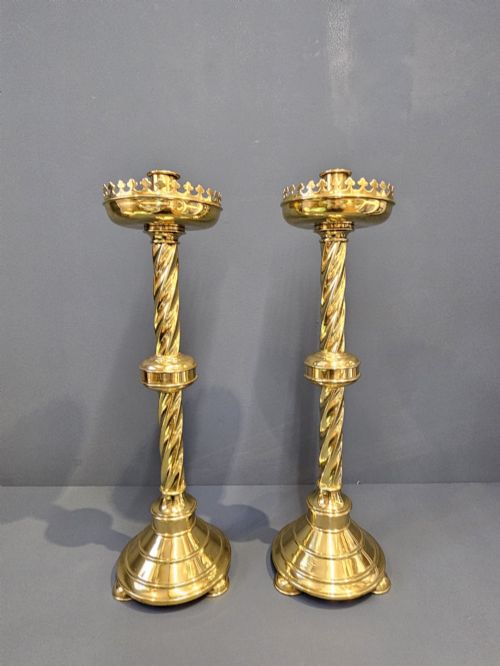


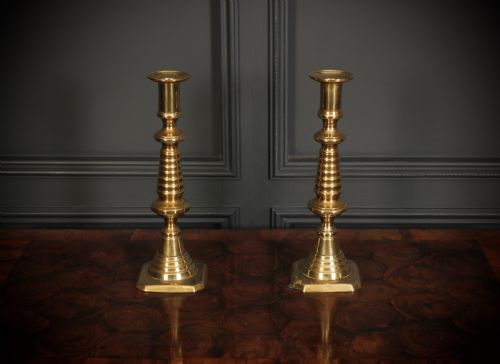


Large Brass Candleholders
Large brass candleholders bring heavy metal presence and bright candlelight to a room, ranging from simple church candlesticks to multi-stem French candelabra.
Large Brass Candleholders
Large brass candleholders are tall domestic and ecclesiastical lighting pieces designed to stand on tables, altars or sideboards. When you search for large brass candleholders, you encounter substantial pairs dating predominantly from the nineteenth century, including Victorian, Edwardian and earlier styles.
The selections span simple turned shafts from the Victorian era to more ornate French multi-stem candelabra and architectural Gothic revival designs. You will also find ecclesiastical pricket sticks and mixed-material examples incorporating wrought iron, bronze or marble.
Most items appear in matched pairs, offering symmetry for mantelpieces and dining tables. Their substantial weight and height distinguish them from smaller chambersticks or desk lights.
How they were made
Maker construction relies heavily on cast and turned brass, often utilising heavy gauge metal to achieve significant weight, such as single pieces scaling five kilograms. Sections are frequently cast in parts and joined together, incorporating detailed knops and drip pans.
Surface finishes vary between polished brass, gilt brass, gilded applications and patinated bronze, depending on the intended aesthetic of the workshop. Secondary materials like wrought iron, Sienna marble and mahogany occasionally combine with the brass components in specific stylistic pieces.
The current selection spans from the seventeenth century through the Victorian era up to the nineteen thirties.
What varies in quality
Quality rests in the crispness of the casting and the weight of the metal. Superior pieces display deep, clean turning on the shafts and well-defined decorative motifs rather than soft, blurred edges from worn moulds.
Proportion and stability determine the success of the piece, with better examples standing solidly on well-balanced bases. The integrity of the joins and the retention of original gilding or patination further elevate the standing of a pair.
The Large Brass Candleholders Glossary
- Pricket
- A candlestick featuring a sharp metal spike at the top designed to impale the base of a candle. This form is common in ecclesiastical settings.
- Knop
- A knob or rounded swelling on the stem of a candlestick. It provides a secure grip for lifting the heavy piece.
- Candelabra
- A branched candleholder that supports multiple candles from a single base. These often feature three or six stems.
- Sconce
- The socket or cup at the top of a candlestick that holds the base of the candle. In some pieces, this is paired with a removable drip pan.
Large Brass Candleholders: Frequently Asked Questions
How do I clean large brass candleholders?
Dust regularly with a soft cloth to prevent grime build-up on the cast surfaces. Avoid harsh chemical polishes that strip away age-appropriate patination unless a bright polished look is specifically desired.
Take care around gilt or patinated areas where aggressive scrubbing can damage the finish. A gentle wipe with a damp cloth is usually sufficient for maintenance.
How do I tell Victorian pieces from earlier eras?
Victorian examples often display heavier cast construction with machine-turned precision and varied revival styles like Gothic or Rococo. Earlier seventeenth and eighteenth-century pieces tend to show simpler turned knops and heavier hand-finished brass.
Examination of the underside and construction joins often reveals the manufacturing techniques typical of different decades. Maker marks are uncommon, so style and material provide the main clues.
Can I mix different styles on a mantelpiece?
While many listings offer matched pairs, mixing single sticks or varying heights can create an interesting display. Maintaining a similar material palette, such as polished brass or gilt finishes, helps unify disparate pieces.
Ensure the scale of individual items complements the surrounding furniture and room proportions. Heavy ecclesiastical sticks demand more substantial placement than slender domestic tapers.