


Large Brass Candle Holders
Large brass candle holders bring weight and steady illumination to a room, ranging from simple domestic pieces to tall church items.
Large Brass Candle Holders
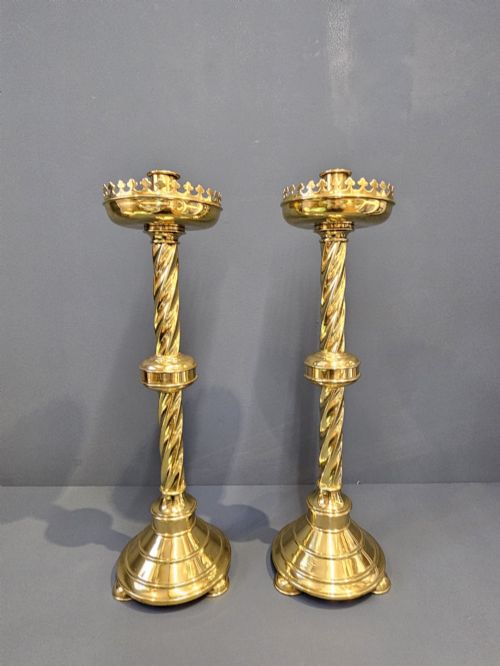
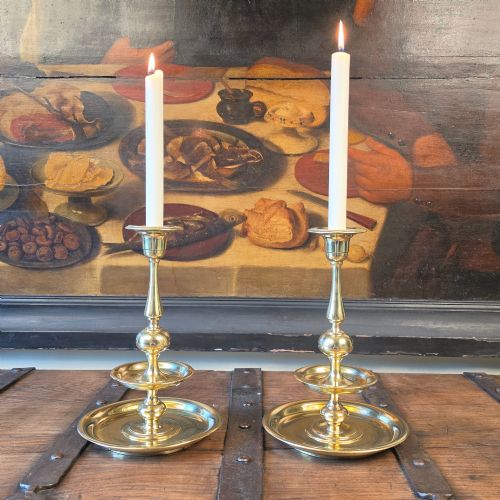
Large brass candle holders encompass substantial candlesticks, multi-branched candelabra, and tall floor-standing church pieces designed for significant illumination. The most common examples met on this page date from the nineteenth century, including Victorian domestic designs and heavy ecclesiastical pairs.
How they were made
Makers utilised cast and turned brass, often combining iron, copper, or bronze within the same piece, particularly in church and Amsterdam School designs. Surface finishes range from high gilding and gilt-bronze ormolu to patinated bronze and hand-engraved detailing.
Multi-component construction is standard, with separate nozzles, drip pans, stems, and weighted bases joined securely to support heavy candle arrangements.
One notably heavy French specimen tips the scales at five kilograms, ensuring it stays firmly put.
What varies in quality
Quality rests in the crispness of the casting, the proportion of the parts, and the integrity of the base weight rather than mere scale. Superior pieces display finely chased ornament, substantial metal thickness, and well-fitted joints across multi-branch or column structures.
The finish also dictates worth, where original gilding, subtle patination, or deliberate hand-engraving remain intact without over-cleaning or distortion to the original brass surface.
The Large Brass Candle Holders Glossary
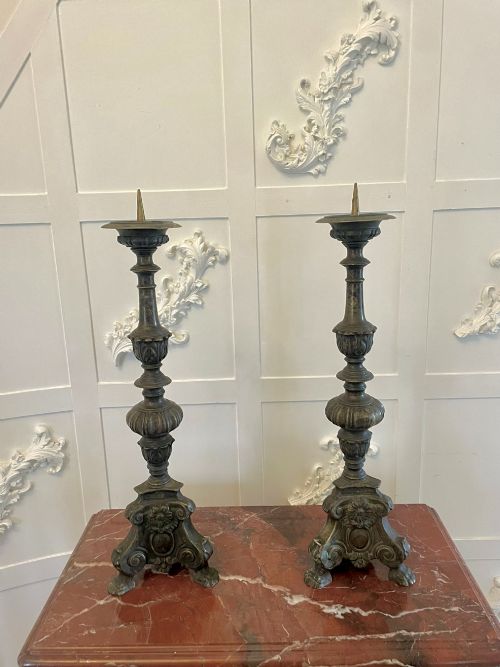
- Pricket candlestick
- A candle holder featuring an upright metal spike that impales the base of the candle, commonly found on church and ecclesiastical pieces.
- Candelabra
- A branched candle holder designed to support multiple candles from a single central stem or base.
- Ormolu
- Finely ground high-carat gold applied to a bronze base, creating a rich golden surface often seen on French Empire examples.
- Sconce
- The metal pan or socket at the top of a candlestick designed to catch dripping wax and hold the candle firmly.
Large Brass Candle Holders: Frequently Asked Questions
Where were large brass candle holders used?
Many large pieces originated in churches, chapels, and grand domestic halls where heavy illumination was necessary. Tall floor standards and multi-branch candelabra suited wide spaces and formal dining settings.
Domestic pairs typically stood on mantelpieces, sideboards, or large tables to provide ambient light during evenings before electricity became common.
How do I clean antique brass?
Antique brass requires minimal intervention to preserve its historic surface and natural patina. Dusting with a soft cloth is usually sufficient for regular maintenance.
Avoid harsh commercial metal polishes that strip away the aged surface and remove traces of original gilding or patination.
Can these candle holders take modern candles?
Many older holders accommodate standard taper candles, though inner socket diameters vary due to historical manufacturing methods. Pricket types require candles with a pre-drilled base to sit securely on the metal spike.
Checking the internal dimensions of the sconce prevents damage and ensures stability during use.
How do I date a brass candlestick?
Dating relies on stylistic clues, casting techniques, and assembly methods visible in the base and stem. Nineteenth-century and Victorian pieces often show heavier, more ornate decoration, while earlier examples feature simpler knops and hand-finished surfaces.
Proportions and construction details provide reliable indicators of the period of manufacture.