
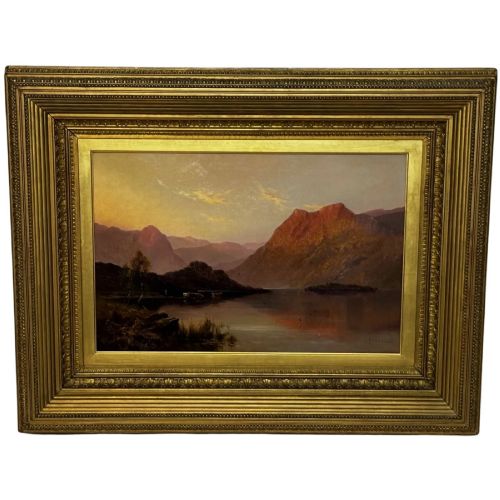
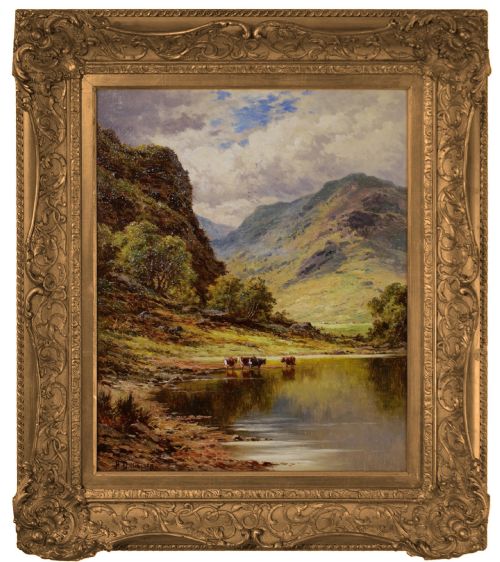


Lake Landscape Oil Painting
A lake landscape oil painting captures expansive water and distant mountains through the textured weight of applied pigment.
Lake Landscape Oil Painting
A lake landscape oil painting presents serene waters, mountainous horizons, and rural shorelines executed across the nineteenth and twentieth centuries. These artworks capture specific bodies of water, from English and Scottish lakes to Italian lakes and Alpine vistas.
The selections span Victorian academic studies, impressionist interpretations, and mid-century interpretations on canvas, board, and card. Buyers encounter framed Scottish Highland scenes, moonlight nocturnes over water, and winter lake landscapes with skating figures.
Works originate from British, French, Italian, and Scandinavian schools, reflecting diverse regional approaches to natural light and atmospheric water reflections. Many pieces incorporate original wooden gilt frames matching their period of creation.
How They Were Made
Artists painted primarily using oil paint applied to woven canvas, wooden panels, card, or supporting boards. The handling of pigment ranges from smooth, blended nineteenth-century glazing to thick, textured impasto strokes found in later impressionist and expressionist works.
Many historical examples retain their period frames constructed from wood, embellished with gesso mouldings, and finished with gilt, gold leaf, or painted surfaces.
Materials span oil paint on canvas, wood panels, card, and board, complemented by giltwood and gesso frames.
What Varies in Quality
Quality rests in the artist's command of atmospheric perspective, where subtle tonal shifts render distant mountain ranges and reflective water surfaces convincing. The dexterity of brushwork determines whether foliage, skies, and ripples possess genuine depth or remain flat.
The preservation of the original paint surface and the structural integrity of the underlying canvas or panel define the enduring condition of each work. Original period framing matching the age of the canvas contributes significantly to the historical integrity of the piece.
Alfred Fontville de Breanski Jr·Henry H Parker·Helen Layfield Bradley·Gabriel Dauchot·Frank Hider·Charles Leslie·Giulio Cecchini·James Gunson Atkinson·John Douglas Perrett·James Bell Anderson·Joseph Farrington RA·Stephen Enoch Hogley·Alexis De Leeuw·Alfred de Breanski Snr·Benjamin Williams Leader·T B Garvie·Sidney Richard Percy·Louis Smets·Antoine Bouvard·Gustave De Breanski·William Mellor·Samuel Hart Turpin·George Neil·Nicolas Victor Fonville·H Thomas
The Lake Landscape Oil Painting Glossary
- Impasto
- Paint applied thickly to a canvas or board, standing out in relief from the surface and retaining visible brush marks. This technique adds tactile dimension to highlights on water or foliage.
- Giltwood
- Wood that has been carved and coated with gold leaf or a gold-coloured finish. It provides traditional ornate framing for nineteenth-century canvases.
- Gesso
- A plaster-like mixture applied to wooden frames as a base for gilding. It allows for crisp ornamental moulding details around the edge of the artwork.
- Nocturne
- A painting depicting a scene at night, often illuminated by moonlight over water. These works emphasise dark tonalities and subtle nocturnal light effects.
- Provenance
- The documented history of ownership surrounding an artwork. Established provenance verifies the origin and past exhibitions of the piece.
Lake Landscape Oil Painting: Frequently Asked Questions
How do I identify a Victorian lake painting?
Victorian lake paintings typically feature detailed naturalism, often depicting Scottish Highlands or English lake district views with precise brushwork and subdued natural colour palettes.
They frequently appear in heavy gesso and giltwood frames, sometimes bearing artist inscriptions or nineteenth-century exhibition labels on the reverse.
What subjects appear in these lake landscapes?
Common subjects include mountain-backed waters, sailing boats, ruined castles beside shores, cattle grazing near the water margin, and figures on winter ice.
Artists also captured specific atmospheric conditions such as morning sunrise, moonlight, threatening storms, and summer showers passing over peaks.
Are these paintings executed on canvas or board?
The works utilise several supports, with traditional stretched canvas being the most common for larger nineteenth-century landscape compositions.
Smaller studies, cabinet pieces, and twentieth-century works frequently utilise wooden panels, heavy card, or artist boards.
How do impressionist lake paintings differ from earlier works?
Impressionist and post-impressionist lake paintings focus on the play of light and colour across water rather than precise topographical recording.
They employ looser brushstrokes, brighter palettes, and textured impasto surfaces to evoke the feeling of a garden pond or continental lake scene.