



Kurdish Long Rug
When buying a Kurdish long rug, you secure a woven runner or carpet originating from nineteenth and early twentieth-century workshops and homelands in North West Persia.
Kurdish Long Rug
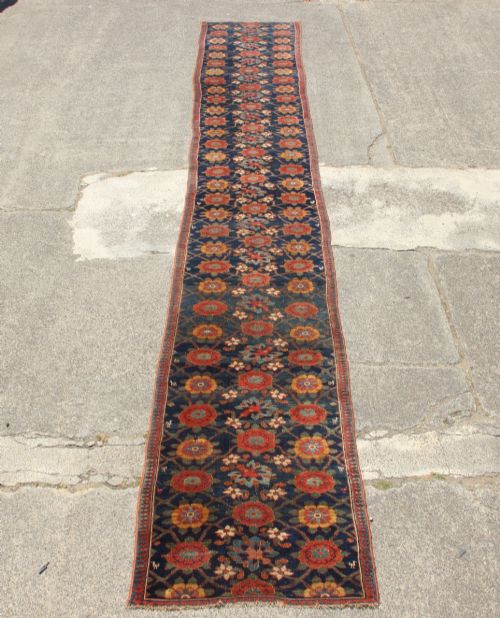
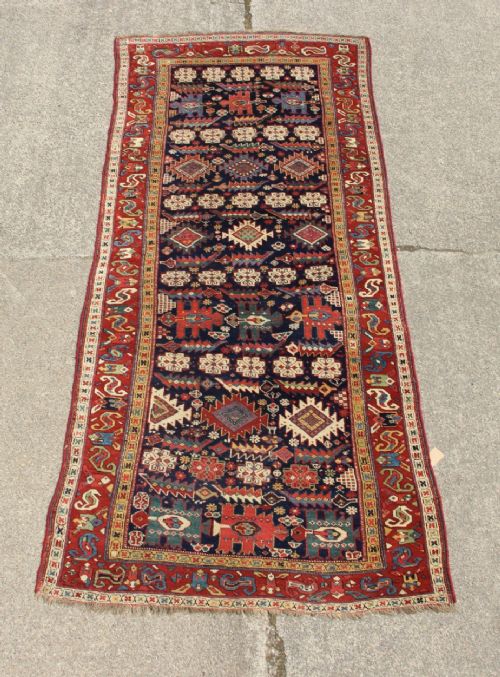
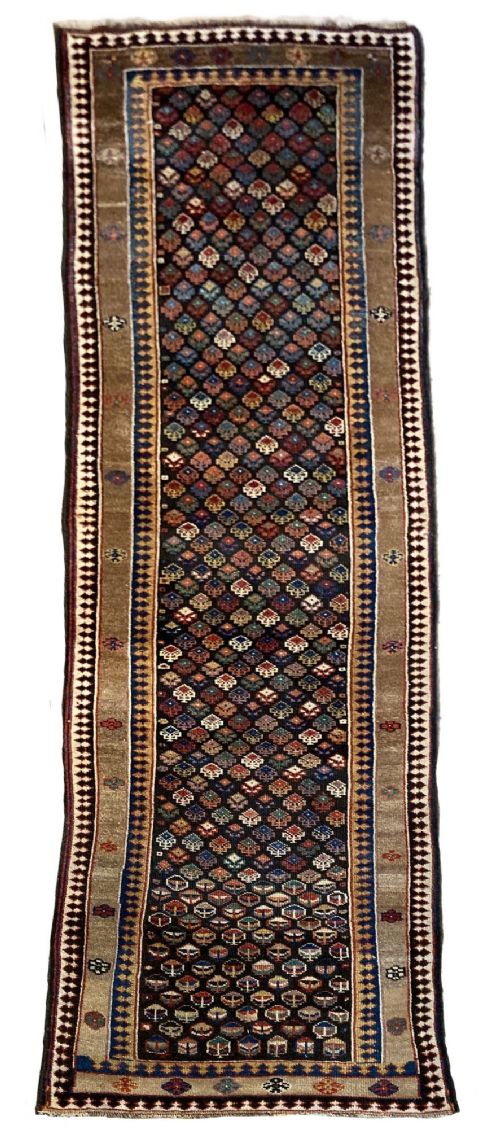
A Kurdish long rug typically presents as a narrow runner or an elongated kelleh format designed for corridors, halls, and country house interiors. These textiles originate largely from North West Persia, encompassing tribal regions and specific weaving centres such as Bidjar, Senneh, and Hamadan.
The format is characterised by extended proportions, spanning narrow hallway runners to wider gallery carpets. Common design elements include the Mina Khani flower pattern, repeating boteh motifs, shrub designs, and geometric gul medallions framed by detailed borders.
How they were made
Weavers constructed these pieces using wool pile tied onto robust cotton or wool foundations, frequently incorporating hand-spun wool for durability and rich texture. The structure often relies on dense knots, producing a heavy, resilient pile suited to high-traffic domestic spaces.
Dyes were derived from natural sources, yielding deep red, ivory, and blue colour palettes that develop patination over time. Certain lighter formats, such as flatweave kilims, utilised alternative interlacing techniques without a raised pile.
Certain narrow runners preserve the charming domestic observations of their makers, incorporating tiny figures of tribeswomen and birds perched on trees directly into the wool field.
What varies in quality
The standard of a Kurdish long rug depends significantly on the fineness of the knotting and the handling of the wool. Pieces woven with tightly packed hand-spun wool offer greater structural integrity and longevity than looser structures.
Visual complexity and balance also dictate distinction within this category. Examples featuring intricate drawing, such as dragon borders or well-defined shrub lattices, command greater appreciation among collectors than simpler, repetitive field layouts.
The Kurdish Long Rug Glossary
- Kelleh
- A large format rug, longer than a standard carpet but broader than a runner, traditionally used in Persian rooms. It provides an extended rectangular field for repeating motifs like the boteh.
- Boteh
- A stylised almond or paisley-shaped motif representing a shrub or floral spray. It appears frequently in all-over field designs across nineteenth-century Persian weavings.
- Mina Khani
- A symmetrical repeating pattern composed of daisy-like flowers linked by a lattice of vines. This design is commonly found on pieces originating from the Bidjar region.
- Gul
- A medallion or octagonal motif used repeatedly within tribal rug geometry. Different regional tribes employed distinct gul shapes to signal identity.
- Kilim
- A flatweave textile produced without a pile by tightly interweaving warp and weft threads. These runners offer a lighter, reversible floor covering.
Kurdish Long Rug: Frequently Asked Questions
Where were Kurdish long rugs made?
These textiles were produced primarily in the tribal homelands and weaving districts of North West Persia, including regions associated with Bidjar, Senneh, and Hamadan.
Weavers in these areas utilised local materials and traditional geometric or floral iconography passed down through generations.
How were long runners used in homes?
Historical interiors utilised these elongated formats mainly in hallways, corridors, and long reception rooms to protect wooden flooring and add warmth.
Their narrow proportions allowed them to line corridors while displaying complex border patterns and central motifs to visitors.
How do I care for an antique wool rug?
Maintenance requires gentle vacuuming without rotary brush heads to protect the hand-spun wool pile and vulnerable flatweave ends.
Professional specialist cleaning is recommended to preserve natural dyes and prevent fibre degradation over decades of use.
How can I tell the age of these rugs?
Age is assessed through material analysis, dye characteristics, structural wear patterns, and stylistic markers typical of nineteenth and early twentieth-century production.
Hand-spun wool combined with natural indigo and madder-derived colours generally points towards pieces woven before synthetic dyes became widespread.