

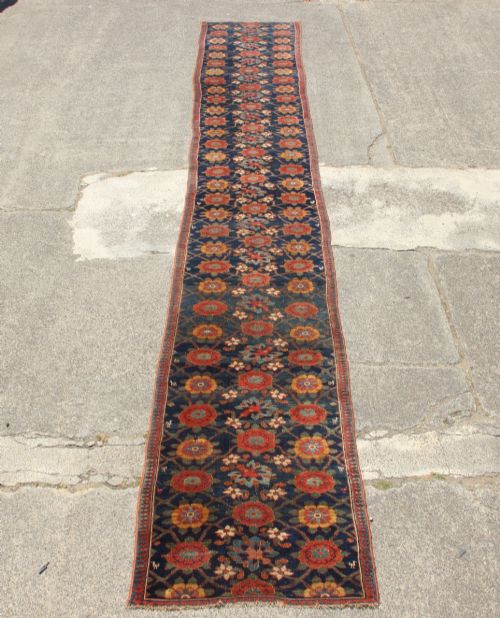
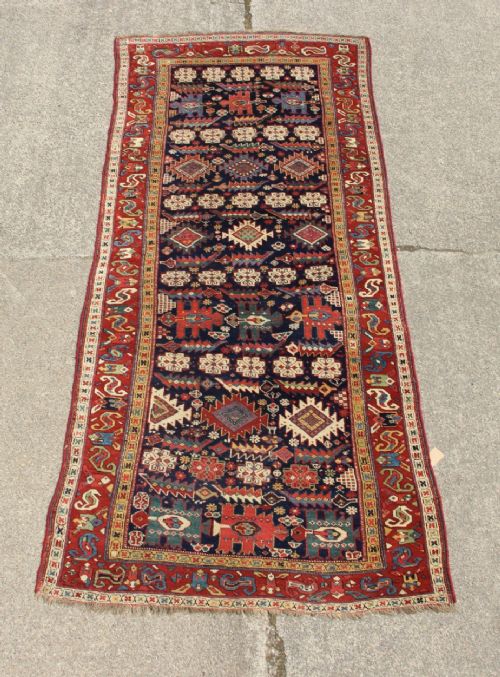
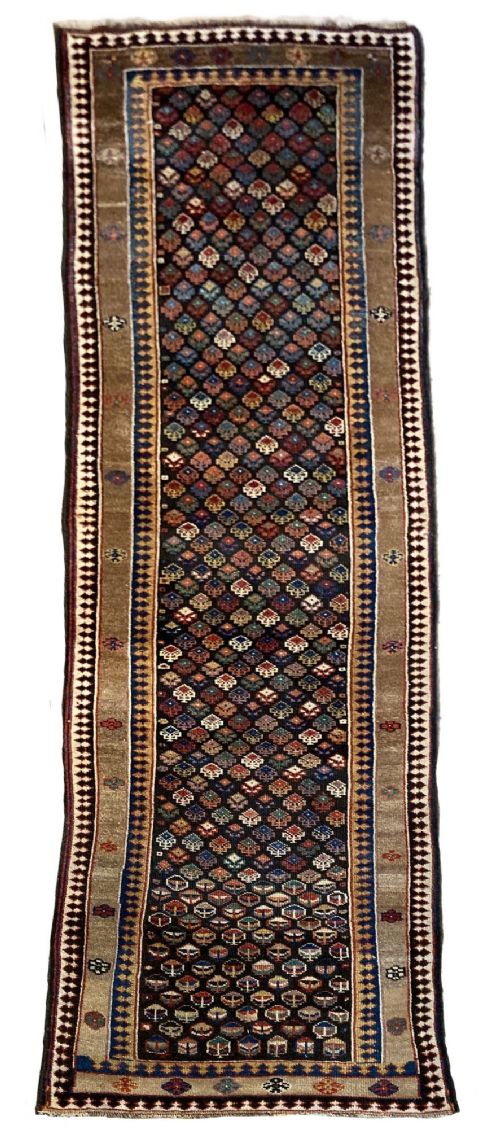


Kurdish Hallway Runner
When you search for a kurdish hallway runner, you discover tribal floor coverings woven in village workshops across nineteenth and early twentieth century Persia.
Kurdish Hallway Runner
A kurdish hallway runner takes the form of an elongated carpet designed specifically for corridors, passageways, and long domestic spaces. These pieces emerge predominantly from the tribal regions and villages of northwest Persia.
The format spans narrow narrow strips measuring under a metre wide alongside broaderelleh formats that stretch several metres in length. Most examples encountered here date from the mid-nineteenth century through to the early decades of the twentieth century.
Makers integrated traditional village motifs such as latch hook medallions, garden designs, and repeating floral patterns into their floor coverings. Pieces frequently exhibit tribal influences tied directly to weaving communities across Kurdistan and surrounding Persian districts.
Materials and Construction
Weavers relied primarily on wool and hand-spun wool for the pile, providing a dense and resilient surface suited for heavy foot traffic in corridors. Foundations typically consist of sturdy cotton or wool warp and weft threads.
Dyes derived from natural sources interact with hand-spun fibres to create characteristic depth and variation across the pile. The tight knotting technique ensures structural integrity, allowing these antique textiles to survive a century or more of domestic use.
Kurdish Hallway Runner Retail Price Guide 2026
Typical asking prices for kurdish hallway runner among the pieces listed under this phrase on Sellingantiques today, from the lower quarter to the upper quarter. They describe what is for sale here now, not the wider market.
Keep an eye out for rogue birds perched on stylized trees, quietly observing hallway traffic for over a century.
Assessing Quality and Execution
Quality rests in the crispness of the drawing and the handling of secondary motifs like birds, trees, and geometric fills. Tighter knot density allows intricate details such as the mina khani or boteh patterns to remain sharp along long corridors.
The treatment of natural dye colour sets superior examples apart, showing subtle abrash where tones shift naturally across the field. A successful balance between sturdy wool foundations and precise tribal geometry distinguishes the finest village output.
The Kurdish Hallway Runner Glossary
- Kelleh
- A large format rug or runner that is longer than it is wide, typically intermediate between a standard rug and a full room-size carpet. These proportions suit spacious hallways and principal ground floor corridors.
- Mina Khani
- A repeating pattern composed of stylized flowers linked by a lattice network. This classic Persian design frequently appears in village and tribal weaving traditions.
- Abrash
- A visible variation in colour tone within a single field of wool, caused by changes in dye batches or hand-spun yarn. Collectors prize this natural characteristic as evidence of traditional dyeing methods.
Kurdish Hallway Runner: Frequently Asked Questions
Where were these runners woven?
These textiles originate from the mountainous tribal lands and village workshops of northwest Persia. Weavers in regions such as Bidjar, Senneh, and surrounding Kurdish districts produced them for domestic use and local trade.
Production spanned the nineteenth and early twentieth centuries, reflecting distinct regional styles rooted in nomadic and village traditions.
How do I place a runner in a modern hallway?
Measure your corridor carefully to leave an even margin of exposed floorboards or stone around the edges of the textile. Long narrow formats anchor high-traffic areas while softening hard architectural surfaces.
Use a quality underlay beneath the wool pile to prevent slipping and protect the foundation threads from excessive friction against the floor.
How do I identify a nineteenth century piece?
Examine the materials, structure, and colour saturation visible across the pile and foundation. Nineteenth-century examples typically employ hand-spun wool and natural dyes that mellow gracefully over time.
Structural traits like irregular dimensions and hand-finished selvedges point toward traditional village manufacture rather than twentieth-century commercial production.
What maintenance do these runners require?
Vacuum the wool surface regularly using low suction without a rotating brush bar to protect the hand-knotted pile. Professional cleaning by a specialist in antique textiles ensures the natural dyes remain stable.
Rotate the runner periodically to distribute foot traffic evenly across the length of the piece.