


Kingwood Slant Front Desk
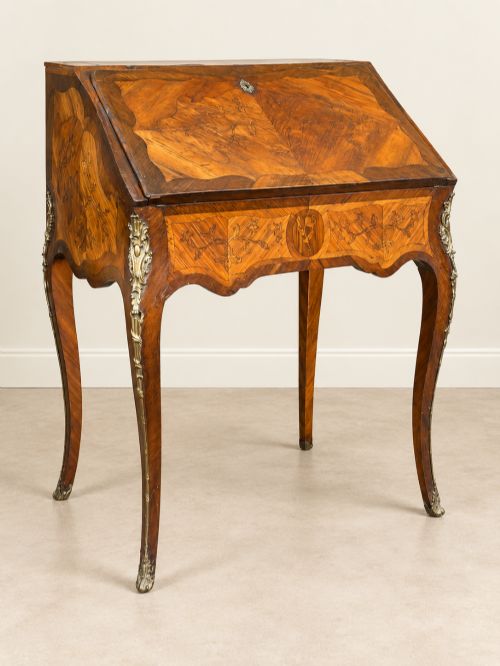
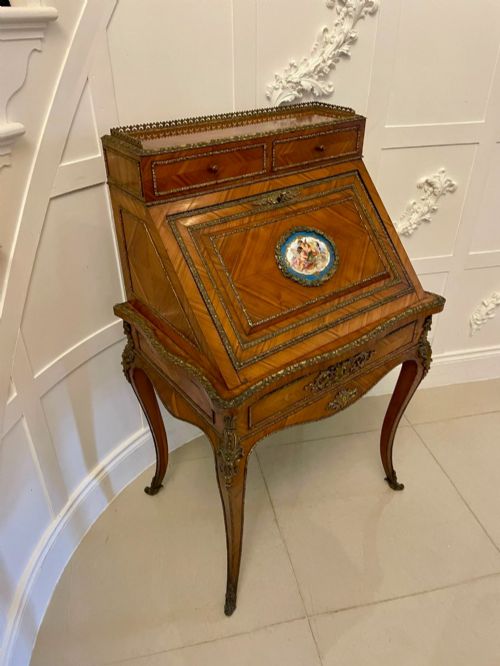
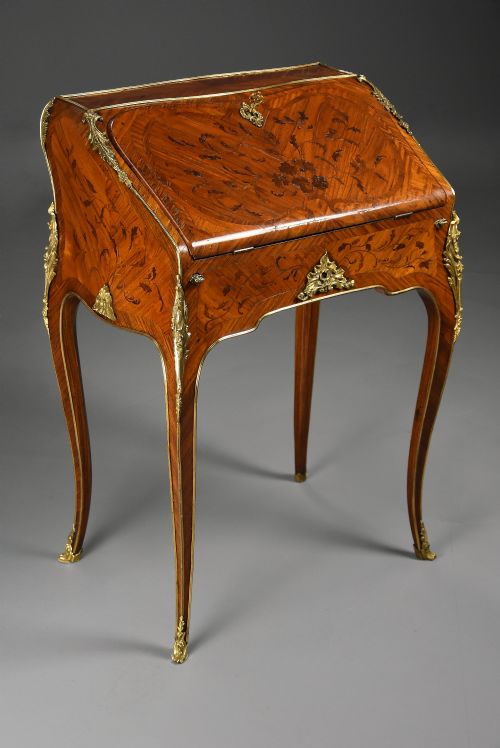
A kingwood slant front desk brings together figured veneers and refined mounts to create a striking writing surface for the home.
Kingwood Slant Front Desk
A kingwood slant front desk comprises compact writing pieces with hinged writing flaps that conceal fitted interiors of small drawers and pigeonholes. The selection here spans the eighteenth, nineteenth, and early twentieth centuries, drawing heavily upon French taste.
Most examples lean towards the Louis XV style and French Rococo Revival, taking forms such as the bureau de dame, petite secretaire en pente, and bonheur du jour. These shapes emphasise curved lines, cabriole legs, and delicate proportions suited to private chambers or drawing rooms.
Woods such as walnut and rosewood occasionally accompany the primary timber, while parquetry and marquetry patterns display geometric designs or floral motifs across the surfaces.
How they were made
Cabinetmakers utilised quarter-cut kingwood veneers arranged to highlight the natural grain patterns across curved and flat expanses alike. Artisans laid these veneers over firmer secondary timbers using traditional hot glues.
Gilt bronze and ormolu mounts were cast and chased then fixed to corners, edges, and aprons to accentuate the contours of each piece. Porcelain plaques and glass details appear in select panels, adding contrasting textures to the polished wood.
Listings span the eighteenth to the early twentieth century, incorporating walnut, rosewood, and porcelain plaques alongside kingwood.
What varies in quality
The refinement of the ormolu mounts separates standard production from superior examples, where hand-chasing brings out crisp detail in the foliage and scrollwork. The precision of the marquetry and parquetry cutting dictates the visual harmony of the exterior.
Interior construction reveals the maker's hand through the dovetailing of small drawers and the neatness of the secondary wood linings behind the fall-front flap.
The Kingwood Slant Front Desk Glossary
- Kingwood
- A dense Brazilian timber featuring rich violet-brown tones with darker figuring, prized for high-end French cabinetmaking. It is sliced into thin veneers for decorative surfaces.
- Ormolu
- Gilded bronze mounts applied to furniture to protect vulnerable corners and enhance the aesthetic design. The metal is cast and then finished with mercury gilding or modern electroplating.
- Bureau de dame
- A small ladies writing desk, often featuring a sloping lid or a fitted superstructure. These pieces gained popularity in eighteenth-century France and saw revivals during the Victorian era.
- Parquetry
- Geometric patterns formed by fitting small pieces of contrasting wood veneer together. This technique creates tiled or cubic designs across tabletops and fall-front panels.
- Marquetry
- Inlaid wood veneers assembled to create pictorial designs, commonly floral arrangements or scrolling foliage. Artisans cut these patterns from various tinted woods before pressing them onto the carcase.
Kingwood Slant Front Desk: Frequently Asked Questions
How were these desks used?
They served as private writing desks for correspondence, record-keeping, and the storage of letters.
The enclosed compartments kept stationery and personal documents secure behind the locked fall-front flap.
Where do these pieces originate?
The designs trace back to eighteenth-century French cabinetmaking, particularly the Louis XV style and works associated with master ebenistes.
Many examples on this page reflect nineteenth-century French revival craftsmanship inspired by those earlier forms.
How do I care for kingwood furniture?
Keep the wood away from direct sunlight and heat sources to prevent the veneers from drying out or lifting.
Apply a light microcrystalline wax occasionally to protect the polished surface without building up excessive residue.
What is the difference between parquetry and marquetry?
Parquetry relies on geometric shapes like cubes or chevrons to create repeating patterns across panels.
Marquetry uses varied timber veneers to form pictorial scenes, scrolls, or floral motifs.