
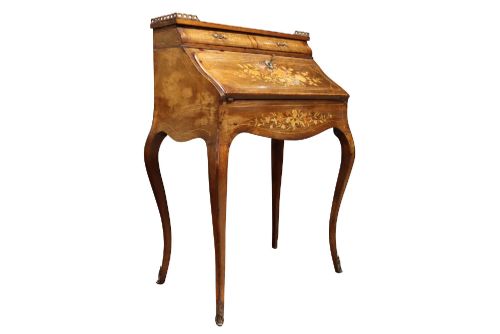
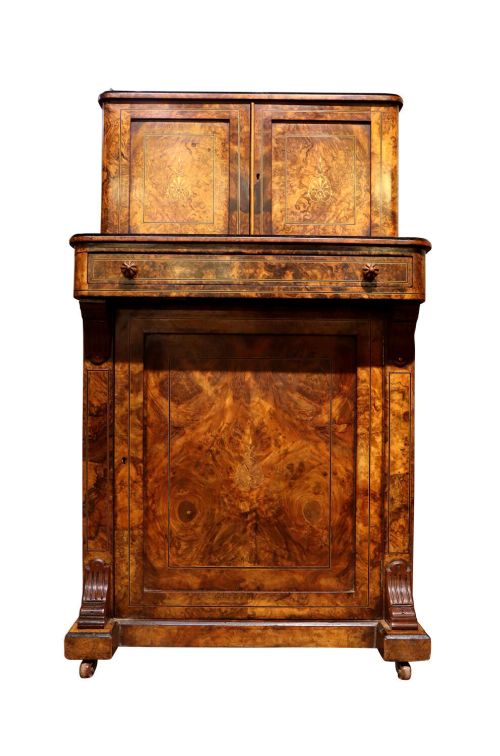
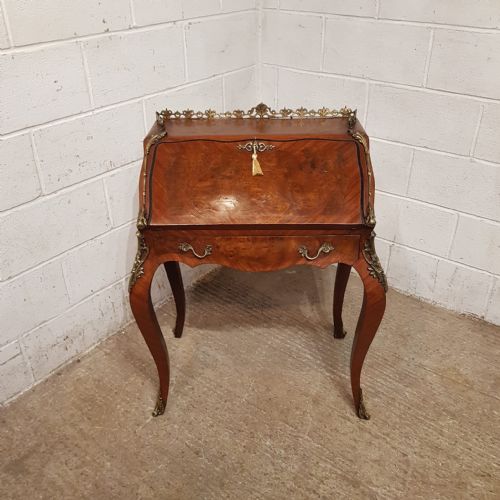


Walnut Bureau De Dame
A walnut bureau de dame offers compact private writing space in beautifully figured wood, perfect for a quiet corner.
Walnut Bureau De Dame
A walnut bureau de dame is a ladies writing desk designed for personal correspondence, combining a small writing surface with internal compartments and drawers. Most examples seen here date from the nineteenth century, including Victorian periods and the year 1870, alongside occasional pieces from 1920 and 1850.
Buyers frequently encounter French Louis XV revival styles and French chateau influences alongside Victorian interpretations. These forms often merge into the related bonheur-du-jour typology, featuring tiered superstructures above the writing flap.
How They Were Made
Cabinet makers utilised solid walnut and highly figured burr walnut veneers over secondary timbers, frequently enhanced by kingwood, amboyna and rosewood borders. Marquetry inlay creates floral and geometric patterns across the main surfaces.
Gilt metal mounts, brass inlay and ormolu framing accent the curves of the Louis XV style desks. Glass panels and mirrors occasionally appear within the upper superstructures of bonheur-du-jour variations.
Listings feature walnut, burr walnut, kingwood and amboyna woods combined with brass inlay, ormolu mounts and glass mirrors.
What Varies in Quality
The choice of veneer defines the visual impact, where densely figured burr walnut and intricate multi-wood marquetry separate superior examples from plain timber. Crisply cast ormolu mounts and finely chased brass details elevate the overall execution.
Structural refinement shows in the smoothness of the fall-front mechanism and the precise fitting of internal pigeonholes and small drawers. Exhibition quality pieces display a higher degree of hand-finishing in both the cabinetry and the metalwork.
Paul Sormani
The Walnut Bureau De Dame Glossary
- Bureau de dame
- A ladies writing desk, typically featuring a sloping fall-front or a cylinder top enclosing a fitted interior. These pieces were designed for domestic correspondence rather than estate administration.
- Bonheur-du-jour
- A light daytime writing desk with a small cabinet or set of shelves fixed to the top surface. The name translates from French as daylight joy.
- Burr walnut
- Wood taken from a tree growth or burl, yielding swirling, highly decorative grain patterns. Cabinet makers prized this timber for veneering prominent exterior surfaces.
- Ormolu
- Gilded bronze mounts applied to furniture for decorative effect. The technique involves mercury amalgamation or electroplating on cast bronze.
- Marquetry
- Inlaid wood veneers arranged to form decorative pictures or geometric patterns. Various coloured timbers create contrast without paint.
Walnut Bureau De Dame: Frequently Asked Questions
What is a bureau de dame?
A bureau de dame is a small ladies writing desk made for private correspondence. It usually includes a sloping writing flap and internal compartments.
These pieces emerged in France during the eighteenth century and remained popular through the Victorian era in walnut and other decorative timbers.
How do I date a walnut desk?
Dating relies on stylistic clues like Louis XV revival curves, construction methods, and secondary woods. Pieces from the 1850 to 1880 Victorian periods often exhibit distinct marquetry and brass inlay.
Later pieces from around 1920 adopt similar French revival aesthetics while showing different interior construction techniques.
Where should I place it?
These compact desks suit reception rooms, bedrooms, or studies where a large partner desk would overwhelm the space. Their finished backs allow them to sit away from walls.
Keep them out of direct sunlight to protect the walnut veneer and prevent the polish from fading.