
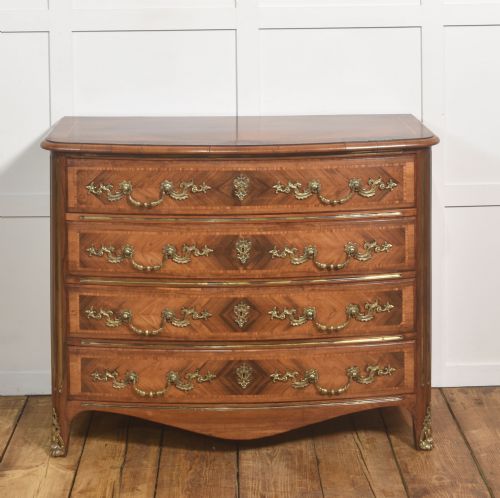
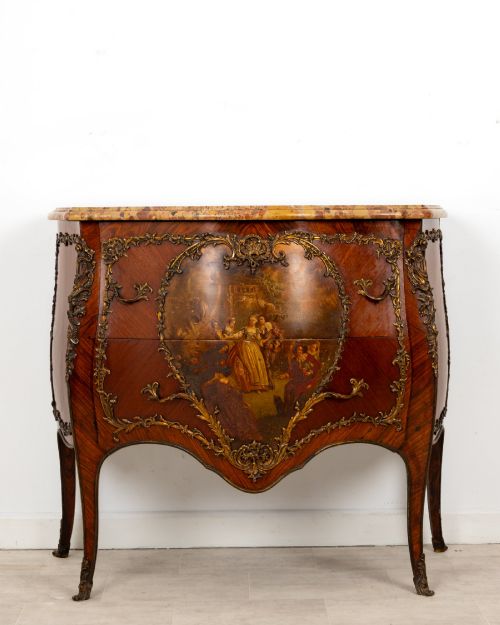
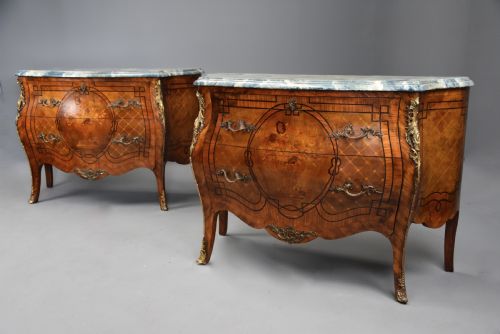
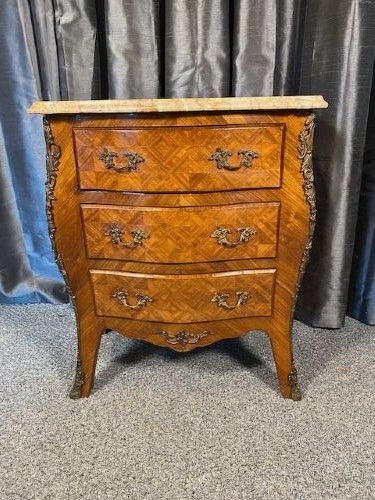
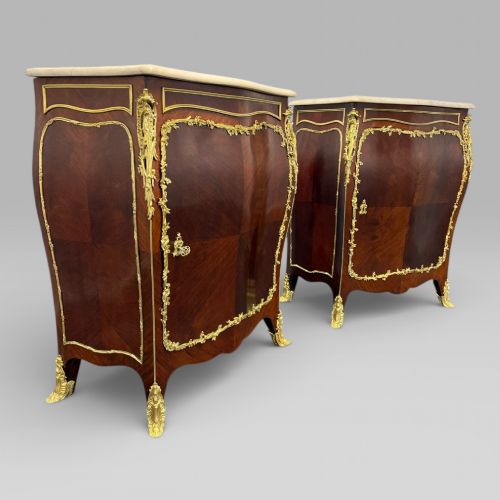
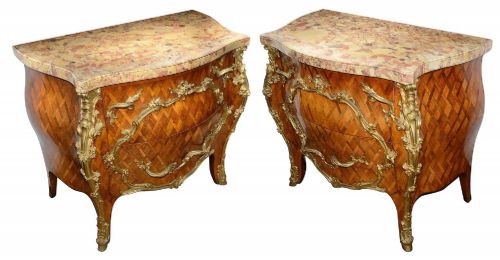
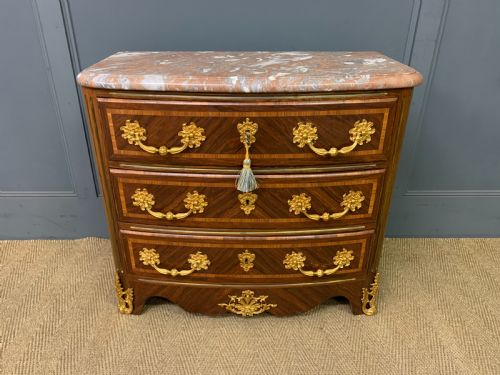
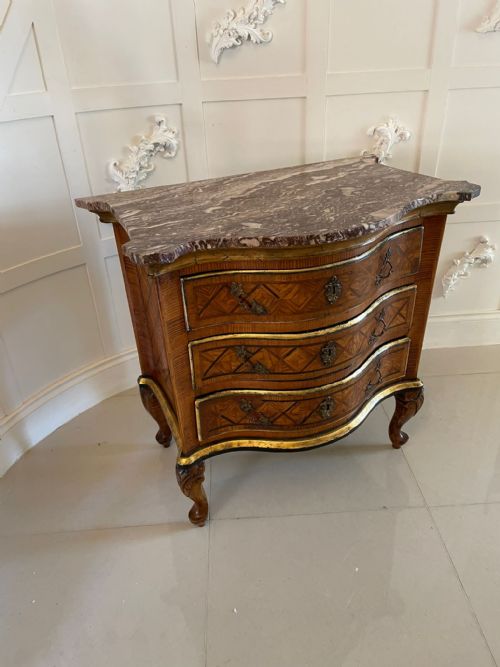


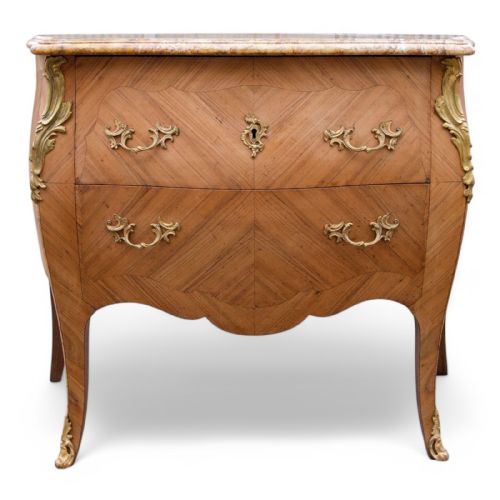


Kingwood Serpentine Commode
A kingwood serpentine commode brings French cabinet-making into a room, combining curved drawer fronts with patterned timber and gilt mounts.
Kingwood Serpentine Commode
A kingwood serpentine commode is a drawer-chest designed with an undulating front curve, commonly seen in French stylistic revivals from the nineteenth century alongside eighteenth-century originals. These pieces function as low storage cabinets, often topped with marble and finished with decorative parquetry or marquetry patterns across the timber surfaces.
The versions most frequently met on this page belong to the nineteenth century, particularly in the Louis XV and Louis XVI styles, constructed with bombe profiles or straight serpentine fronts. Alongside standard room-sized chests of drawers, the selection occasionally includes smaller bedside cabinets, side cabinets, and miniature pieces.
How they were made
Cabinet-makers built these commodes using oak or softwood carcases as a foundation, onto which thin veneers of kingwood were applied in geometric parquetry or floral marquetry arrangements. The characteristic serpentine and bombe shapes required careful cutting and steaming of timber to achieve the flowing contours of the drawer fronts and sides.
Gilt bronze, ormolu, and brass mounts were cast, chased, and fixed to the corners, feet, and handles to accentuate the structural lines of the cabinet. Heavy slabs of marble, including scagliola varieties, were then shaped to fit the undulating upper profile of the commode and laid directly onto the wooden top.
Listings feature commodes spanning the eighteenth to the twentieth centuries, employing kingwood, marble, ormolu, and gilt bronze.
What varies in quality
Quality in a kingwood serpentine commode rests in the crispness of the gilt-bronze mounts and the precision of the underlying timber veneers. Finer examples display hand-chased ormolu details that fit snugly against the curves of the wood, whilst simpler pieces utilise cast mounts with softer definition.
The complexity of the parquetry or marquetry pattern also dictates the standing of a piece, with intricate multi-timber arrangements demanding greater skill from the maker. Furthermore, the thickness and polish of the marble top, alongside the structural integrity of the curved drawers, separates standard production from exceptional workshop output.
E. Kahn·Charles Cressant
The Kingwood Serpentine Commode Glossary
- Kingwood
- A dense, durable timber native to Brazil, prized for its rich brown colour and dark violet or black striping. It was frequently sliced into thin veneers for eighteenth- and nineteenth-century French furniture.
- Serpentine
- A furniture profile featuring a central convex curve flanked by two concave curves, creating an undulating wave effect across the front. This shape requires specialised joinery to match the drawer frames.
- Ormolu
- Gilt bronze applied to furniture mounts and decorative hardware. The process involves creating a mercury-gilding layer over cast bronze to produce a bright, metallic finish.
- Bombe
- A swelling, outward-curving shape found on the sides and fronts of commodes and cabinets. This voluminous profile gained popularity during the French Rococo period.
- Marquetry
- The art of applying veneer pieces in pictorial or geometric patterns onto a structural carcase. Makers used various contrasting woods to build up complex floral or abstract designs.
- Parquetry
- A geometric mosaic of wood veneer arranged in repeating patterns such as cubes, chevrons, or squares. It differs from marquetry by relying on regular, repeating geometric shapes rather than pictorial scenes.
Kingwood Serpentine Commode: Frequently Asked Questions
What is a serpentine commode?
A serpentine commode is a set of drawers featuring a front edge that curves inward and outward in a wavy line. These pieces serve as decorative storage units in living spaces or bedrooms.
Originating largely from French cabinet-making traditions, they combine practical drawer space with sculptural wooden forms and metal mounts.
How do I identify an 18th-century piece?
Eighteenth-century pieces typically show hand-cut dovetailing in the drawer construction and timber shrinkage appropriate to age. The mounts are hand-chased rather than cast mechanically.
Examining the secondary woods inside the carcase helps confirm the period of origin alongside the style of the marquetry.
Why do they have marble tops?
Marble tops provided a durable, stain-resistant surface for washing items or placing decorative objects in period interiors. They also added substantial weight to anchor the wooden commode.
The marble was carved to match the exact undulating contour of the serpentine wooden frame beneath it.
Where should I place a commode?
These commodes suit reception rooms, hallways, or bedrooms where their decorative veneers and gilt mounts can be viewed clearly. Their curved profiles allow them to soften corners in a room layout.
Care should be taken to keep them away from direct sunlight and strong heat sources to protect the kingwood veneer.