

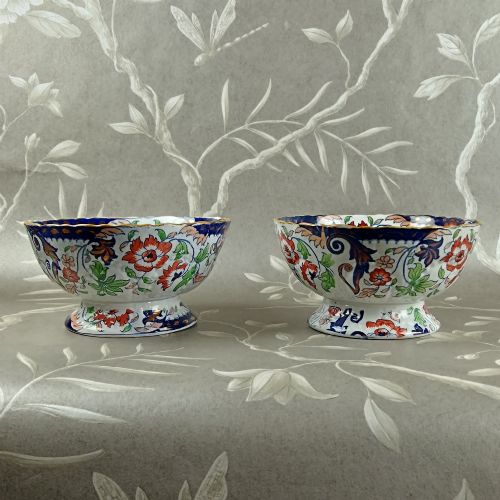
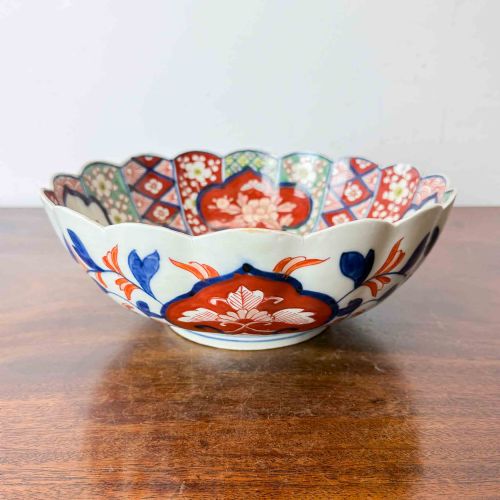
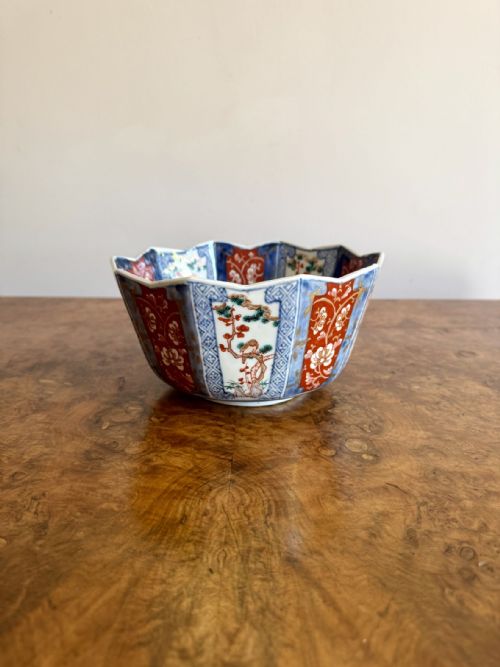


Japanese Imari Centrepiece Bowl
A Japanese imari centrepiece bowl brings bold cobalt blue, rust red and gold leaf into a room, offering the striking presence collectors seek.
Japanese Imari Centrepiece Bowl
A japanese imari centrepiece bowl is a large decorative vessel shaped by historic kiln traditions and finished in striking palettes. The pieces appearing here span the nineteenth century and the year nineteen hundred, encompassing the Meiji period and Edwardian export eras.
Most examples take the form of substantial decorative bowls, including scallop edge variants and large presentation pieces. These items originate from Japanese production centres such as Arita, alongside Edwardian import channels destined for British homes.
How they were made
The foundation of a Japanese imari centrepiece bowl is white porcelain, shaped at the wheel before receiving its primary decoration. Artisans applied cobalt blue pigment beneath the glaze, creating deep tones that define the classic patterns.
After the initial firing, detailed enamels in iron red and supplementary colours were added by hand. Many pieces received final highlights in gold leaf or gilt, fixing the metallic sheen across the patterned surface during a subsequent low-temperature firing.
Materials recorded across the selection include porcelain, enamel, glaze, gold leaf, cobalt blue, gilt and cobalt underglaze.
What varies in quality
The distinction between ordinary and exceptional work rests on the clarity of the underglaze cobalt and the precision of the hand-painted enamel. Superior pieces display crisp brushwork and balanced compositions where the iron red and gold leaf sit harmoniously upon the porcelain body.
Scale and ambition also dictate standing, with large scallop edge centrepiece bowls demanding greater technical control during the high-heat firing process to maintain structural integrity and a true circular or lobed form.
The Japanese Imari Centrepiece Bowl Glossary
- Cobalt Underglaze
- A blue pigment applied directly to the raw porcelain body prior to glazing and firing. This technique protects the pigment beneath a glassy layer, ensuring the blue colour remains bright and stable over centuries.
- Imari
- A style of Japanese export porcelain originating from the port of Imari in Arita. It typically employs a palette of cobalt blue and iron red, frequently enriched with gilt.
- Meiji Period
- The era of Japanese history lasting from eighteen sixty-eight to nineteen twelve. Pieces from this time often exhibit refined technical execution and cater to international export markets.
- Scallop Edge
- A decorative rim shaped into a series of symmetrical curves resembling a scallop shell. This moulding technique appears frequently on large nineteenth-century display bowls.
- Arita
- The Japanese town renowned as the birthplace of porcelain production. Kilns in this region produced the painted wares exported through neighbouring ports.
Japanese Imari Centrepiece Bowl: Frequently Asked Questions
What is a Japanese imari centrepiece bowl?
A Japanese imari centrepiece bowl is a large decorative porcelain vessel featuring traditional hand-painted motifs in cobalt blue, iron red and gold.
These pieces were produced for display in domestic interiors, serving as striking focal points on tables or sideboards.
How do I date a Japanese imari bowl?
Dating relies on stylistic markers, materials and manufacturing context, with pieces here pointing to the nineteenth century and nineteen hundred.
Edwardian export items often reflect British interior tastes of the early twentieth century, while Meiji period pieces align with Japanese imperial-era production.
How were these bowls used historically?
These vessels functioned primarily as decorative centrepieces rather than functional tableware.
Their bold palettes and large scale made them ideal for display in formal reception rooms during the late nineteenth and early twentieth centuries.
What distinguishes Arita imari porcelain?
Arita porcelain is defined by its hard white ceramic body and specialised underglaze and enamel decoration.
Master potters in the Arita region developed the distinctive imari aesthetic that combined local techniques with international export demands.